1. In honor of Trump’s last full day in office, and what may end up being the big story of the day, here’s a quick #thread on the President’s pardon power — and answers to some of the questions about it that may come up today:

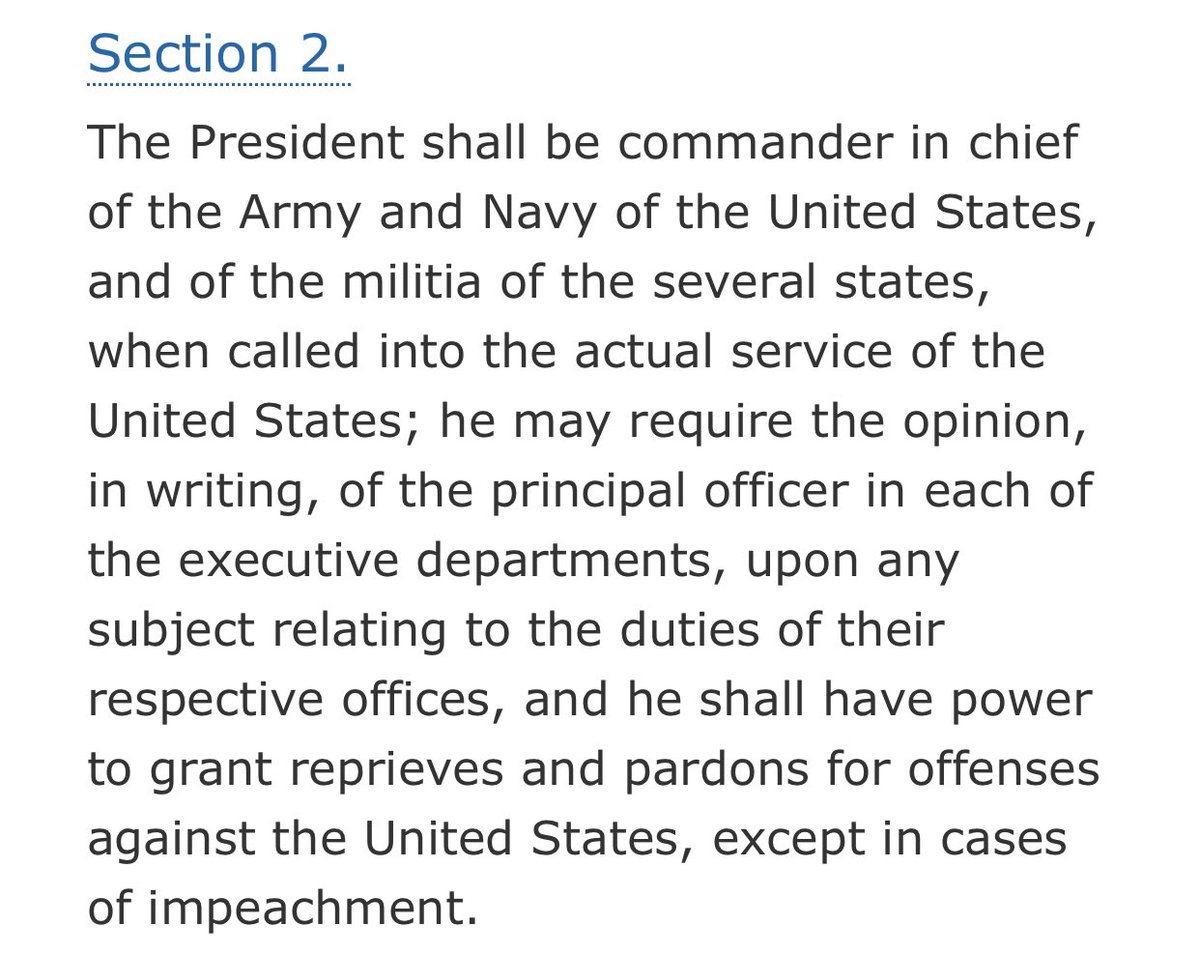
2. Article II, § 2 of the Constitution gives the President the power to “grant reprieves and pardons for offenses against the United States, except in cases of impeachment.”

The idea was to provide the executive with a check on (perceived) excesses by the courts.
3. That’s why the pardon power is absolute; it wouldn’t be much of a check on the courts if they had the power to review every pardon. Instead, the remedy for abuses of the power, as Chief Justice — and former President — Taft wrote for #SCOTUS in 1925, is ... impeachment.
4. But which offenses can be pardoned? The widespread consensus is that the President may pardon any federal offense (this includes “local” crimes in federal territories like D.C.) by anyone *else* that has been committed (even if not charged) prior to the granting of the pardon.
5. This *includes* so-called “blanket” pardons, such as the one President Carter issued on his first full day in office for Vietnam-era draft dodgers:

https://t.co/LlNFIpj3LC
6. What about the exception for “cases of impeachment”?

Some argue that this means that no pardons can be issued *while* the President is under impeachment or for offenses by others that are *related* to the basis for an impeachment.

I (and most scholars) strongly disagree.
7. To me, the exception is best read as part of checks and balances — as preventing the President from mooting an impeachment proceeding by pardoning the offense that provoked impeachment. Otherwise, the President could easily thwart Congress’s impeachment powers through pardons.
8. What about self-pardons? Here, there’s obviously no precedent, but the consensus again is against the President having such the power — because a self-pardon would not have been understood as a pardon at the time the Constitution was enacted.

Trump might still try it, but...
9. That wouldn’t spare him from potential liability under *state* law, and it would put a lot more pressure on the Biden Administration to prosecute him anyway — in order to force the courts to resolve the issue, rather than allowing Trump to create a precedent by default.
10. How about the story @Lawrence reported about “secret” pardons? Is that a thing?

It might be, but I don’t see what would stop the next President from publicizing them (the power is held by the office, after all), or Congress from requiring disclosures of future pardons.
11. What if someone commits a crime to *obtain* a pardon, e.g. bribery?

There’s a rich debate here, but my view, and what I think is the consensus, is that the *pardon* remains valid (it’s absolute, after all), but the offenses related to obtaining it are subject to prosecution.
12. If this seems like an awful lot of power for the President to have, it is. The Founders assumed that it would be exercised responsibly, that having such a check on unelected and mostly unaccountable judges was worth it, and that it would be a basis for impeachment if abused.
13. If nothing else, that underscores the importance of being able to impeach/convict a President after he’s left office.

Otherwise, there’d be no reason not to spend the last day in office grossly abusing this power for personal/political benefit — as Trump may do today.

/end
For a really thoughtful thread that takes a different view on the question of what "except in cases of impeachment" means, see @earlymodjustice:

https://t.co/PYLGNc3q0n

More from Trump

Allow me to offer some commentary on several SCOTUS cases that are NOT the #moab, but which, considered in aggregate, will reveal my impressions on the #TRUMPSMASH #lawOfFunny

Can someone give me a google number or something? I want a party line.

https://t.co/SlJCsjWMUa


I'm sorry, but #lawOFFunny #nominologicaldeterminism.

#thomists


This one is important:
I missed that DOJ has posted the individual certificates listing what offenses Trump pardoned for each person listed in his January 19 master clemency warrant, which had names but didn't spell out the covered crimes. https://t.co/oL44VoCVbr
Here's Steve Bannon's, for example.


Here's Elliot Broidy, a Trump fund-raiser who admitted to a role in a covert campaign to influence the administration on behalf of Chinese and Malaysian interests.

https://t.co/tvpHORLrps


Here's Ken Kurson, a former Giuliani speechwriter and former editor of a newspaper Jared Kushner owned, who had been charged with cyberstalking
https://t.co/HxcexSK4Sc


Here's Aviem Sella, an Israeli who had been a fugitive from 1987 esionage and subversive activities charges related to recruiting a spy against the United States, Jonathan Pollard. (He was never extradited and pardoning him was a favor toNetanyahu.)

https://t.co/neHjN57ok3


Here's Dwayne Michael Carter a/k/a Lil Wayne, who had pleaded guilty to firearm offenses
https://t.co/yixm1fTR2b
1. @NYGovCuomo became a pandemic star by contrasting himself with Trump

Cuomo crafted an IMAGE of being determined, honest and grounded in science

But 11 months later this image is falling apart

Follow along for a FACTUAL assessment of Cuomo's

2. Cuomo WROTE A BOOK, published in October, celebrating his own leadership during the pandemic.

Cuomo writes that NY had "confronted and defeated" the virus, and had "achieved what all the experts told us was impossible."

Today, things look

3. Today, New York has 338 people hospitalized with COVID per million residents.

This is the HIGHEST NUMBER IN ANY STATE by a considerable margin.

https://t.co/Hl4fsFxB6l


4. Overall, 46K New Yorkers have died of COVID, which trails only California (47K), a state with 2x as many people.

On a per capita basis, New York has had more deaths than every state but New Jersey.

Cuomo made decisions that made things

5. A new report by NY AG Letitia James (D) found Cuomo's order requiring nursing homes to accept residents w/COVID "may have put residents at increased risk of harm"

Cuomo dismissed criticisms of his nursing home policies in his book as

You May Also Like

Following @BAUDEGS I have experienced hateful and propagandist tweets time after time. I have been shocked that an academic community would be so reckless with their publications. So I did some research.
The question is:
Is this an official account for Bahcesehir Uni (Bau)?


Bahcesehir Uni, BAU has an official website
https://t.co/ztzX6uj34V which links to their social media, leading to their Twitter account @Bahcesehir

BAU’s official Twitter account


BAU has many departments, which all have separate accounts. Nowhere among them did I find @BAUDEGS
@BAUOrganization @ApplyBAU @adayBAU @BAUAlumniCenter @bahcesehirfbe @baufens @CyprusBau @bauiisbf @bauglobal @bahcesehirebe @BAUintBatumi @BAUiletisim @BAUSaglik @bauebf @TIPBAU

Nowhere among them was @BAUDEGS to find
1/“What would need to be true for you to….X”

Why is this the most powerful question you can ask when attempting to reach an agreement with another human being or organization?

A thread, co-written by @deanmbrody:


2/ First, “X” could be lots of things. Examples: What would need to be true for you to

- “Feel it's in our best interest for me to be CMO"
- “Feel that we’re in a good place as a company”
- “Feel that we’re on the same page”
- “Feel that we both got what we wanted from this deal

3/ Normally, we aren’t that direct. Example from startup/VC land:

Founders leave VC meetings thinking that every VC will invest, but they rarely do.

Worse over, the founders don’t know what they need to do in order to be fundable.

4/ So why should you ask the magic Q?

To get clarity.

You want to know where you stand, and what it takes to get what you want in a way that also gets them what they want.

It also holds them (mentally) accountable once the thing they need becomes true.

5/ Staying in the context of soliciting investors, the question is “what would need to be true for you to want to invest (or partner with us on this journey, etc)?”

Multiple responses to this question are likely to deliver a positive result.