
President Trump has been preparing the public for more than a year now for a major tectonic shift as what the CCP has been doing to us through our own political class is fully exposed.
Including election fraud.
@JoshJPhilipp of @EpochTimes
Sometimes they tell us . . but we fail to listen carefully . .\U0001f914pic.twitter.com/VpJbZQwhsj
— Lawyerforlaws (@lawyer4laws) December 16, 2020
More from Brian The Great
The CCP Virus relieve bill was tacked on to the **annual federal spending package**.
That includes the Defense budget, among other things.
The House of Representatives and the Senate on Monday passed a $900 billion #COVID19relief bill following months of negotiations. It heads to @realDonaldTrump to be signed. The bill is coupled with a $1.4 trillion annual federal spending package.https://t.co/wjkTkIqWcz
— The Epoch Times (@EpochTimes) December 22, 2020
NEW: US election data was forwarded from Frankfurt, Germany to Rome, Italy where the man pictured below partnered with members of MI6, the CIA, & the Italian defense-contractor, Leonardo, led the operation & built the algorithms that were used to manipulate US election data.\U0001f53b pic.twitter.com/m4GtoONps6
— Kanekoa (@KanekoaTheGreat) January 2, 2021
More from Trump

Can someone give me a google number or something? I want a party line.
https://t.co/SlJCsjWMUa
We will be INTERVENING in the Texas (plus many other states) case. This is the big one. Our Country needs a victory!
— Donald J. Trump (@realDonaldTrump) December 9, 2020
I'm sorry, but #lawOFFunny #nominologicaldeterminism.
#thomists

This one is important:


If you incite violence on Twitter, the company can - and should - stop you. Good call.
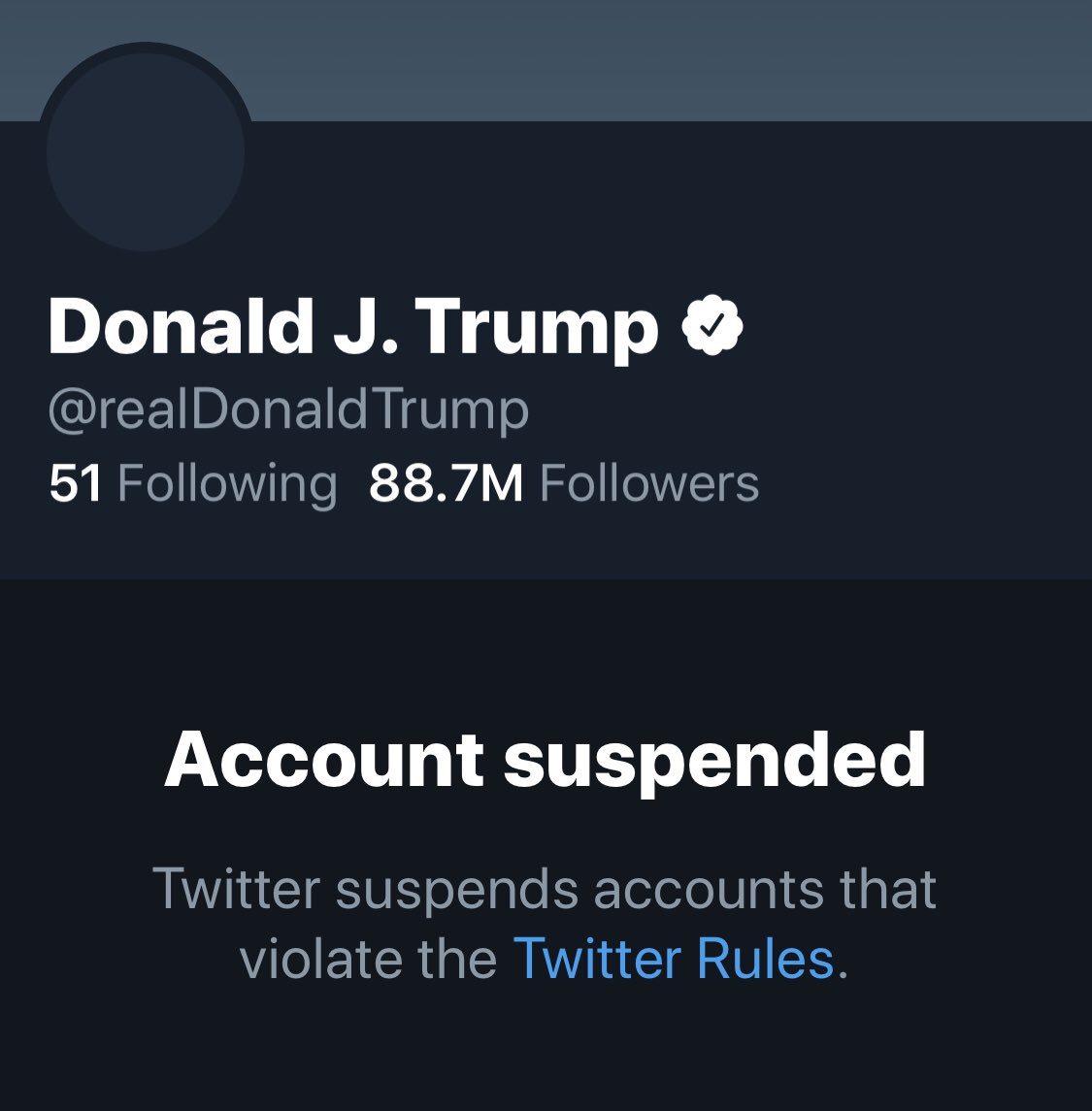
Plans for “future armed protests” are spreading on Twitter and elsewhere, the company warned, “including a proposed secondary attack on the US Capitol and state capitol buildings on January 17, 2021”.
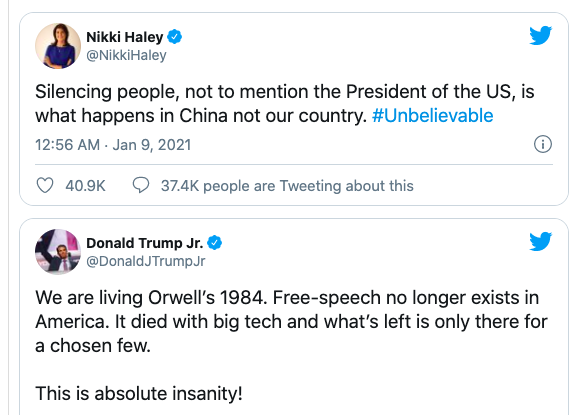
Yes, people who boosted their careers off of Trump - his sycophants, his kids & people like Haley, who helped him attack and undermine human rights around the world - are boo-hooing right now.
Always beware of powerful people pretending to be victims.
https://t.co/0A5D5eJFvL
But no one should react with glee. The president of the United States has been inciting violence, and Republican Party leaders, along with a willing, violent mob, have been aiding his attempts to overthrow the democratic process.
That's the real story here.
The dangers are real, and we've all seen them. That Twitter even had to contemplate banning any politician for inciting violence is awful. That they had to ban the sitting president for it is even worse.


You May Also Like

One thing I've been noticing about responses to today's column is that many people still don't get how strong the forces behind regional divergence are, and how hard to reverse 1/ https://t.co/Ft2aH1NcQt
— Paul Krugman (@paulkrugman) November 20, 2018
See this thing that @lymanstoneky wrote:
And see this thing that I wrote:
And see this book that @JamesFallows wrote:
And see this other thing that I wrote:

Why is this the most powerful question you can ask when attempting to reach an agreement with another human being or organization?
A thread, co-written by @deanmbrody:
Next level tactic when closing a sale, candidate, or investment:
— Erik Torenberg (@eriktorenberg) February 27, 2018
Ask: \u201cWhat needs to be true for you to be all in?\u201d
You'll usually get an explicit answer that you might not get otherwise. It also holds them accountable once the thing they need becomes true.
2/ First, “X” could be lots of things. Examples: What would need to be true for you to
- “Feel it's in our best interest for me to be CMO"
- “Feel that we’re in a good place as a company”
- “Feel that we’re on the same page”
- “Feel that we both got what we wanted from this deal
3/ Normally, we aren’t that direct. Example from startup/VC land:
Founders leave VC meetings thinking that every VC will invest, but they rarely do.
Worse over, the founders don’t know what they need to do in order to be fundable.
4/ So why should you ask the magic Q?
To get clarity.
You want to know where you stand, and what it takes to get what you want in a way that also gets them what they want.
It also holds them (mentally) accountable once the thing they need becomes true.
5/ Staying in the context of soliciting investors, the question is “what would need to be true for you to want to invest (or partner with us on this journey, etc)?”
Multiple responses to this question are likely to deliver a positive result.

As someone\u2019s who\u2019s read the book, this review strikes me as tremendously unfair. It mostly faults Adler for not writing the book the reviewer wishes he had! https://t.co/pqpt5Ziivj
— Teresa M. Bejan (@tmbejan) January 12, 2021
The meat of the criticism is that the history Adler gives is insufficiently critical. Adler describes a few figures who had a great influence on how the modern US university was formed. It's certainly critical: it focuses on the social Darwinism of these figures. 2/x
Other insinuations and suggestions in the review seem wildly off the mark, distorted, or inappropriate-- for example, that the book is clickbaity (it is scholarly) or conservative (hardly) or connected to the events at the Capitol (give me a break). 3/x
The core question: in what sense is classics inherently racist? Classics is old. On Adler's account, it begins in ancient Rome and is revived in the Renaissance. Slavery (Christiansen's primary concern) is also very old. Let's say classics is an education for slaveowners. 4/x
It's worth remembering that literacy itself is elite throughout most of this history. Literacy is, then, also the education of slaveowners. We can honor oral and musical traditions without denying that literacy is, generally, good. 5/x


