THREAD // How I Invest

1. Successful Investing starts with Education
2. Psychology of Trading & General Rules
3. Essentials of Fundamental Analysis
4. Master Technical Analysis
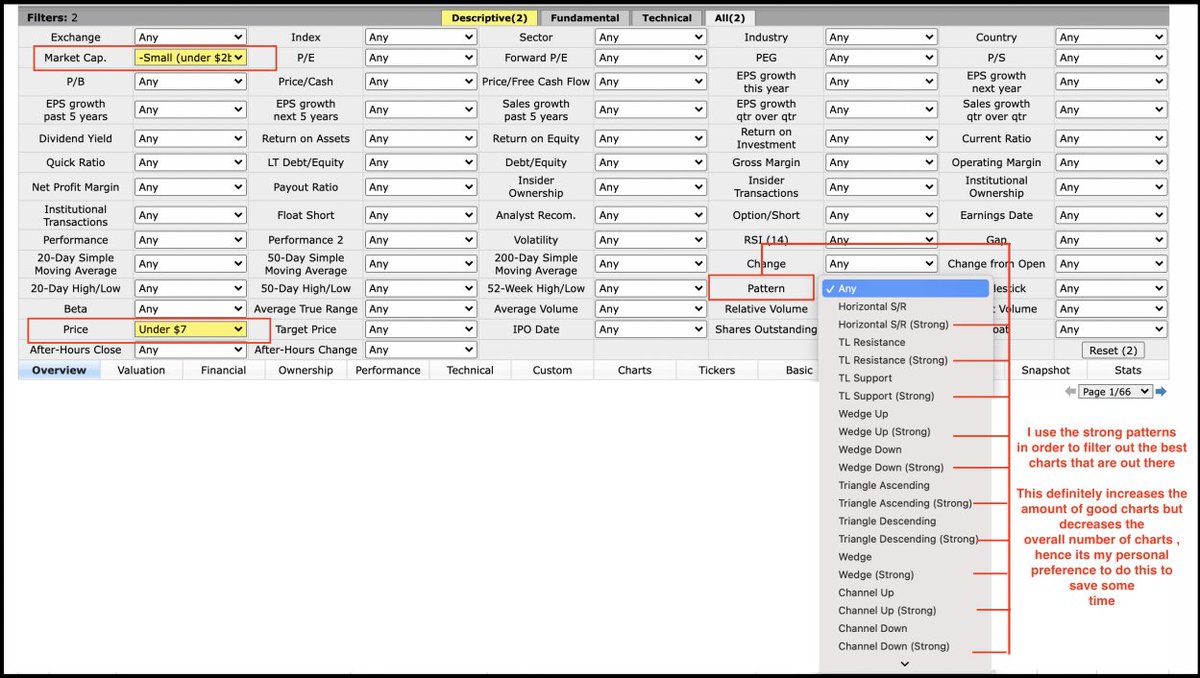
5. Screening for Stocks
6. Making a Watchlist
7. Money Management
8. Diversification of Accounts

1 // Successful Investing starts with Education

Following 2000-2002, I realized that I needed an education to help me understand many of the topics mentioned in this thread.

So, I started to educated myself using books. Seek mentors as well.

Then DO!

https://t.co/zA1m0lxH9n
2 // Psychology of Trading & General Rules

Develop a working SYSTEM (for you)
Preservation of capital
Consistent profitability
Cutting losses short
Superior returns

Understanding “You”:
What is your general personality?
What influences your decisions?
What is your lifestyle?
3a // Essentials of Fundamental Analysis

Earnings Per Share:
1. % Change in Latest Qtr EPS vs. Same QTR Prior Year
2. % Increase in Next Year’s EPS Estimate vs Prior Year’s Actual EPS
3. % Change in Latest EPS, trend past several qtrs
4. Annual % EPS Growth Rate of Last 3 Years
3b // Essentials of Fundamental Analysis

Sales / Revenues
1. % Change Latest Qtr’s Sales vs. Same Qtr Prior Year
2. % Change Latest Reported Fiscal Year Sales vs. Prior Year
3. % Change in Latest Sales, trend past several qtrs
4. Annual % Sales Growth Rate of Last 3 Years
3c // Essentials of Fundamental Analysis

Other items I analyze:

1. Increasing Return on Equity (ROE)
2. Cash flows
3. Net Income
4. Price/Earnings Growth (PEG)
5. Valuation
6. Market Cap & opportunity
7. Institutional Sponsorship
8. New &/or growing product or service
4a // Master Technical Analysis

Preferred graphic is Candlestick Charts
Focus on Daily & Weekly Charts

What to Look for:
1. Properly Forming Bases
2. Major Moving Averages (50d & 200d)
3. Support & resistance areas
4. Volume
5. Pivot Points
6. Breakout Areas
4b // Master Technical Analysis

Always understand breadth: New Highs vs. New Lows Ratio

Extreme readings on NH-NL ratio signal a change in trend coming.

Look for increasing accumulation days (stock up on above average volume).

Zoom out to monthly charts every so often.
5a // Screening for Stocks

1. Quality Stocks making New 52-week Highs
2. Quality Stocks w/ a recent IPO (past few years)
3. Institutional Sponsorship Increasing
4. Quality Stocks trading within 15% of 52-week Highs
5. Quality Stocks within 10% of the 200-day Moving Average
5b // Screening for Stocks

6. Quality stocks with a strong daily &/or weekly close
7. Sales & Earnings rising, QoQ
8. Quality stocks trading between the 50d & 200d ma

*CANSLIM Quality:
Earnings Per Share (EPS) Rating: From 60-99
Relative Price Strength (RS) Rating: From 60-99
6 // Making a Watchlist

Filter stocks up 2% or more
Volume greater than average by at least 50%
Seek stocks that are making multiple screens

Technical criteria:
Identify trend (up or down)
Recognize base
Identify pivot or breakout area
Establish support & resistance levels
7a // Money Management

Position Sizing (Risk Management):

1. Understand “how much” money to trade on each position
2. Know account size & available funds
3. Determine maximum risk per position
4. Never exceed max risk = potential blow up of account
7b // Money Management

Expectancy**:
1. Reliability, % of time one makes money
2. Size of Profits vs Losses
3. Cost of making a trade
4. Opportunity to trade (how often)

** Doesn't always apply to longer term discretionary investors.
8 // Diversification of Accounts

Breakdown of our investments (by size):

1.Long term IRA portfolio
https://t.co/iMuBbtUK4l growth portfolio
3.Crypto portfolio
https://t.co/oZLUkOne6Z stock
5.Index funds

*Real Estate & Business excluded
BOUNS: Interview

https://t.co/6NUnBNb7ck
9 // Presentation

How to Invest While Working Full Time

https://t.co/r6Q4dtoASB
https://t.co/5a8HqA8iHI

More from Tradingthread

I’m using Twitter as my trading journal. Feel free to follow along and learn with me. I’ll post the resources I’ve found most valuable below. I’ve attached my evolving trading rules. As you can see, I am continually learning from my mistakes and feel more prepared each day.


Wave theory resources:

https://t.co/zMLJx0Posg

Recommend checking out @StockDweebs newsletter. I don’t practice wave theory myself but have found his picks highly accurate and like to correlate them with my own.

YouTube channels:

TrendSpider @TrendSpider
smithsintheblack @RobInTheBlack
Sara Sabatino @ssabatino84
_ms_izzy @_ms_izzy
Learn to Day Trade @TrueBubbleHead
StockDweebs @StockDweebs
watchjoshtrade @watchjoshtrade
BullTradeFinder @BullTradeFinder
MagicMike @magicmiketrader
🚨CRASH COURSE THREAD🚨

Below YOU will find a thread to ALL my #InestrTradesCrashCourse!

Please ❤️Like, 🔁Retweet & ✅Follow if you want more videos!

I Will continue to add content to this as I create more crash courses for you guys!

Tools Used:
@unusual_whales

https://t.co/6HpP0YeJoj


https://t.co/It3cOSqxkj


https://t.co/lc7HAXqXKz

You May Also Like

Recently, the @CNIL issued a decision regarding the GDPR compliance of an unknown French adtech company named "Vectaury". It may seem like small fry, but the decision has potential wide-ranging impacts for Google, the IAB framework, and today's adtech. It's thread time! 👇

It's all in French, but if you're up for it you can read:
• Their blog post (lacks the most interesting details):
https://t.co/PHkDcOT1hy
• Their high-level legal decision: https://t.co/hwpiEvjodt
• The full notification: https://t.co/QQB7rfynha

I've read it so you needn't!

Vectaury was collecting geolocation data in order to create profiles (eg. people who often go to this or that type of shop) so as to power ad targeting. They operate through embedded SDKs and ad bidding, making them invisible to users.

The @CNIL notes that profiling based off of geolocation presents particular risks since it reveals people's movements and habits. As risky, the processing requires consent — this will be the heart of their assessment.

Interesting point: they justify the decision in part because of how many people COULD be targeted in this way (rather than how many have — though they note that too). Because it's on a phone, and many have phones, it is considered large-scale processing no matter what.
A THREAD ON @SarangSood

Decoded his way of analysis/logics for everyone to easily understand.

Have covered:
1. Analysis of volatility, how to foresee/signs.
2. Workbook
3. When to sell options
4. Diff category of days
5. How movement of option prices tell us what will happen

1. Keeps following volatility super closely.

Makes 7-8 different strategies to give him a sense of what's going on.

Whichever gives highest profit he trades in.


2. Theta falls when market moves.
Falls where market is headed towards not on our original position.


3. If you're an options seller then sell only when volatility is dropping, there is a high probability of you making the right trade and getting profit as a result

He believes in a market operator, if market mover sells volatility Sarang Sir joins him.


4. Theta decay vs Fall in vega

Sell when Vega is falling rather than for theta decay. You won't be trapped and higher probability of making profit.