A process requires an edge which is simply a statistical advantage you have over other players. A strong psychological state can be considered a bonus edge.
A COMPLETE BREAKDOWN OF MY MOMENTUM DAY TRADING PROCESS.
[THREAD]
A process requires an edge which is simply a statistical advantage you have over other players. A strong psychological state can be considered a bonus edge.
1) Knowledge and idea generation
2) Method and trade execution
3) Risk management and mindset
Each element is necessary and it builds a solid foundation in your trading process.
These factors make up the trading trinity.
In PM, I look for:
- Top gainers (40%+)
- Notable volume on gappers
- News or catalysts (to justify gap)
- Float (<50M)
- Market cap (<500M)
- Range (check daily)
- Price (<25)
- Stock personality (check daily)
- Filings (cash on hand and offering potential)
- https://t.co/dGrDjwtOR8
- https://t.co/Vc256oZCre
- https://t.co/AFrA2ebGr6
- https://t.co/N9nDmqz54E
- https://t.co/0aEt36amzx
- https://t.co/K5b5oercFQ
- https://t.co/VogPh4QNHM
- https://t.co/OoMHVH19CX
I hone in on my top 2.
Also, I have any names that have had momentum and held trend in the prior days as back burner watches since they may see continuation.
I want to identify:
- Prior ranges (since I believe stocks will trade in ranges until they breakout/down)
- Key levels from the daily
- PML and PMH
Also, I take note of the trend and the 50 and 200 SMA.
INDICATORS:
- 9 EMA = Red
- 20 EMA = Light Blue
- 50 SMA = Yellow
- 200 SMA = Green
- VWAP = Purple
- Volume Bars
TIME FRAMES:
- 5 Minute
- 1 Minute
- 1 Day

I prefer to dip buy most of the time because breakout trades require a certain market condition.
I try add as close to major key levels as possible for low risk/high reward.

When it comes down to a channel line or key level. I look to see if price respects that level for an entry with risk just beneath.
I don’t breakout add unless the market is hot. I would rather for a breakout and re-test and get my adds there.
I flick between the 1m and 5m and I mainly watch candle bodies.

Seasonal strategies are simply strategies that are high probability given the current market conditions.
*I go through and explain some strategies in my pinned tweet.
I constantly assess sentiment and I always ask myself: “Who’s in control and who’s stuck?”.
This helps me better understand the price action.
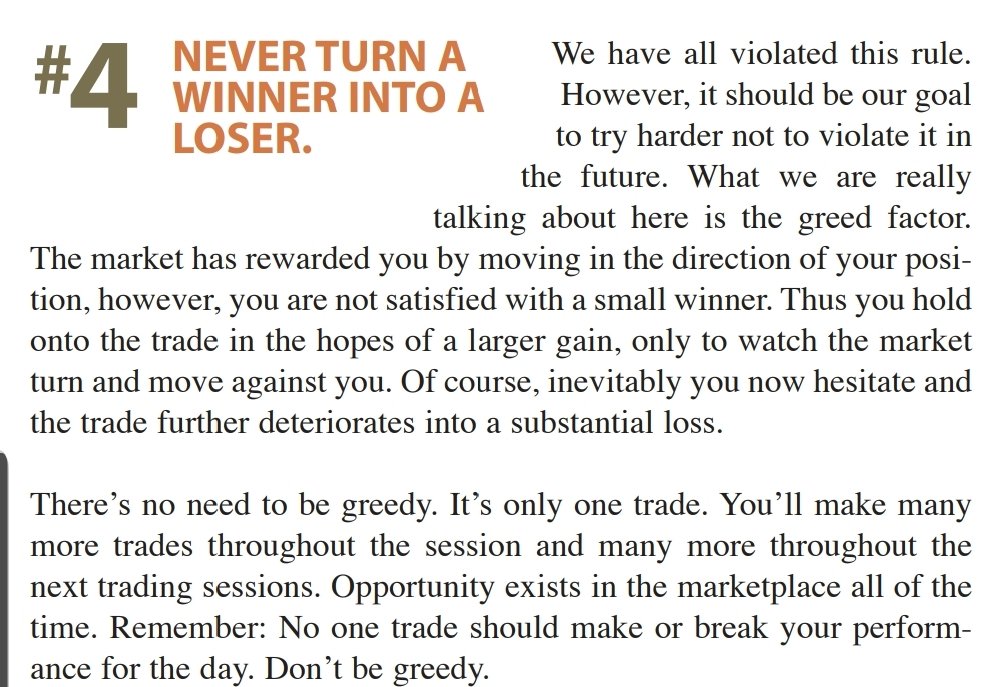
I love asymmetrical bets where risk/reward and probability is skewed heavily in my favor.
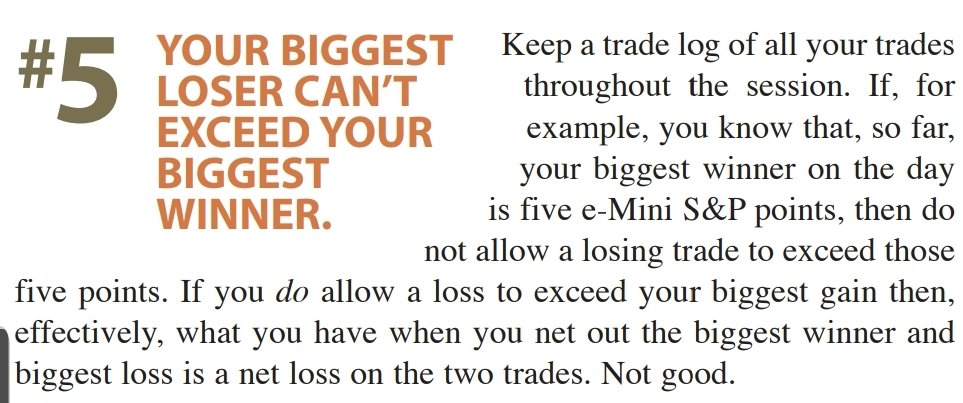
I have a max pain of 10% on a trade and I will risk <2.5% of my account on a trade.

You can calculate position size by:
Max risk / (Entry price - Stop price) = Position size
I believe these levels to be potential pivot points so I’m really strict at cutting my losses because if I carry on holding then price is likely to flush.
I don’t hold bags!
Either I will:
1) Scale most (50%+) on the first target and move my stop to entry
2) Let the stock work and only scale out small amounts (~10%) at key resistances and ride the trend based on the 20 EMA on the 5m
However, I take note of runners that remain strong and AH movers depending on their action and their close.
I will chart these names when market closes. I keep them on back burner watch the next day.
It’s what I find consistency, repeatability and profitability in.
It works for me but it may not work for you.
You can take this thread as a guideline and adapt it to fit your way of trading.
Ideally, I want an ADR% of 10+ because I’m interested in explosive momentum moves.
Also, you always want to keep an eye on volume. You don’t want volume to fall off a cliff for a trade you’re in.

Keep things simple and be able to do them time and time again with ease.
There’s no need to make things complex and sophisticated when they don’t need to be.
It’s better to have something straightforward where you just need to execute well.
In many ways, my strategy is inspired and derived from their own.
More from Tradingthread



You May Also Like





“We don’t negotiate salaries” is a negotiation tactic.
Always. No, your company is not an exception.
A tactic I don’t appreciate at all because of how unfairly it penalizes low-leverage, junior employees, and those loyal enough not to question it, but that’s negotiation for you after all. Weaponized information asymmetry.
Listen to Aditya
And by the way, you should never be worried that an offer would be withdrawn if you politely negotiate.
I have seen this happen *extremely* rarely, mostly to women, and anyway is a giant red flag. It suggests you probably didn’t want to work there.
You wish there was no negotiating so it would all be more fair? I feel you, but it’s not happening.
Instead, negotiate hard, use your privilege, and then go and share numbers with your underrepresented and underpaid colleagues. […]
Always. No, your company is not an exception.
A tactic I don’t appreciate at all because of how unfairly it penalizes low-leverage, junior employees, and those loyal enough not to question it, but that’s negotiation for you after all. Weaponized information asymmetry.
Listen to Aditya
"we don't negotiate salaries" really means "we'd prefer to negotiate massive signing bonuses and equity grants, but we'll negotiate salary if you REALLY insist" https://t.co/80k7nWAMoK
— Aditya Mukerjee, the Otterrific \U0001f3f3\ufe0f\u200d\U0001f308 (@chimeracoder) December 4, 2018
And by the way, you should never be worried that an offer would be withdrawn if you politely negotiate.
I have seen this happen *extremely* rarely, mostly to women, and anyway is a giant red flag. It suggests you probably didn’t want to work there.
You wish there was no negotiating so it would all be more fair? I feel you, but it’s not happening.
Instead, negotiate hard, use your privilege, and then go and share numbers with your underrepresented and underpaid colleagues. […]

Neo-nazi group #PatriotFront held a photo op in #Chicago last weekend & is currently marching around #DC so it's as good time as any to compile a list of their identified members for folks to watch for
Who are these chuds?
Patriot Front broke away from white nationalist org Vanguard America following #unitetheright in #charlottesville after James Alex Fields was seen with a VA shield before driving his car into a crowd, murdering Heather Heyer & injuring dozens of others
Syed Robbie Javid a.k.a. Sayed Robbie Javid or Robbie Javid of Alexandria,
Antoine Bernard Renard (a.k.a. “Charlemagne MD” on Discord) from Rockville, MD.
https://t.co/ykEjdZFDi6

Brandon Troy Higgs, 25, from Reisterstown,
Who are these chuds?
Patriot Front broke away from white nationalist org Vanguard America following #unitetheright in #charlottesville after James Alex Fields was seen with a VA shield before driving his car into a crowd, murdering Heather Heyer & injuring dozens of others
Syed Robbie Javid a.k.a. Sayed Robbie Javid or Robbie Javid of Alexandria,
Happy Monday everyone :-) Let's ring in September by reacquainting ourselves with Virginia neo-Nazi and NSC Dixie affiliate Sayed "Robbie" Javid, now known by "Reform the States". Robbie is an explicitly genocidal neo-Nazi, so lets get to know him a bit better!
— Garfield but Anti-Fascist (@AntifaGarfield) August 31, 2020
CW on this thread pic.twitter.com/3gzxrIo9HD
Antoine Bernard Renard (a.k.a. “Charlemagne MD” on Discord) from Rockville, MD.
https://t.co/ykEjdZFDi6
Brandon Troy Higgs, 25, from Reisterstown,