JANUARY 4, 2021

The first day back at work at the WTO.
What’s happened to the UK’s commitments (“schedules”) on goods (tariffs, tariff quotas, farm support) and services in the WTO now that the Brexit transition is over, and the UK no longer applies the EU’s commitments?

1/12

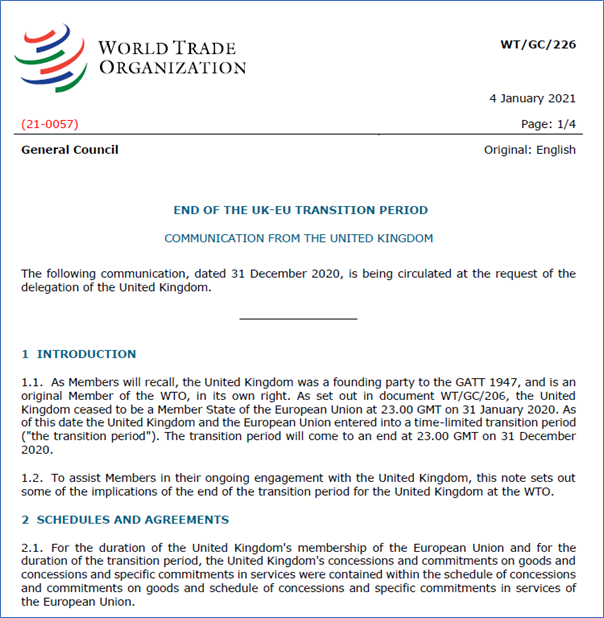
NEW UK DOCUMENT

The UK has circulated a new document outlining the latest situation with the commitments on goods and services, various agreements, applied tariffs and preferences (GSP, UK-EU deal), WTO dispute settlement, trade remedies, laws

https://t.co/DtiObLumJd

2/12
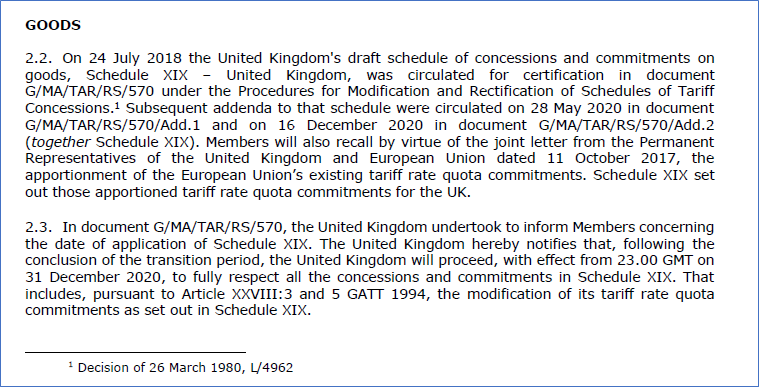
GOODS
Tariffs, tariff quotas, farm support

The UK is now applying the commitments it proposed in 2018 with amendments in May and Dec 2020 (correcting errors) even though they have not been agreed.

5 rounds of talks. Some agreement, or “close” to

https://t.co/DtiObLumJd

3/12
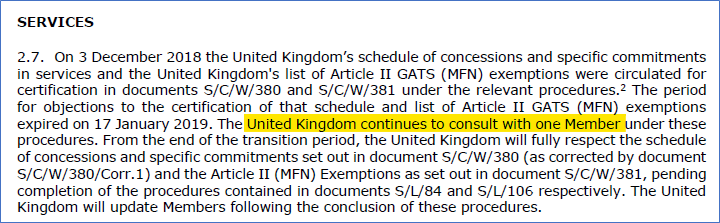
SERVICES

The UK is now also applying its proposed commitments on services. These have not been agreed either, but only one other country (understood to be Russia) is in negotiations with the UK. The rest have not raised objections.

https://t.co/DtiObLumJd

4/12
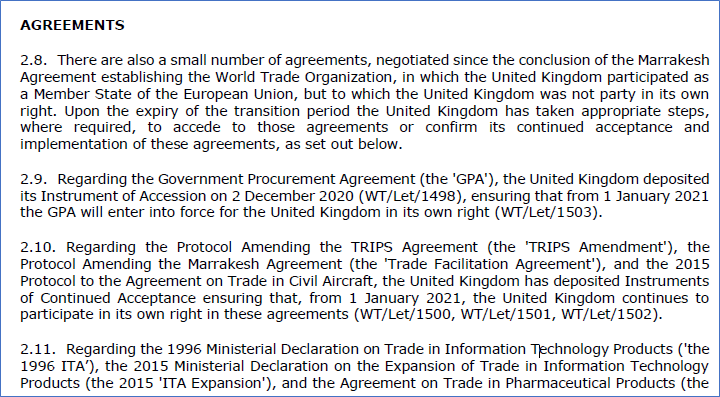
AGREEMENTS

The UK confirms accession/ratification in its own right

● Government Procurement
● intellectual property (amendment)
● Trade Facilitation
● Civil Aircraft
● information technology products (duty-free)
● pharma products (duty-free)

https://t.co/DtiObLumJd

5/12
The rest of the WTO agreements were signed by the UK itself, as well as the EU, so no need to do anything.

But the UK has notified that it is now responsible for the affairs of two bailiwicks in the WTO—Guernsey and Jersey.

Does anyone know why?

https://t.co/DtiObLumJd

6/12
TARIFFS

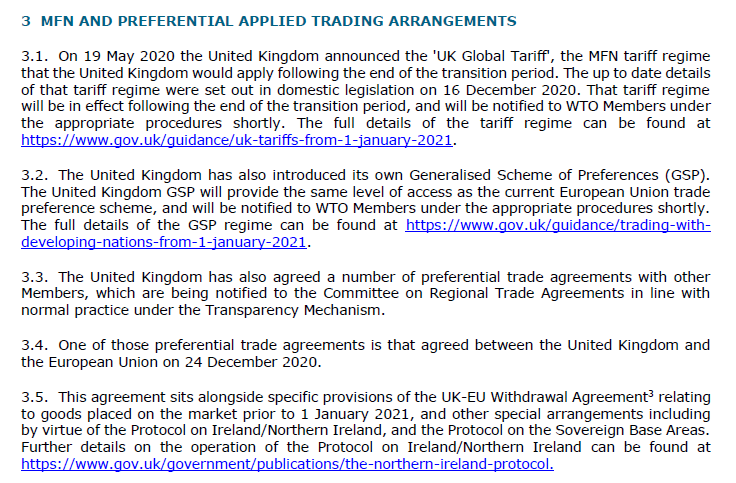
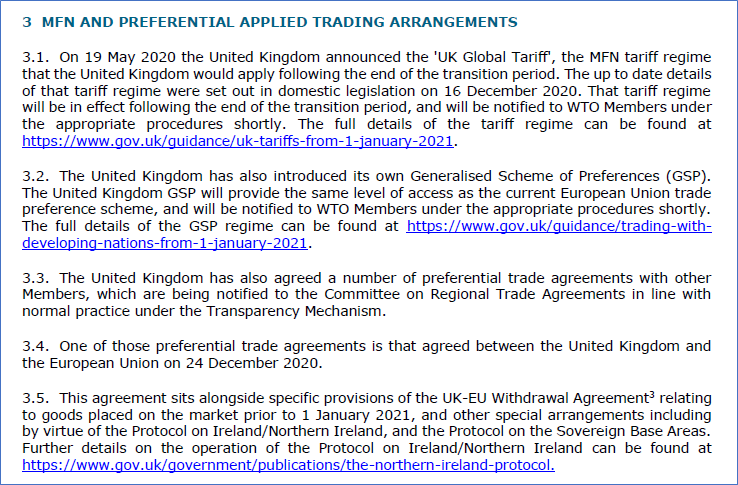
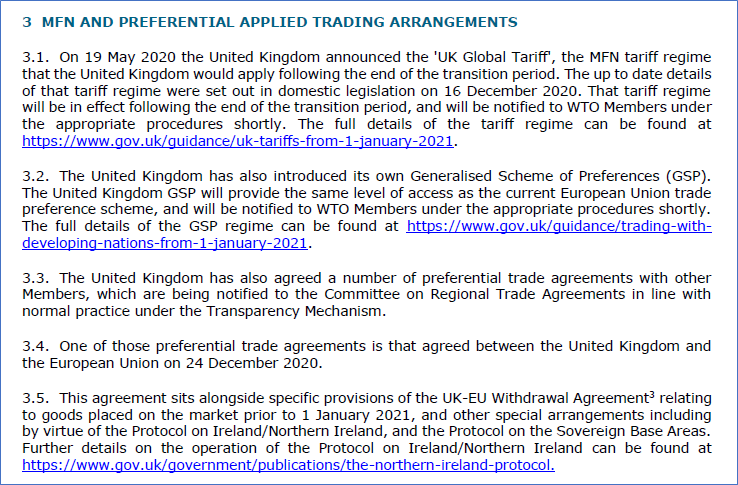
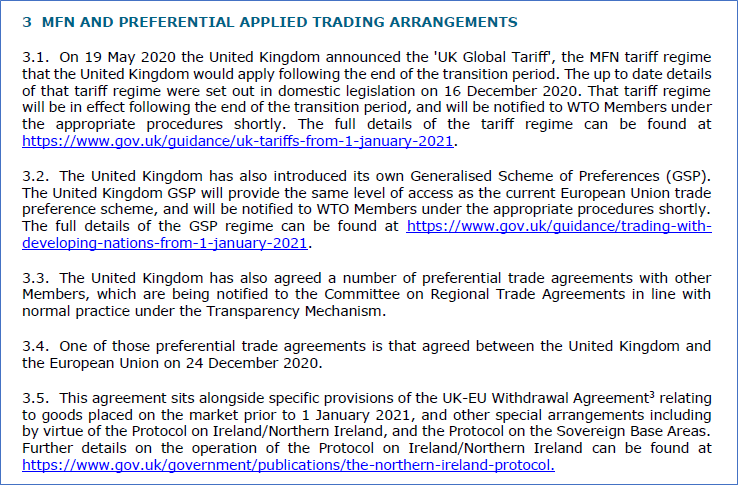
(3.1) The UK “Global Tariff” applies tariffs (which can be below the binding commitments) on imports from countries without preferences (ie “MFN”).

The UK informs WTO members that it will apply these, but not a formal “notification”

https://t.co/DtiObLumJd

7/12
PREFERENCES

(3.2) The UK tells WTO members it is sticking to preferences for developing countries previously given under the EU’s Generalised Scheme of Preferences

(GSPs come from UNCTAD which uses S=System. For some reason UK/EU use S=Scheme)

https://t.co/DtiObLumJd

8/12
FREE TRADE AGREEMENTS (1)

(3.3) The UK will formally notify its free trade agreements [continuity deals + 2] as required. These will be discussed in the WTO Regional Trade Agreements Committee (for transparency only—approval not needed)

https://t.co/DtiObLumJd

9/12
FREE TRADE AGREEMENTS (2)

(3.4, 3.5) The two that are not a continuity agreements are

● the UK-EU post-Brexit agreement. Only the trade parts are relevant to the WTO—not even the fishing rights
● the Withdrawal Agreement with Irish Protocol

https://t.co/DtiObLumJd

10/12
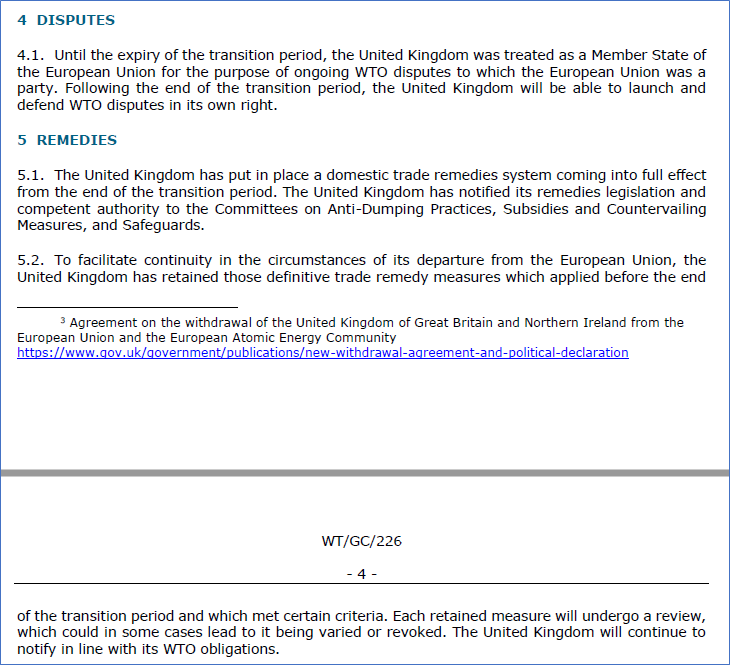
WTO DISPUTE SETTLEMENT
The UK says it can participate as itself instead of through the EU

REMEDIES
The UK now has its own system, notified to the committees on anti-dumping, subsidies and safeguards. Measures applied by the EU: retained & reviewed

https://t.co/DtiObLumJd

11/12
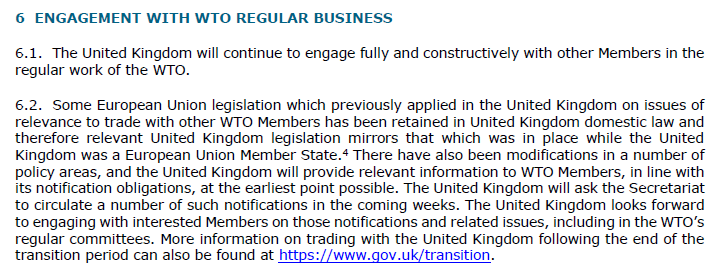
EU LAWS ETC

Many EU laws have been “mirrored” in UK law. There will be modifications. The UK will notify members through the WTO committees as required.

https://t.co/DtiObLumJd

12/12

More from Trading

You May Also Like

THREAD: 12 Things Everyone Should Know About IQ

1. IQ is one of the most heritable psychological traits – that is, individual differences in IQ are strongly associated with individual differences in genes (at least in fairly typical modern environments). https://t.co/3XxzW9bxLE


2. The heritability of IQ *increases* from childhood to adulthood. Meanwhile, the effect of the shared environment largely fades away. In other words, when it comes to IQ, nature becomes more important as we get older, nurture less.
https://t.co/UqtS1lpw3n


3. IQ scores have been increasing for the last century or so, a phenomenon known as the Flynn effect. https://t.co/sCZvCst3hw (N ≈ 4 million)

(Note that the Flynn effect shows that IQ isn't 100% genetic; it doesn't show that it's 100% environmental.)


4. IQ predicts many important real world outcomes.

For example, though far from perfect, IQ is the single-best predictor of job performance we have – much better than Emotional Intelligence, the Big Five, Grit, etc. https://t.co/rKUgKDAAVx https://t.co/DWbVI8QSU3


5. Higher IQ is associated with a lower risk of death from most causes, including cardiovascular disease, respiratory disease, most forms of cancer, homicide, suicide, and accident. https://t.co/PJjGNyeQRA (N = 728,160)
1/“What would need to be true for you to….X”

Why is this the most powerful question you can ask when attempting to reach an agreement with another human being or organization?

A thread, co-written by @deanmbrody:


2/ First, “X” could be lots of things. Examples: What would need to be true for you to

- “Feel it's in our best interest for me to be CMO"
- “Feel that we’re in a good place as a company”
- “Feel that we’re on the same page”
- “Feel that we both got what we wanted from this deal

3/ Normally, we aren’t that direct. Example from startup/VC land:

Founders leave VC meetings thinking that every VC will invest, but they rarely do.

Worse over, the founders don’t know what they need to do in order to be fundable.

4/ So why should you ask the magic Q?

To get clarity.

You want to know where you stand, and what it takes to get what you want in a way that also gets them what they want.

It also holds them (mentally) accountable once the thing they need becomes true.

5/ Staying in the context of soliciting investors, the question is “what would need to be true for you to want to invest (or partner with us on this journey, etc)?”

Multiple responses to this question are likely to deliver a positive result.