There are two main ways these days can go.
How to deal with Deep Red/ Reversal Days (Thread)
There are two main ways these days can go.
It’s key to understand that emotion can never be eliminated from your trading, that isn’t the goal and is not achievable.
How are leadership stocks acting in the overall context? Are they above 21DMA, near 21DMA, above 10DMA (considered extended).
For your own positions, you should know their trends, profit cushion, position size, etc...
Grading your stocks is extremely helpful. Your worst stocks should be trimmed first when you feel portfolio pressure.
How to Grade your Stocks @mwebster1971
https://t.co/VkaCCJhdiu
Know your best and worst stocks, key levels for the market, and have a pre-made plan to lower or increase exposure depending on what happens.
Setting alerts is extremely helpful here.
As mentioned before, it's not just your positions that need to be managed but also your emotions.
This way you can keep track of your current state of mind and relate the current environment to past instances.
These are the strongest stocks and making a list and keeping track of these will benefit you when the market pressure lifts.
https://t.co/zDX4FvqVLk
However, if the market retraces and then reverses back up quickly, it is possible that it was just a shakeout.
Note stocks that bounced back quickly when the market rebounded, formed higher lows intraday. Sort your lists by % from the low and by highest daily closing ranges.
If you were stopped out of a stock and it comes back through your sell point, consider buying it back if that meets your system/plans.
More from TraderLion
The market’s best investors have made millions from the simple saying:
“Buy right, sit tight”
Sounds simple - but what does “buying right” even mean?
Use TraderLion's 10-Step Ultimate Guide to buying right 👇
By the end of this thread, you'll know how to:
1. Build an objective list of buy criteria
2. Have 10+ real world examples to study
3. Increase your win rate.
4. Increase your profitability
Let's dive in!
Buy Rule #1: The General market must be in an uptrend.
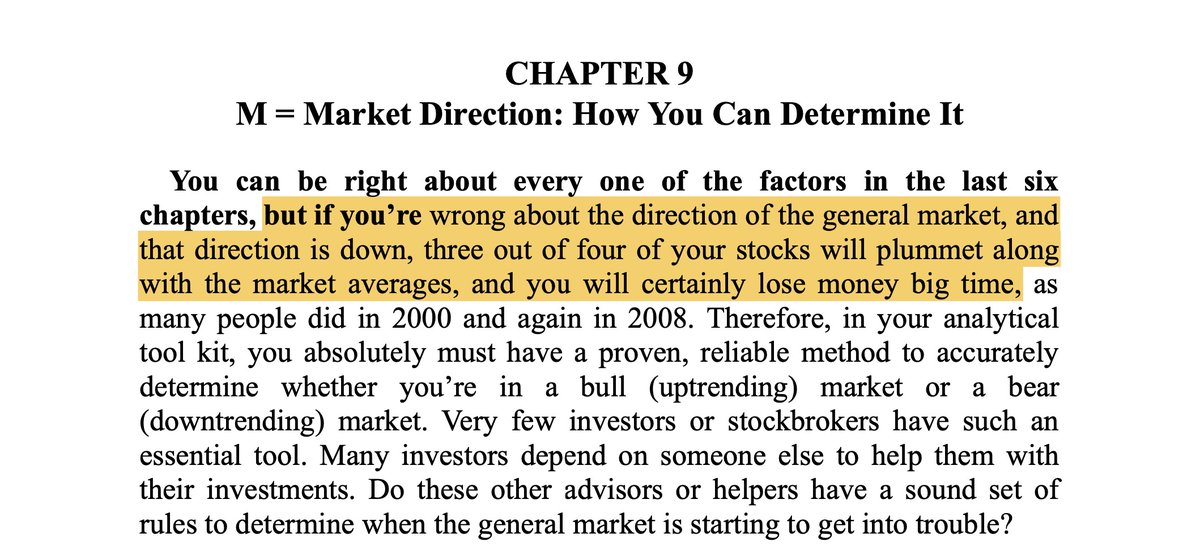
3 out of every 4 stocks follow the market trend both to the upside and to the downside.
This means that if you are buying a breakout in a downtrend, it already has a 75% chance of failing!
It doesn't matter if the stock is in a leading group with an impressive RS line and strong fundamental story.
At the end of the day, market direction is the MOST important factor!
Here's an excerpt from How To Make Money In Stocks by stock market legend William O'Neil:
Here's another video by @richardmoglen that will help you determine if the stock market is in a downtrend:
https://t.co/shD5OjkP6s
Let's move on to #2.
“Buy right, sit tight”
Sounds simple - but what does “buying right” even mean?
Use TraderLion's 10-Step Ultimate Guide to buying right 👇
By the end of this thread, you'll know how to:
1. Build an objective list of buy criteria
2. Have 10+ real world examples to study
3. Increase your win rate.
4. Increase your profitability
Let's dive in!
Buy Rule #1: The General market must be in an uptrend.
3 out of every 4 stocks follow the market trend both to the upside and to the downside.
This means that if you are buying a breakout in a downtrend, it already has a 75% chance of failing!
It doesn't matter if the stock is in a leading group with an impressive RS line and strong fundamental story.
At the end of the day, market direction is the MOST important factor!
Here's an excerpt from How To Make Money In Stocks by stock market legend William O'Neil:
Here's another video by @richardmoglen that will help you determine if the stock market is in a downtrend:
https://t.co/shD5OjkP6s
Let's move on to #2.