If you've followed me in the past you know that I've talked a lot about Xbox is moving beyond the console and has a goal to offer multiple entry points into its ecosystem, with Game Pass being the main entry point into its software and services ecosystem.
https://t.co/CfEWbDyKB6
This strategy makes a lot of sense on paper, but is proving difficult for Microsoft to execute in the short term.
The aim is to scale Game Pass as a service to reach the entire gaming audience via multiple console offerings, but also beyond console via PC & Mobile (Cloud) etc.
It's also why Xbox has plans to extend Game Pass + xCloud to iOS, Windows and other devices (Smart TV's) in the future.
Its investment in studios and IP aims to increase the value prop of Game Pass, with multiple AAA titles available on the service day 1.
All for $15pm.
Game Pass has already grown to 15 million subscribers, but it's worth noting that the majority of these subs are also Xbox console players.
The goal of reaching the broader gaming audience beyond console will take some time to fully execute for a number of reasons:
For example, cloud gaming isn't viable for everyone just yet. It's currently being used by existing console players to extend play to other devices.
Even with recent acquisitions, Game Pass doesn't have a steady flow of day 1 AAA content just yet (Halo delay).
With this in mind I want to refer to an old thread I wrote last year about how Xbox wants to grow beyond console, but how it also needs to maintain and grow its console business too
The majority of its revenue is still derived from its console business
https://t.co/i5cSqdUnpe
Right now, Xbox is focusing all its efforts on transitioning existing and new console players to Game Pass. Hence all the incentives over the past years
It's long term goal, as above, is to grow Game Pass subscribers off console or via low cost hardware like Series S for example
Xbox needs its console user base on GP for it to remain viable in the short term, given the costs associated
Game Pass is designed to generate higher revenue per user on console than a user with Gold. It also locks people in at single monthly price, not a discounted annual price
Xbox knows they have two issues right now.
1. A lack of scale not just on console, but beyond console. (The former referring to installed base vs PS4/5. This is also why Xbox has Series S now)
2. Not everyone (millions) has converted from Gold to Game Pass Ultimate on console.
The company has been exploring multiple ways to solve this issue.
Removing Gold doesn't guarantee those users sign up to Game Pass.
Making Gold part of a lower Game Pass tier disincentivizes the upgrade to Game Pass Ultimate.
So what was the solution announced yesterday?
Double the cost of Xbox Live Gold over a 12 month period.
Why?
- The assumption that most users well see the value in upgrading to a Game Pass Ultimate sub.
- Even if some do not shift, the assumption is they stay on Gold at the higher cost, which increases sub revenue anyway.
The simple fact is that everything Microsoft does or has done recently revolves around trying to get as many people to sign up to Game Pass as they can.
The company needs as many core console players as possible on the service while it gears up to acquire new users long term.
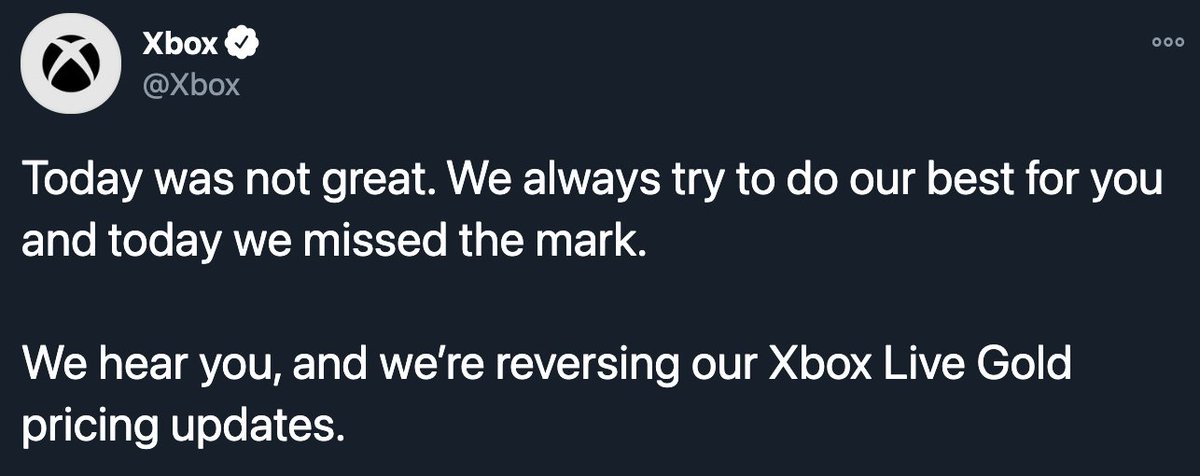
The reversal shows that Xbox is indeed responsive to criticism of how it is achieving its goals, as it does not want to have a repeat of the Xbox One launch debacle, but it should be noted that Xbox will continue to find a solution to increase the revenue per user on console.
The F2P announcement has been in the works for months and that announcement was dropped today to help offset the backlash from the original price increase announcement.
Microsoft will continue its focus on Game Pass moving forward, and its acquisition of IP for the service.