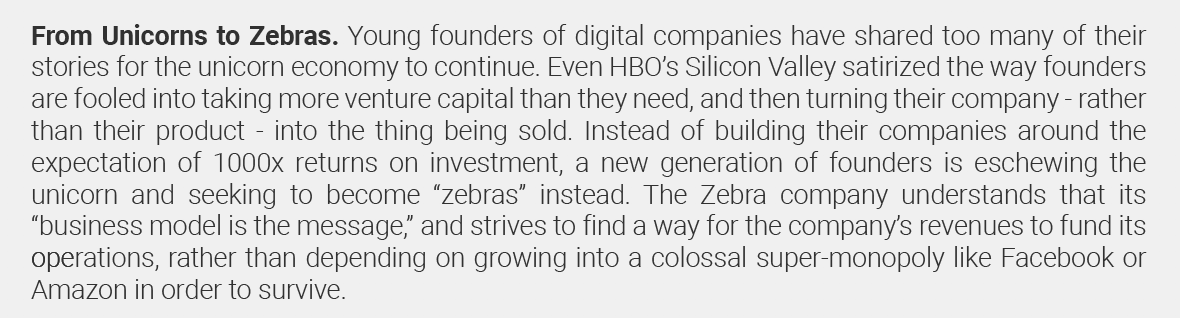
Because our feed has been blowing up about the injustice of Zebras Unite (uh, that's us) being erased from this article about...uh, us in @TechCrunch we are going to do a thread about what we know and how this happened. tl;dr: Follow the money. https://t.co/f4CaGJwN8n


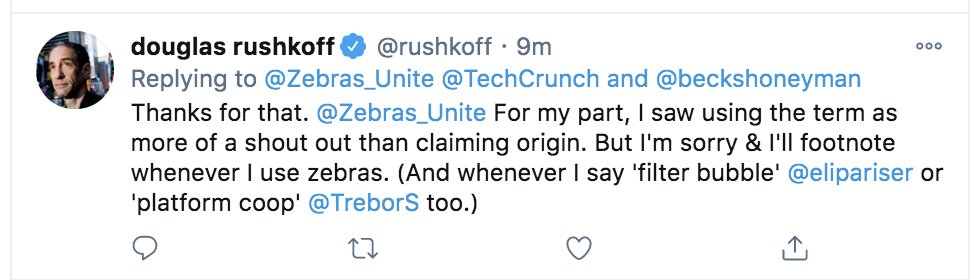
Thanks for that. @Zebras_Unite For my part, I saw using the term as more of a shout out than claiming origin. But I'm sorry & I'll footnote whenever I use zebras. (And whenever I say 'filter bubble' @elipariser or 'platform coop' @TreborS too.)
— douglas rushkoff (@rushkoff) December 22, 2020

More from Tech


The entire discussion around Facebook’s disclosures of what happened in 2016 is very frustrating. No exec stopped any investigations, but there were a lot of heated discussions about what to publish and when.
In the spring and summer of 2016, as reported by the Times, activity we traced to GRU was reported to the FBI. This was the standard model of interaction companies used for nation-state attacks against likely US targeted.
In the Spring of 2017, after a deep dive into the Fake News phenomena, the security team wanted to publish an update that covered what we had learned. At this point, we didn’t have any advertising content or the big IRA cluster, but we did know about the GRU model.
This report when through dozens of edits as different equities were represented. I did not have any meetings with Sheryl on the paper, but I can’t speak to whether she was in the loop with my higher-ups.
In the end, the difficult question of attribution was settled by us pointing to the DNI report instead of saying Russia or GRU directly. In my pre-briefs with members of Congress, I made it clear that we believed this action was GRU.
The story doesn\u2019t say you were told not to... it says you did so without approval and they tried to obfuscate what you found. Is that true?
— Sarah Frier (@sarahfrier) November 15, 2018
In the spring and summer of 2016, as reported by the Times, activity we traced to GRU was reported to the FBI. This was the standard model of interaction companies used for nation-state attacks against likely US targeted.
In the Spring of 2017, after a deep dive into the Fake News phenomena, the security team wanted to publish an update that covered what we had learned. At this point, we didn’t have any advertising content or the big IRA cluster, but we did know about the GRU model.
This report when through dozens of edits as different equities were represented. I did not have any meetings with Sheryl on the paper, but I can’t speak to whether she was in the loop with my higher-ups.
In the end, the difficult question of attribution was settled by us pointing to the DNI report instead of saying Russia or GRU directly. In my pre-briefs with members of Congress, I made it clear that we believed this action was GRU.


1. One of the best changes in recent years is the GOP abandoning libertarianism. Here's GOP Rep. Greg Steube: “I do think there is an appetite amongst Republicans, if the Dems wanted to try to break up Big Tech, I think there is support for that."
2. And @RepKenBuck, who offered a thoughtful Third Way report on antitrust law in 2020, weighed in quite reasonably on Biden antitrust frameworks.
3. I believe this change is sincere because it's so pervasive and beginning to result in real policy changes. Example: The North Dakota GOP is taking on Apple's app store.
4. And yet there's a problem. The GOP establishment is still pro-big tech. Trump, despite some of his instincts, appointed pro-monopoly antitrust enforcers. Antitrust chief Makan Delrahim helped big tech, and the antitrust case happened bc he was recused.
5. At the other sleepy antitrust agency, the Federal Trade Commission, Trump appointed commissioners
@FTCPhillips and @CSWilsonFTC are both pro-monopoly. Both voted *against* the antitrust case on FB. That case was 3-2, with a GOP Chair and 2 Dems teaming up against 2 Rs.
2. And @RepKenBuck, who offered a thoughtful Third Way report on antitrust law in 2020, weighed in quite reasonably on Biden antitrust frameworks.
3. I believe this change is sincere because it's so pervasive and beginning to result in real policy changes. Example: The North Dakota GOP is taking on Apple's app store.
Republican North Dakota legislators have introduced #SB2333, a bill that prohibits large tech companies from locking their users into a single app store or payment processor.https://t.co/PgyhgOhFAl
— Cory Doctorow #BLM (@doctorow) February 11, 2021
1/ pic.twitter.com/KZ8BMFQoPO
4. And yet there's a problem. The GOP establishment is still pro-big tech. Trump, despite some of his instincts, appointed pro-monopoly antitrust enforcers. Antitrust chief Makan Delrahim helped big tech, and the antitrust case happened bc he was recused.
5. At the other sleepy antitrust agency, the Federal Trade Commission, Trump appointed commissioners
@FTCPhillips and @CSWilsonFTC are both pro-monopoly. Both voted *against* the antitrust case on FB. That case was 3-2, with a GOP Chair and 2 Dems teaming up against 2 Rs.