[1/4] Ok this is really funny, check this out.
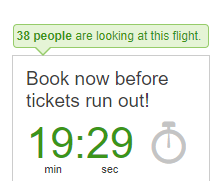
I was in the process of booking a flight via @OneTravel. Trying to make me book ASAP, they claimed: "38 people are looking at this flight".

Whoa, 38 is a lot, I have to hurry up. But first I have to check how they came up with 38 >>

[2/4] Right click and a quick "inspect" on the number, I found out the element's class name is "view_notification_random".
Awesome variable naming guys.
So you're _randomly_ trying to freak me out. Alright >>
[3/4] So what's your sophisticated pseudo-random algorithm?
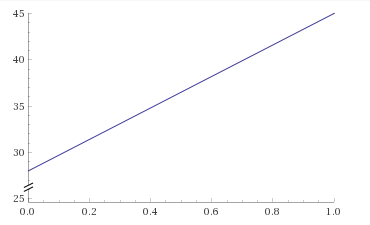
Apparently, OneTravel are choosing a number between 28 and 45.
Because as you all know, based on serious psychological research, these numbers tend to make people book their flights fast #sarcasm #not42 >>
[4/4] Here's a bonus graph.
Thanks @IddoYadlin and #WolframAlpha.

More from Tech

Recently, the @CNIL issued a decision regarding the GDPR compliance of an unknown French adtech company named "Vectaury". It may seem like small fry, but the decision has potential wide-ranging impacts for Google, the IAB framework, and today's adtech. It's thread time! 👇

It's all in French, but if you're up for it you can read:
• Their blog post (lacks the most interesting details):
https://t.co/PHkDcOT1hy
• Their high-level legal decision: https://t.co/hwpiEvjodt
• The full notification: https://t.co/QQB7rfynha

I've read it so you needn't!

Vectaury was collecting geolocation data in order to create profiles (eg. people who often go to this or that type of shop) so as to power ad targeting. They operate through embedded SDKs and ad bidding, making them invisible to users.

The @CNIL notes that profiling based off of geolocation presents particular risks since it reveals people's movements and habits. As risky, the processing requires consent — this will be the heart of their assessment.

Interesting point: they justify the decision in part because of how many people COULD be targeted in this way (rather than how many have — though they note that too). Because it's on a phone, and many have phones, it is considered large-scale processing no matter what.
Ok, I’ve told this story a few times, but maybe never here. Here we go. 🧵👇


I was about 6. I was in the car with my mother. We were driving a few hours from home to go to Orlando. My parents were letting me audition for a tv show. It would end up being my first job. I was very excited. But, in the meantime we drove and listened to Rush’s show.

There was some sort of trivia question they posed to the audience. I don’t remember what the riddle was, but I remember I knew the answer right away. It was phrased in this way that was somehow just simpler to see from a kid’s perspective. The answer was CAROUSEL. I was elated.

My mother was THRILLED. She insisted that we call Into the show using her “for emergencies only” giant cell phone. It was this phone:


I called in. The phone rang for a while, but someone answered. It was an impatient-sounding dude. The screener. I said I had the trivia answer. He wasn’t charmed, I could hear him rolling his eyes. He asked me what it was. I told him. “Please hold.”

You May Also Like