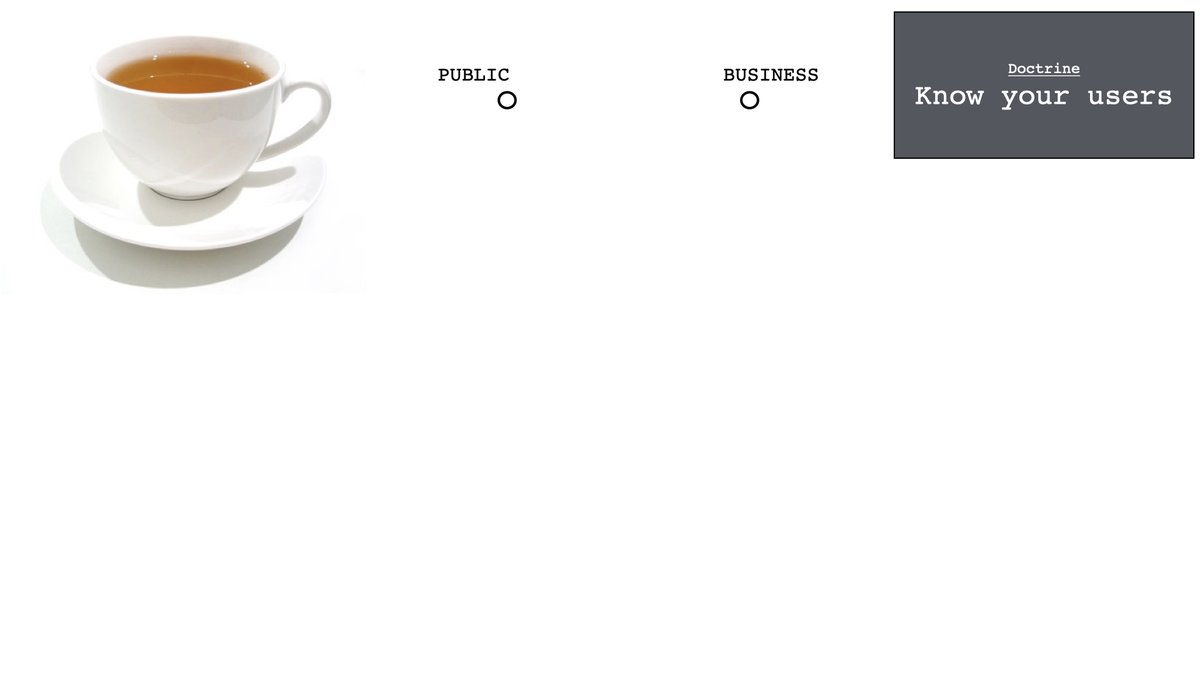
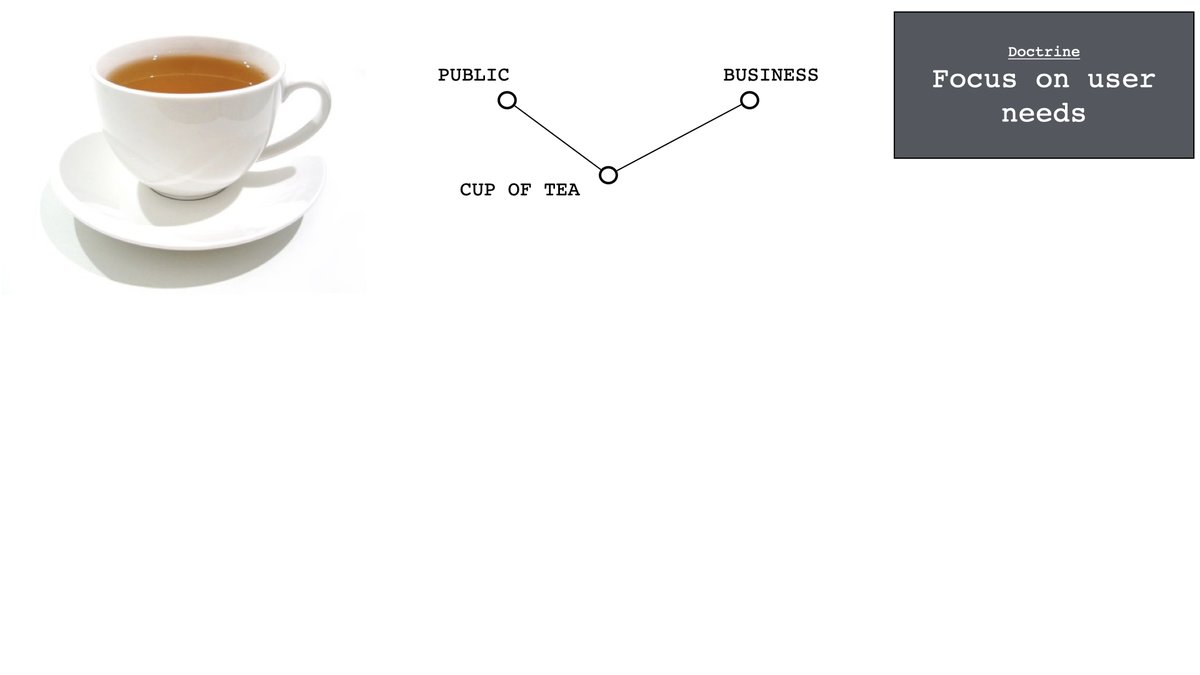
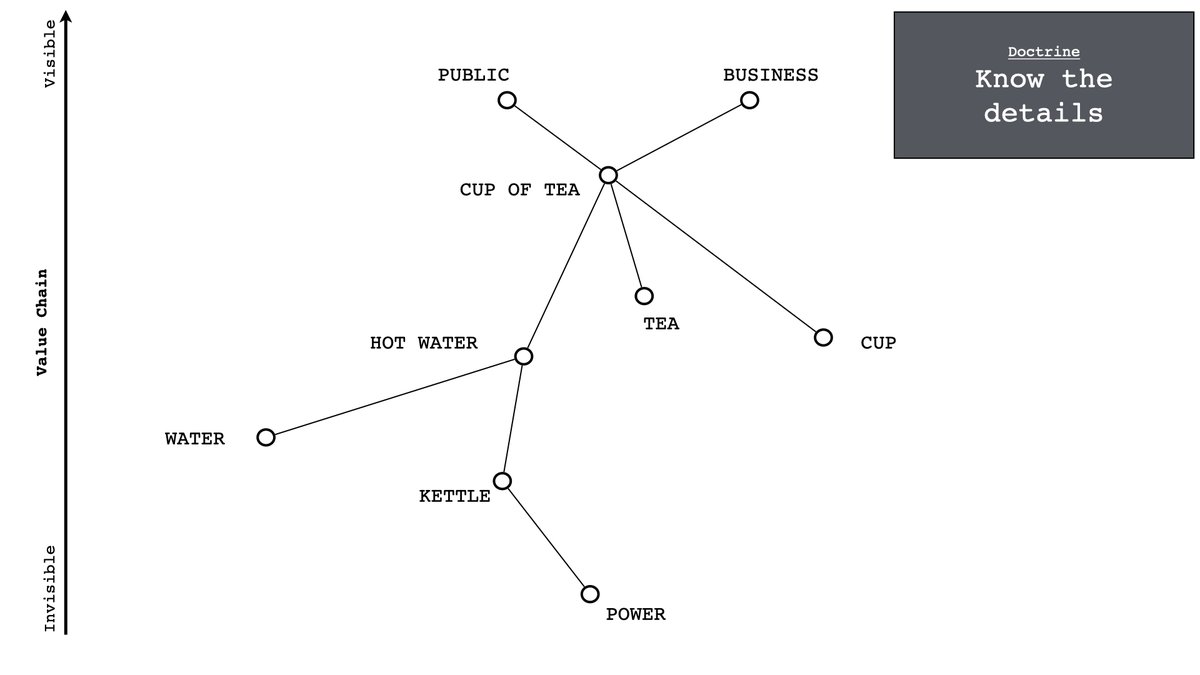
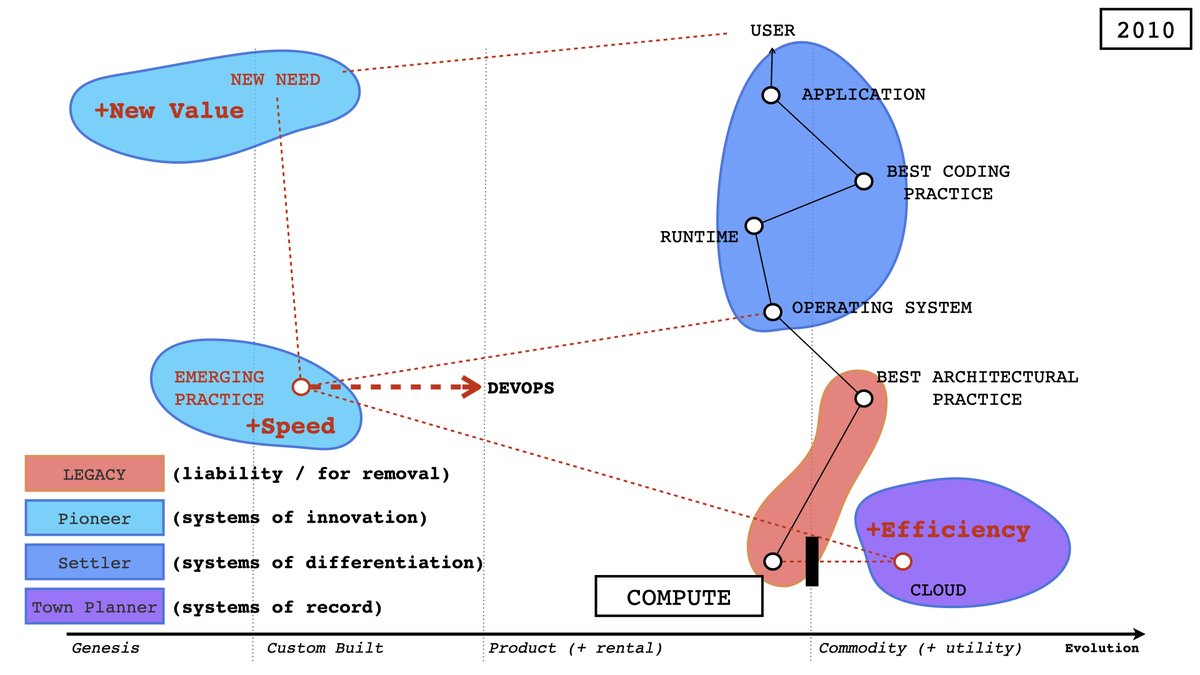
X : Why is that a map?
Me : Long story, all to do with how space has meaning. To keep it short, maps help people to focus on user needs, the components involved, to communicate missing components and scenario play ideas like staff becoming robots.
Me : They’re also good for measuring and managing capital flow, making investment decisions, removing bias and getting rid of duplication.
X : I don’t see how that helps with innovation?
Me : Well, innovation is a tricky word because we use it to describe many things. If you’re talking about differentiation with the adjacent unexplored then you’re experimenting in the “uncharted” space e.g. immortality with magic provided by the special custom built kettle.
X : That sounds like nonsense.
Me : A lot of what people think will be the next great innovation is nonsense. Actually, most of it is. That’s the nature of the uncharted space, it’s experimental, high risk and generally results in failure.
X : We need more reliable innovation.
Me : Ah, so you’re talking more product innovation or shifting product to utilities (business model innovation). They’re all different things and different methods are required.
X : We need a consistent method.
Me : You can’t have one ...
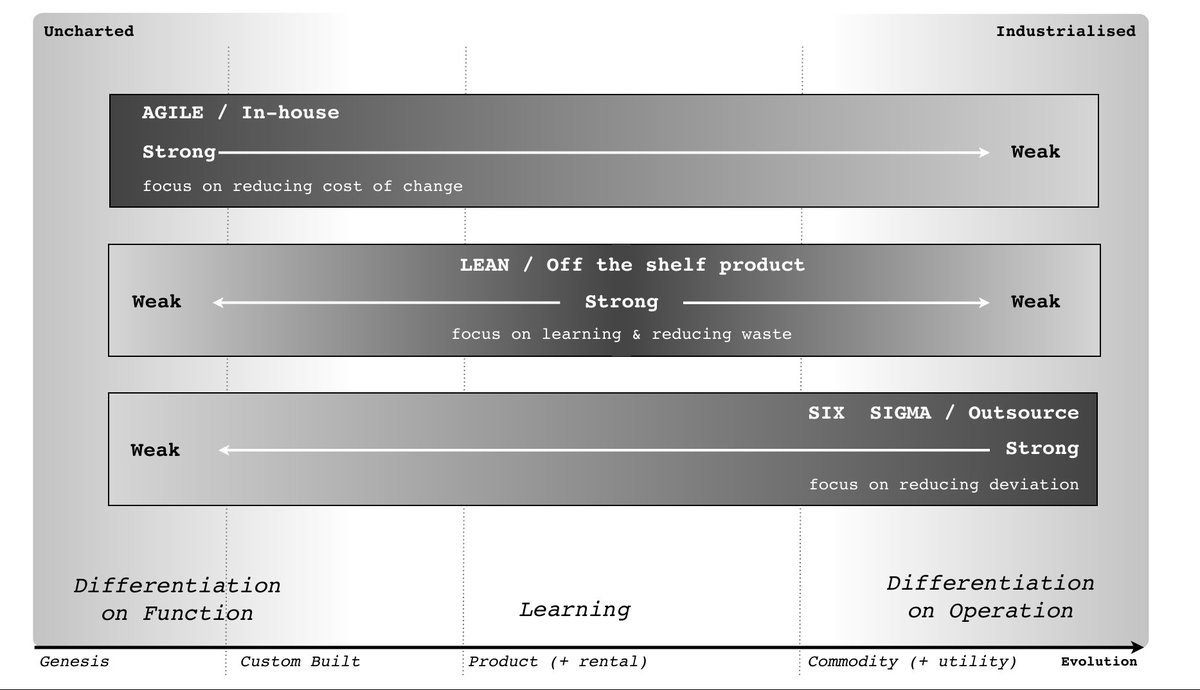
… even taking something simple such as project management, there is no magic one size fits all method. You need to use multiple across the landscape. Hence any large system will require multiple methods at the same time which is why we break things into components.
X : That seems complex.
Me : It can be both complex and complicated. At some points also simple, but we’re wandering. This is just the start, wait until you get into team organisation, culture, purchasing methods etc.
X : I don’t have time for this, I need something now.
Me : Ok, well we can start with doctrine.
X : What’s that?
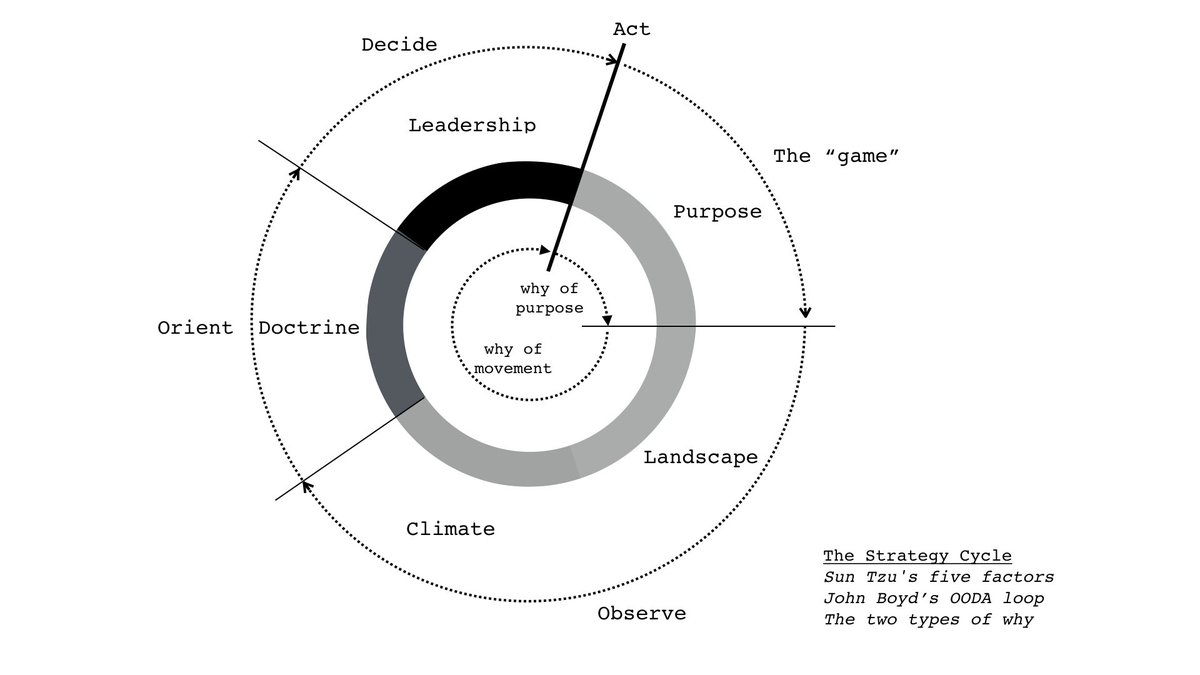
Me : Do you know the strategy cycle?
X : No
Me : Ok, let us start there ….
… the strategy cycle is simply a representation of change and how we need to react to it. It starts with your purpose, understanding the landscape, climatic patterns useful for anticipation, universal principles (or doctrine) useful for organisation, gameplay and action.
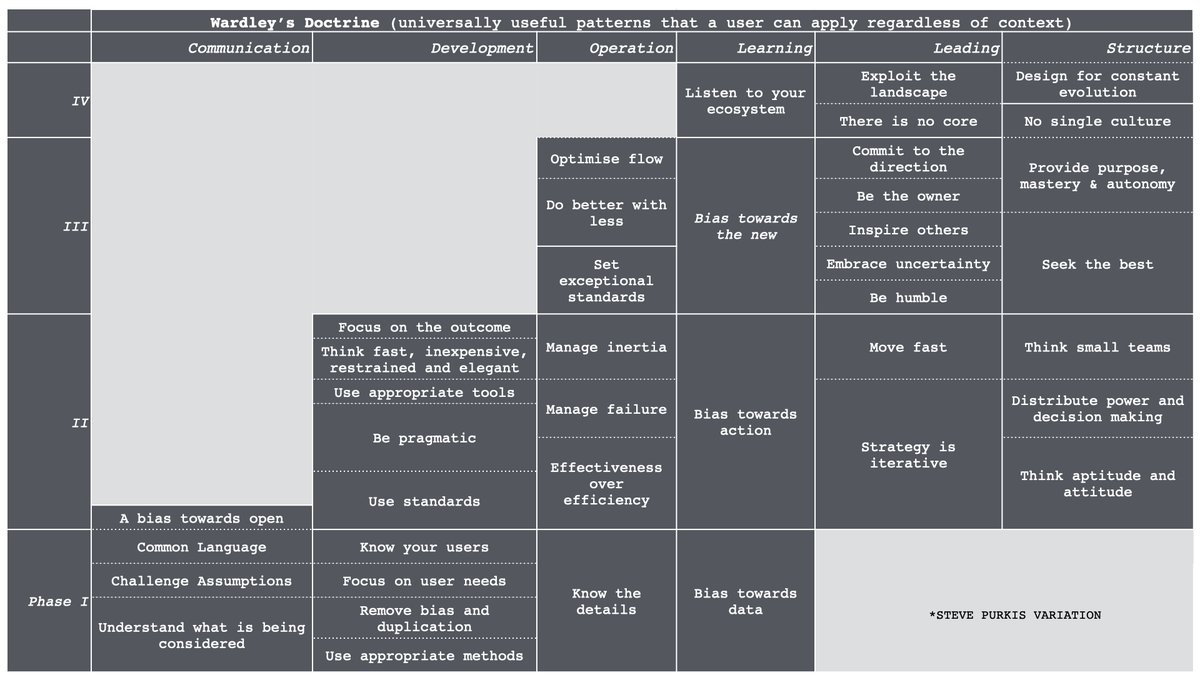
Doctrine contains the universally useful patterns, so you can just do those without having to map. Except of course, the implementation is context specific and maps are essential to fixing some of it. But we can start here.
X : How do I use it?
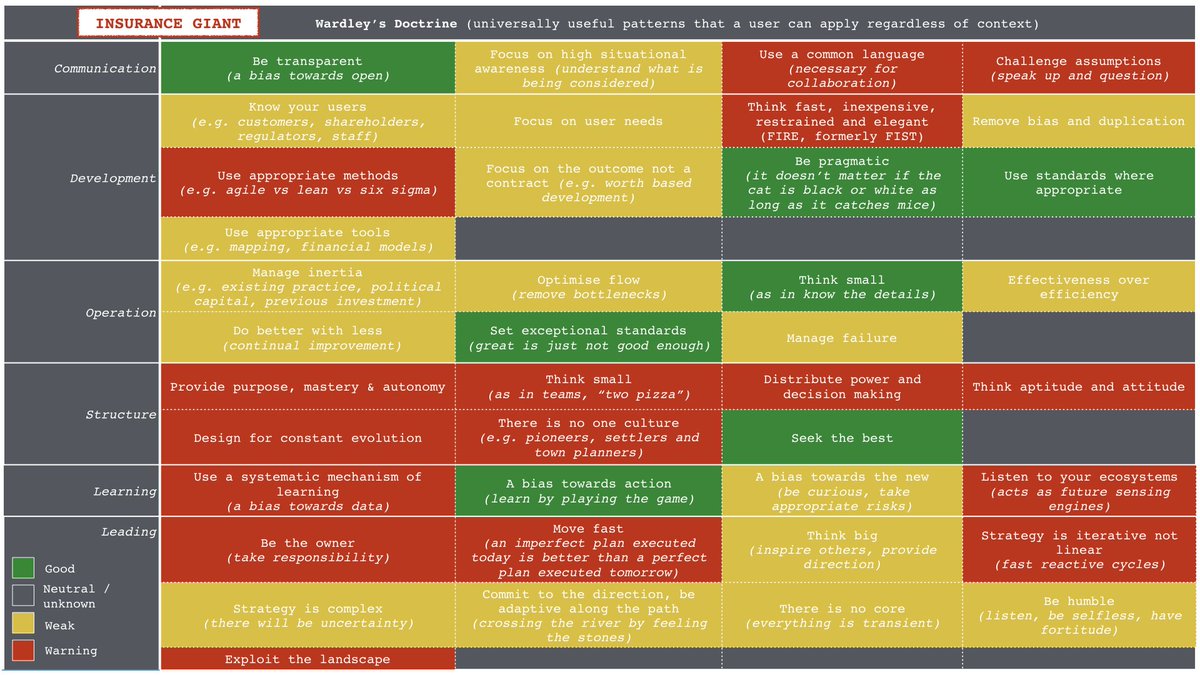
Me : Measure yourself against doctrine. Ask people. You’ll soon discover whether you look more like the bank or the web company.
X : And why does this matter?
Me : Adaptability. The more green, the better.
X : That says Insurance giant.
Me : My bad, this is a banking giant.
X : How do they survive?
Me : Most of their competitors look the same. Well, they used to anyway. Survive is more past tense for some.
X : So I can just fix doctrine?
Me : It’s a start. You won’t be anyway near anticipation or gameplay yet but you won’t make daft errors.
X : How long does it take.
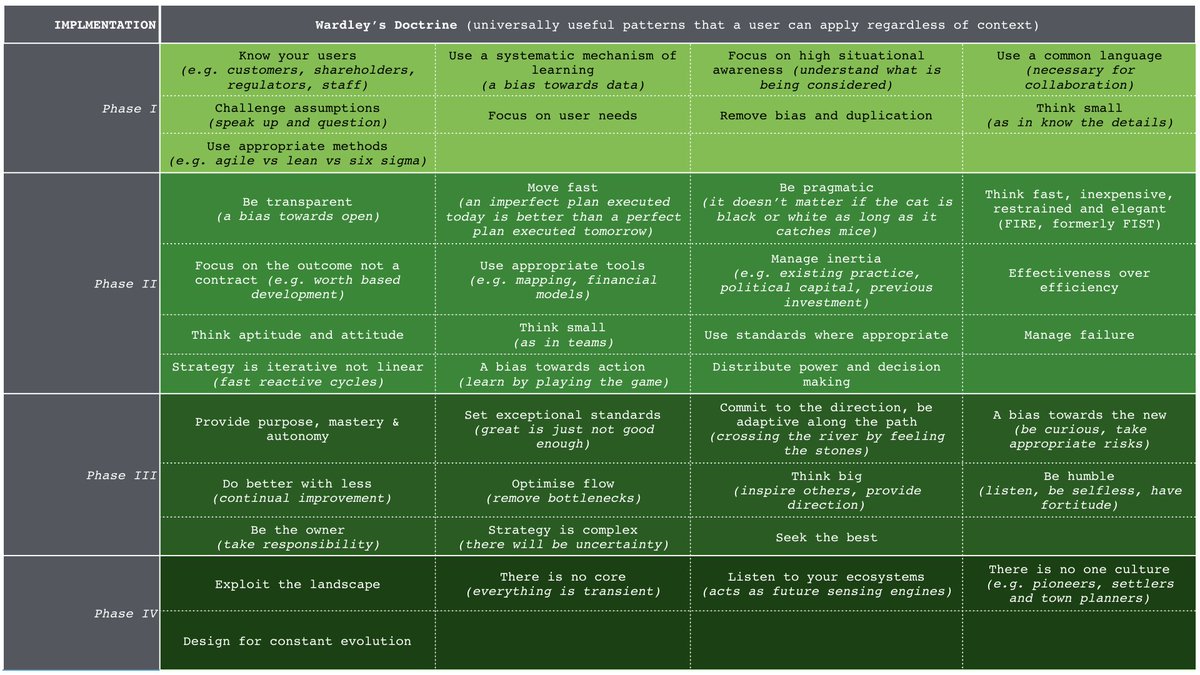
Me : You mean which order should I fix things in? I’ve given a best guess implementation in phases.
X : How long will that take?
Me : Depends upon your size and focus. Give yourself a good few years.
X : We need to move faster. How about gameplay.
Me : There’s a lot to gameplay. Problem is, you know 'nuffin about strategy Jon Snow, so don’t go there.
X : I’ve done strategy for 30 years!
Me : Yes and you’re only just now learning about maps and principles.
X : Are you going to help or not?
Me : Well, you seem unwilling to learn but there is one thing …
X : Yes?
Me : Fire staff, cut costs, buy equivalent companies to replace revenue and repeat the squeeze. Hand out dividends and kick off a share buyback scheme.
X : How is that going to help us become more successful?
Me : It’ll buy you time and keep the stock price up.
X : We should use that time to create something new?
Me : Hell no. If your company is going to have any future then you should use that time for yourself and your exec team to retire.
X : Why would that help?
Me : Look, you run the company with no maps which means you probably don't understand user needs, components involved, duplication and you'll be riddled with misalignment, lack of communication & learning and magic solutions - Let's AI, Spotify, Agile ...
... without an effective means of learning and communication (i.e. maps) then you'll never get a handle on anticipation or strategy. You'll have next to zero situational awareness bar any mental models. It'll all be run with gut feel, magic thinking and outcome bias.
... without an effective means for communication of assumptions (i.e. maps) then you won't have a means of challenge. Any structure you create is also gut feel, you're not even organising around your landscape. Basically, everything will be a mess.
X : So how do we survive?
Me : Because almost everyone else is a mess as well. A few aren't and I'm afraid your competitors of the future won't be as trivial and simple to fight against as the the competitors of the past. Either adapt or get out of the way. Your choice.
X : Are you always this grumpy?
Me : This is my friendly mood. I've always saved the really grumpy face for those who work for me and don't think about context. Situational awareness is not a nice to have in my book.
X : But this is more management than leadership.
Me : If you don't understand the landscape, if you can't anticipate or communicate or learn or challenge effectively, if you can't organise or work out where to attack or what type of people you need then leadership is irrelevant.