WHAT IS SRI YANTRA

The Sri Yantra also known as the Sri Chakra represents all the fundamental principals of Tantric philosophy. It is known as the best or supreme existing yantra and all other yantras derive from it.
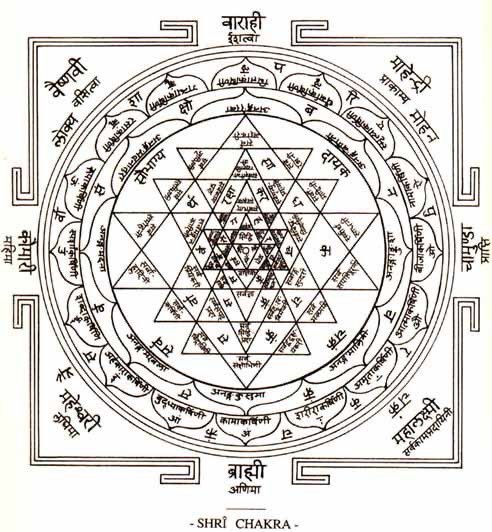
A Yantra is the symbolic representation of the Mother Goddess. It is made up of ‘linear and spatial ‘geometrical permutations’ of the Goddess in the mandala. You find yantras in many sacred geometry works and the design of the Sri Chakra/ Yantra is nine interwoven triangles,
four of which represent the male principle (Shiva) and five inverted triangles representing Shakti, the feminine principal. The nine triangles also represent nine basic elements or root substances (mula-prakritis) of the universe. In the human body they are represented as nine
substances; five from Shakti – skin, blood, flesh, fat and bone. The four from Shiva are – semen, marrow, vital energy (prana) and the individual soul.  
The place of the mother goddess is represented by the dot or bindu in the centre of the design. The dot has four legs
representing the deities responsible for the creation of all things.
Brahma – the creator is in the northeast.
Vishnu – the preserver is in the southeast.
Rudra – for withdrawal is in the southwest.
Sadasiva – for retention is in the northwest.
Surrounding this pattern are two concentric circles of lotus petals: the inner has 8 petals and the outer 16. The entire pattern is encased within a gated frame, called the “courtyard” or “earth stretch”.
An individuals spiritual journey or path to enlightenment from material
existence to ultimate ascension and enlightenment is mapped through the sri yantra, the spiritual journey is undertaken as a pilgrimage each step or elevation is an ascent to the centre.

The Sri Yantra represents the totality of existence and can be used as a tool in meditation.

More from तहक्षी™

You May Also Like

The UN just voted to condemn Israel 9 times, and the rest of the world 0.

View the resolutions and voting results here:

The resolution titled "The occupied Syrian Golan," which condemns Israel for "repressive measures" against Syrian citizens in the Golan Heights, was adopted by a vote of 151 - 2 - 14.

Israel and the U.S. voted 'No'
https://t.co/HoO7oz0dwr


The resolution titled "Israeli practices affecting the human rights of the Palestinian people..." was adopted by a vote of 153 - 6 - 9.

Australia, Canada, Israel, Marshall Islands, Micronesia, and the U.S. voted 'No' https://t.co/1Ntpi7Vqab


The resolution titled "Israeli settlements in the Occupied Palestinian Territory, including East Jerusalem, and the occupied Syrian Golan" was adopted by a vote of 153 – 5 – 10.

Canada, Israel, Marshall Islands, Micronesia, and the U.S. voted 'No'
https://t.co/REumYgyRuF


The resolution titled "Applicability of the Geneva Convention... to the
Occupied Palestinian Territory..." was adopted by a vote of 154 - 5 - 8.

Canada, Israel, Marshall Islands, Micronesia, and the U.S. voted 'No'
https://t.co/xDAeS9K1kW
First thread of the year because I have time during MCO. As requested, a thread on the gods and spirits of Malay folk religion. Some are indigenous, some are of Indian origin, some have Islamic


Before I begin, it might be worth explaining the Malay conception of the spirit world. At its deepest level, Malay religious belief is animist. All living beings and even certain objects are said to have a soul. Natural phenomena are either controlled by or personified as spirits

Although these beings had to be respected, not all of them were powerful enough to be considered gods. Offerings would be made to the spirits that had greater influence on human life. Spells and incantations would invoke their


Two known examples of such elemental spirits that had god-like status are Raja Angin (king of the wind) and Mambang Tali Arus (spirit of river currents). There were undoubtedly many more which have been lost to time

Contact with ancient India brought the influence of Hinduism and Buddhism to SEA. What we now call Hinduism similarly developed in India out of native animism and the more formal Vedic tradition. This can be seen in the multitude of sacred animals and location-specific Hindu gods