2/n
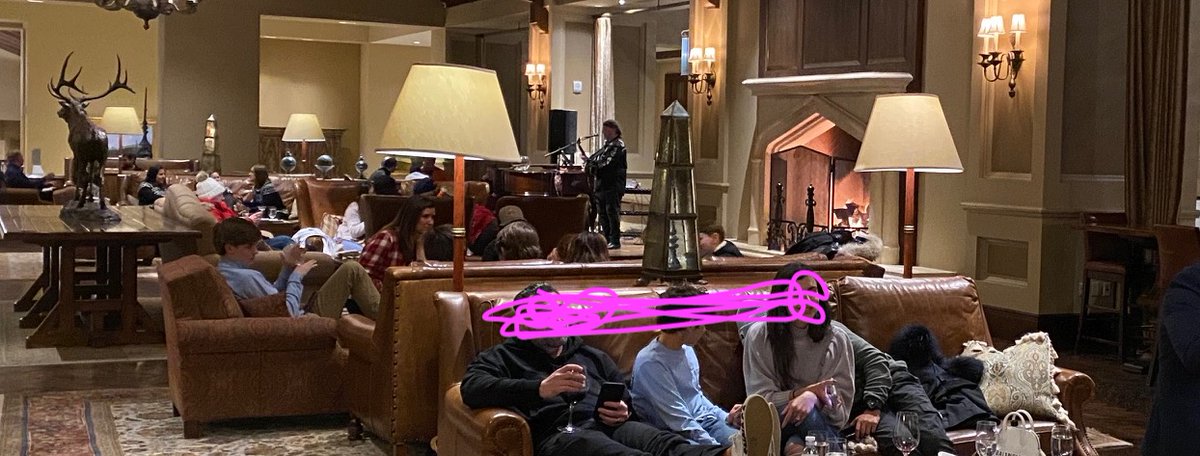
I went to busy restaurants every night, and two of the three nights got to listen to live music, including—gasp—live singing and a band! After skiing, we sat around a firepit drinking, and met new people.
3/n
I met a friend whom I haven’t seen in a year and gave her a hug, without either of us giving a second thought. I met family and extended family; all greeted us with a warm embrace, a wide smile, and quickly ushered us inside.
4/n
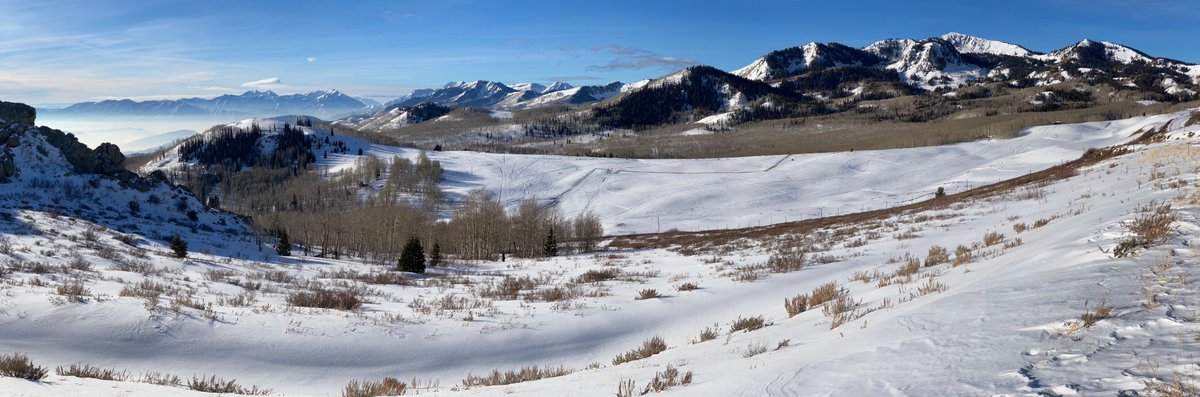
I walked down main street in Park City and was able to luxuriate in being outside without being forced to wear a mask—though indoors it is required. Park City is Utah’s wealthiest and most liberal area, so there was a fair amount of outdoor masking, 80-85%.
5/n
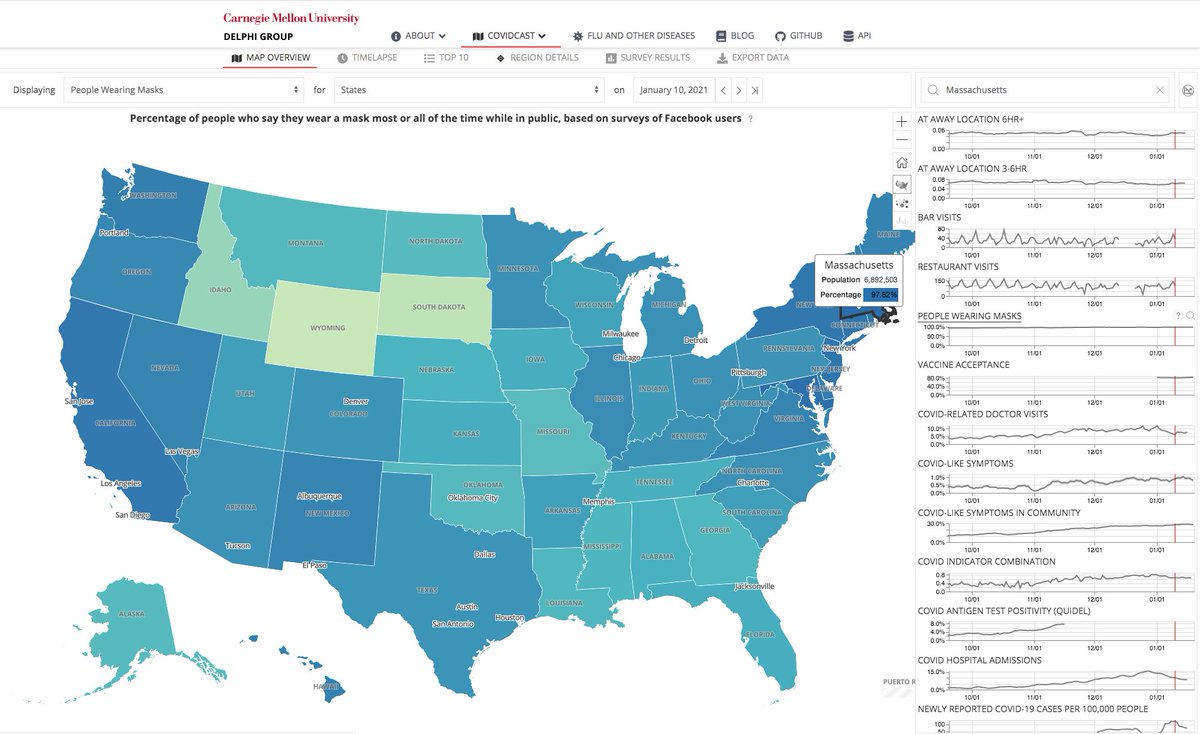
While in Park City, people signaled either their membership in that liberal, affluent group, or their desire to be part of it, elsewhere was far different. Utahns report roughly equal masking to Massachusetts, 92.3% to Massachusetts’ 97.8% however..
https://t.co/4IJZX0hM8E
6/n
While indoors in public places, UT is similar to MA w/nearly 100% masking. Elsewhere the feeling is different. I walked into several different work places, and prior to seeing me, the people were uniformly working away without masks.
7/n
I walked into a gas station and was surprised to see two un-masked men enter, purchase their waters and walk out, without inciting a wave indignation from the other patrons or employees.
8/n
I went to a meeting with 8 people whom I had never met before, and when I walked in, all were working away without masks. We shook hands, then got down to work, sans masks. Had we had masks, our meeting would have been shorter, and far less productive.
9/n
Talking to friends and family, people discussed play dates, dinner parties, travel, and birthday parties without the kind of furtiveness that is required in my now-native Massachusetts.
Everywhere I saw people engaging with people, as people without fear of each other.
10/n
This lack of fear has powerful consequences. UT's unemployment rate is 5th in the nation, at 4.3%, vs. Mass at 35th and 6.7%.
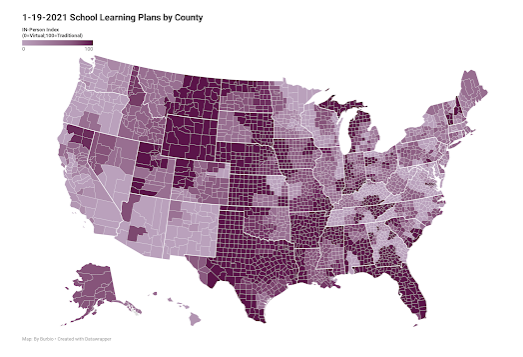
It is also undoubtedly why most of Utah’s schools are offering in-person instruction, where Massachusetts’ are not.
https://t.co/bkZCGwlYek
11/n
Further, Utah’s far more open approach has not resulted in greater lethality. In fact, when it comes to cumulative deaths/million, Utah is 46th, at 470 deaths/million vs. Massachusetts which ranks 3rd in the nation at 1995, nearly 4x Utah.
12/n
Given Utahn’s lack of compliance with the society-destroying atomization recommended by our public health officials, you might expect that their cases, deaths, and hospitalizations would be higher than dystopian Massachusetts. You would be wrong.
13/n
At the moment, Utah has roughly the same cases/million as Massachusetts. As far as deaths, at no point did Utah ever exceed Massachusetts’ daily rate, even during Utah’s summer “surge”. Currently, Utah is at ~1/3 the daily deaths/million of Massachusetts.
14/n
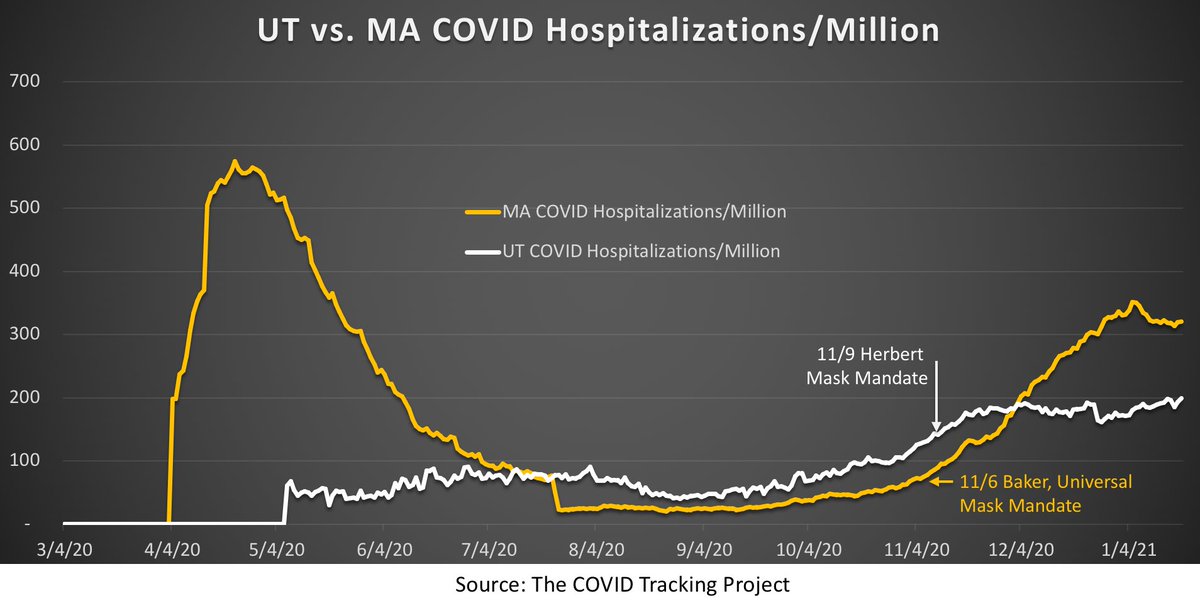
COVID hospitalizations in the Reich, er, Massachusetts, are also 50% higher than they are in Utah.
15/n
Hospital utilization in UT is < 60%, w/ICU utilization at 73%. This despite MA having 50% more hospital capacity than UT. Still, despite having higher numbers than UT, MA is experiencing no hospital strain either, w/utilization at 76% and ICU
@ 64%
https://t.co/dmwKUrZ6bi
16/n
Still others will point to positivity, and say that even if hospitals are not even close to overwhelmed, Utah’s positivity rate of ~ 10% is concerning. Comparing MA and UT shows the major flaw in % Positivity as a metric.
17/n
If % Positivity were a real indication of the number of cases being missed, it would translate to places with hi %+ having higher rolling CFRs. But that is not the case. Rather, Utah’s rolling CFR now is 0.6%, vs. Massachusetts 1.5%.
18/n
Assuming that both states would experience roughly the same mortality, this suggests that MA w/rolling CFR at nearly 3x that of UT is missing 3x the number of cases as UT, despite having a % positive that is ½ that of Utah.
19/n
It is worth noting that at its low point, Utah’s rolling CFR was 0.2%, in-line with the WHO and CDC estimates of Infection Fatality Rate (IFR), suggesting at that point Utah was catching nearly every COVID case, despite a %+ rate over 6%.
20/n
Since June 22nd in fact, Utah has maintained a rolling CFR less than 1%, despite percent positivity never going below 6%, and often over 15%. MA on the otherhand has seen % positive rates as low as 1%, yet never gotten its rolling CFR below 1%.
21/n
One reason this may be the case, is due to widespread testing. Both the state and many other orgs in Massachusetts has required significant testing for work, school, etc., return regardless of symptoms or exposure.
22/n
This leads to a significant increase in tests (denominator for % positive), thereby decreasing % positivity, but does little to identify or stem infections. It is possible that this broad focus of limited testing resources increases risks to at-risk populations.
23/n
Surveillance testing of populations that are not at-risk (like schools) may divert testing away from at-risk populations, potentially allowing infectious people to interact with at-risk populations. MA higher rolling CFR relative to %+ suggests this may be happening here.
24/n
Given Utah’s far better outcomes on nearly every metric either of health, it beggars belief that states such as Massachusetts continue to apply such drastic—and seemingly counter-productive measures.
25/n
In fact it is a breach of the UN Covenant on Civil & Political rights, stating it is incumbent on any government imposing disease control measures to utilize the least restrictive means available to effectively achieve the public health goal
@MichaelPSenger @stacey_rudin
26/n
Note on rolling CFR calculation: Calculated by taking 1 week of deaths/1 week of cases from 2 weeks earlier.
/END