Instacart is a great example of a company that as it exists today is a interim, not end state business. There will be opportunities to change that positioning, but they will face some critical choices ahead.
1) own the customer & monetize the data that comes along w/ that.
2) Efficiently deliver last mile logistics.
Importantly there are better models being developed & proven by some supermarkets powered by the likes of Ocado.

And Reed knew this in calling a DVD-by-mail company "Netflix," so there is a way out, but it's not necessarily easy!
— Elliot Turner (@ElliotTurn) January 19, 2021
More from Society

1/OK, data mystery time.
This New York Times feature shows China with a Gini Index of less than 30, which would make it more equal than Canada, France, or the Netherlands. https://t.co/g3Sv6DZTDE
That's weird. Income inequality in China is legendary.
Let's check this number.
2/The New York Times cites the World Bank's recent report, "Fair Progress? Economic Mobility across Generations Around the World".
The report is available here:
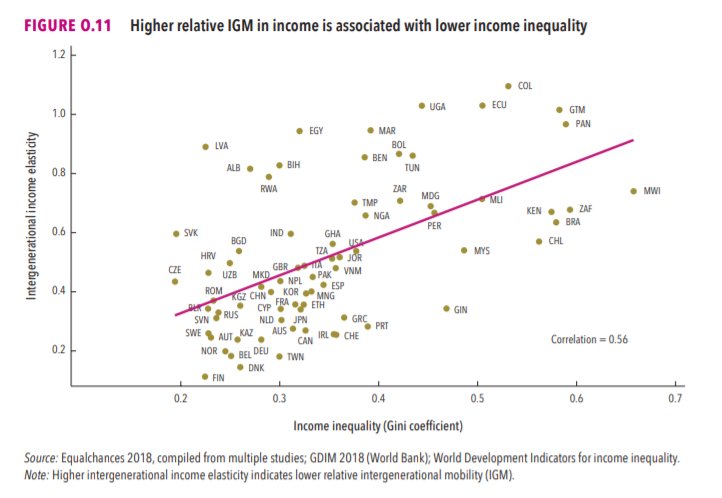
3/The World Bank report has a graph in which it appears to show the same value for China's Gini - under 0.3.
The graph cites the World Development Indicators as its source for the income inequality data.
4/The World Development Indicators are available at the World Bank's website.
Here's the Gini index: https://t.co/MvylQzpX6A
It looks as if the latest estimate for China's Gini is 42.2.
That estimate is from 2012.
5/A Gini of 42.2 would put China in the same neighborhood as the U.S., whose Gini was estimated at 41 in 2013.
I can't find the <30 number anywhere. The only other estimate in the tables for China is from 2008, when it was estimated at 42.8.
This New York Times feature shows China with a Gini Index of less than 30, which would make it more equal than Canada, France, or the Netherlands. https://t.co/g3Sv6DZTDE
That's weird. Income inequality in China is legendary.
Let's check this number.
2/The New York Times cites the World Bank's recent report, "Fair Progress? Economic Mobility across Generations Around the World".
The report is available here:
3/The World Bank report has a graph in which it appears to show the same value for China's Gini - under 0.3.
The graph cites the World Development Indicators as its source for the income inequality data.
4/The World Development Indicators are available at the World Bank's website.
Here's the Gini index: https://t.co/MvylQzpX6A
It looks as if the latest estimate for China's Gini is 42.2.
That estimate is from 2012.
5/A Gini of 42.2 would put China in the same neighborhood as the U.S., whose Gini was estimated at 41 in 2013.
I can't find the <30 number anywhere. The only other estimate in the tables for China is from 2008, when it was estimated at 42.8.




Patriotism is an interesting concept in that it’s excepted to mean something positive to all of us and certainly seen as a morally marketable trait that can fit into any definition you want for it.+
Tolstoy, found it both stupid and immoral. It is stupid because every patriot holds his own country to be the best, which obviously negates all other countries.+
It is immoral because it enjoins us to promote our country’s interests at the expense of all other countries, employing any means, including war. It is thus at odds with the most basic rule of morality, which tells us not to do to others what we would not want them to do to us+
My sincere belief is that patriotism of a personal nature, which does not impede on personal and physical liberties of any other, is not only welcome but perhaps somewhat needed.
But isn’t adherence to a more humane code of life much better than nationalistic patriotism?+
Göring said, “people can always be brought to the bidding of the leaders. That is easy. All you have to do is tell them they are being attacked, and denounce the peacemakers for lack of patriotism and exposing the country to danger. It works the same in any country.”+
\u0926\u0947\u0936 \u092e\u0947\u0902 \u092a\u0939\u0932\u0940 \u092c\u093e\u0930 \U0001f1ee\U0001f1f3
— AAP (@AamAadmiParty) March 12, 2021
\u0926\u0947\u0936\u092d\u0915\u094d\u0924\u093f \u0915\u0940 \u0938\u094d\u092a\u0947\u0936\u0932 \u0915\u094d\u0932\u093e\u0938 \u0932\u0917\u093e\u090f\u0917\u0940 @ArvindKejriwal \u0938\u0930\u0915\u093e\u0930\u0964
\u090f\u0915 \u092a\u093e\u0920\u094d\u092f\u0915\u094d\u0930\u092e \u092c\u0928\u093e\u092f\u093e \u091c\u093e\u090f\u0917\u093e, \u091c\u093f\u0938\u0938\u0947 \u092c\u091a\u094d\u091a\u094b\u0902 \u092e\u0947\u0902 \u0915\u0942\u091f \u0915\u0942\u091f \u0915\u0930 \u0926\u0947\u0936\u092d\u0915\u094d\u0924\u093f \u092d\u0930\u0940 \u091c\u093e\u090f\u0917\u0940\u0964 pic.twitter.com/iO6WMBh4YG
Tolstoy, found it both stupid and immoral. It is stupid because every patriot holds his own country to be the best, which obviously negates all other countries.+
It is immoral because it enjoins us to promote our country’s interests at the expense of all other countries, employing any means, including war. It is thus at odds with the most basic rule of morality, which tells us not to do to others what we would not want them to do to us+
My sincere belief is that patriotism of a personal nature, which does not impede on personal and physical liberties of any other, is not only welcome but perhaps somewhat needed.
But isn’t adherence to a more humane code of life much better than nationalistic patriotism?+
Göring said, “people can always be brought to the bidding of the leaders. That is easy. All you have to do is tell them they are being attacked, and denounce the peacemakers for lack of patriotism and exposing the country to danger. It works the same in any country.”+