Hello everyone arguing about the #minimumwage! Someday I'll post a thread about the evidence our @UW team compiled in Seattle.

Today let's talk about hours.

Raise the wage on most low-paying jobs & workers still don't have enough to live on. Because they can't get enough hours.
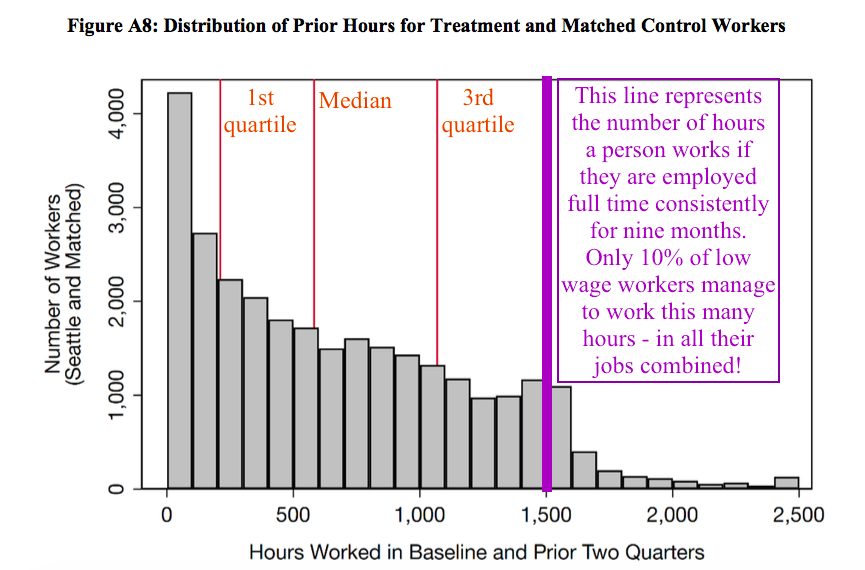
The graph above is based on data from WA: one of only 4 states that collects systematic data on hours worked. It shows information for anyone earning under $11/hr in 2014-15, when the minimum wage was no more than $9.47.

The data have some important limitations:
-No information on gig/contractor employment
-No "informal" employment
-No jobs outside WA

However if a worker is holding 2+ job we can "see" all of them and include them all in calculating how many hours they work.

The median low wage worker works ~800 hours per year.
With a $15 minimum wage, working 800 hours/year, your annual income works out to $12,000.

That's below the poverty line for a single person, and less than half the poverty line for a family of 4.

Whereas if you could get full time hours (2,000/year) your income would be $30k.
The problem with low wage work (aside from low wages): these jobs tend to be unstable, seasonal, or offered by employers that need a large workforce for a limited number of hours per week.

Since the minimum wage is specified in dollars/hour, it can't guarantee a living income.
The @CityofSeattle, and a few other places, have tried to address the hours problem. They've enacted regulations to make hours more stable and predictable, which is a worthy goal. But a job offering a stable, predictable 10 hours a week isn't going to earn you a living.
A century ago, the first minimum wage policies adopted in states like Oregon and Massachusetts set a *weekly* minimum, not hourly. What would a policy like that look like today?

Imagine this: every job must offer either
a) $15/hour
b) $400/week for up to 40 hrs ($15/hr overtime)
Option b) allows businesses to pay as little as $10/hour, if they consistently offer full-time hours.

In exchange for a lower hourly rate, businesses would have to accept risk that, under current policy, they shift to workers.

Consider the case of a beer garden in Seattle.
If the weather's rainy, there won't be many customers and thus little revenue. When workers are paid by the hour, the beer garden passes a portion of this revenue hit to workers by telling them to stay home if it rains.

(at least in the days before Seattle regulated this!)
The hybrid weekly/hourly wage policy would give businesses a choice: they can pay less per hour if they're willing to bear risk themselves. Or they can pay a higher rate that compensates workers for bearing the risk instead.
The hybrid minimum, unlike a straight hourly minimum, would offer at least some workers a guaranteed income above the poverty line (for certain household sizes, anyway).

The main argument against? Same as for the traditional minimum wage: it might reduce employment.
Would it really reduce employment? If so, by how much? That's a thread for another day...

/fin

More from Society

You May Also Like

1/ Some initial thoughts on personal moats:

Like company moats, your personal moat should be a competitive advantage that is not only durable—it should also compound over time.

Characteristics of a personal moat below:


2/ Like a company moat, you want to build career capital while you sleep.

As Andrew Chen noted:


3/ You don’t want to build a competitive advantage that is fleeting or that will get commoditized

Things that might get commoditized over time (some longer than


4/ Before the arrival of recorded music, what used to be scarce was the actual music itself — required an in-person artist.

After recorded music, the music itself became abundant and what became scarce was curation, distribution, and self space.

5/ Similarly, in careers, what used to be (more) scarce were things like ideas, money, and exclusive relationships.

In the internet economy, what has become scarce are things like specific knowledge, rare & valuable skills, and great reputations.
This is NONSENSE. The people who take photos with their books on instagram are known to be voracious readers who graciously take time to review books and recommend them to their followers. Part of their medium is to take elaborate, beautiful photos of books. Die mad, Guardian.


THEY DO READ THEM, YOU JUDGY, RACOON-PICKED TRASH BIN


If you come for Bookstagram, i will fight you.

In appreciation, here are some of my favourite bookstagrams of my books: (photos by lit_nerd37, mybookacademy, bookswrotemystory, and scorpio_books)
Following @BAUDEGS I have experienced hateful and propagandist tweets time after time. I have been shocked that an academic community would be so reckless with their publications. So I did some research.
The question is:
Is this an official account for Bahcesehir Uni (Bau)?


Bahcesehir Uni, BAU has an official website
https://t.co/ztzX6uj34V which links to their social media, leading to their Twitter account @Bahcesehir

BAU’s official Twitter account


BAU has many departments, which all have separate accounts. Nowhere among them did I find @BAUDEGS
@BAUOrganization @ApplyBAU @adayBAU @BAUAlumniCenter @bahcesehirfbe @baufens @CyprusBau @bauiisbf @bauglobal @bahcesehirebe @BAUintBatumi @BAUiletisim @BAUSaglik @bauebf @TIPBAU

Nowhere among them was @BAUDEGS to find