For others (who don't live and breathe disability), saying "normal children" is probably a slip of the tongue- not a betrayal of them secretly being awful people. (2/n)
THREAD: I hope this mistake can be used as an opportunity to learn why this kind of language is bad.
The Minister isn't the only person to say things like this- I've even heard parents of kids with autism refer to other children as "normal" & have had to rearrange my face. (1/n)
Minister for Special Education Josepha Madigan describes children without additional needs as 'normal' | @Jessjcasey @aoifegracemoore https://t.co/4S1Y7vIRRC
— Irish Examiner (@irishexaminer) January 14, 2021
For others (who don't live and breathe disability), saying "normal children" is probably a slip of the tongue- not a betrayal of them secretly being awful people. (2/n)
https://t.co/OgFGRpoYsy
(8/n)
Diagnoses are not disabilities, they're potential causes of disability.
— Irwin Gill (@IrwinGill) January 15, 2021
The disability is the effect on function, activity & participation- not the condition itself. Some medical conditions are disabling for some people & not others.
Disability isn't a dirty word. #SayTheWord https://t.co/ub0KeUwaUF
#disability #rehabilitation #paediatrics #ABI
https://t.co/sjQ3wPLrcr
More from Society









It is simply not correct to point fingers at wind & solar energy as we try to understand the situation in TX. The system (almost) had a plan for weather (almost) like this. 1/x
It relied on very little wind energy - that was the plan. It relied on a lot of natural gas - that was the plan. It relied on all of its nuclear energy - that was the plan. 2/x
There was enough natural gas, coal and nuclear capacity installed to survive this event - it was NOT "forced out" by the wind energy expansion. It was there. 3/x
Wind, natural gas, coal and nuclear plants all failed to deliver on their expectations for long periods of time. The biggest gap was in natural gas! The generators were there, but they were not able to deliver. 4/x
It may be fair to ask why there is so much wind energy in ERCOT if we do NOT expect it to deliver during weather events like this, but that is an entirely different question - and one with a lot of great answers!! 5/x
Conservatives are using the Texas power chaos to argue against climate policy even as fossil-generated power outages dwarf the amount of renewables knocked offline during the historic deep freeze. President Biden and progressives have been slow to respond.https://t.co/UajKhptEAU
— E&E News (@EENewsUpdates) February 17, 2021
It relied on very little wind energy - that was the plan. It relied on a lot of natural gas - that was the plan. It relied on all of its nuclear energy - that was the plan. 2/x
There was enough natural gas, coal and nuclear capacity installed to survive this event - it was NOT "forced out" by the wind energy expansion. It was there. 3/x
Wind, natural gas, coal and nuclear plants all failed to deliver on their expectations for long periods of time. The biggest gap was in natural gas! The generators were there, but they were not able to deliver. 4/x
It may be fair to ask why there is so much wind energy in ERCOT if we do NOT expect it to deliver during weather events like this, but that is an entirely different question - and one with a lot of great answers!! 5/x

I've seen many news articles cite that "the UK variant could be the dominant strain by March". This is emphasized by @CDCDirector.
While this will likely to be the case, this should not be an automatic cause for concern. Cases could still remain contained.
Here's how: 🧵
One of @CDCgov's own models has tracked the true decline in cases quite accurately thus far.
Their projection shows that the B.1.1.7 variant will become the dominant variant in March. But interestingly... there's no fourth wave. Cases simply level out:
https://t.co/tDce0MwO61
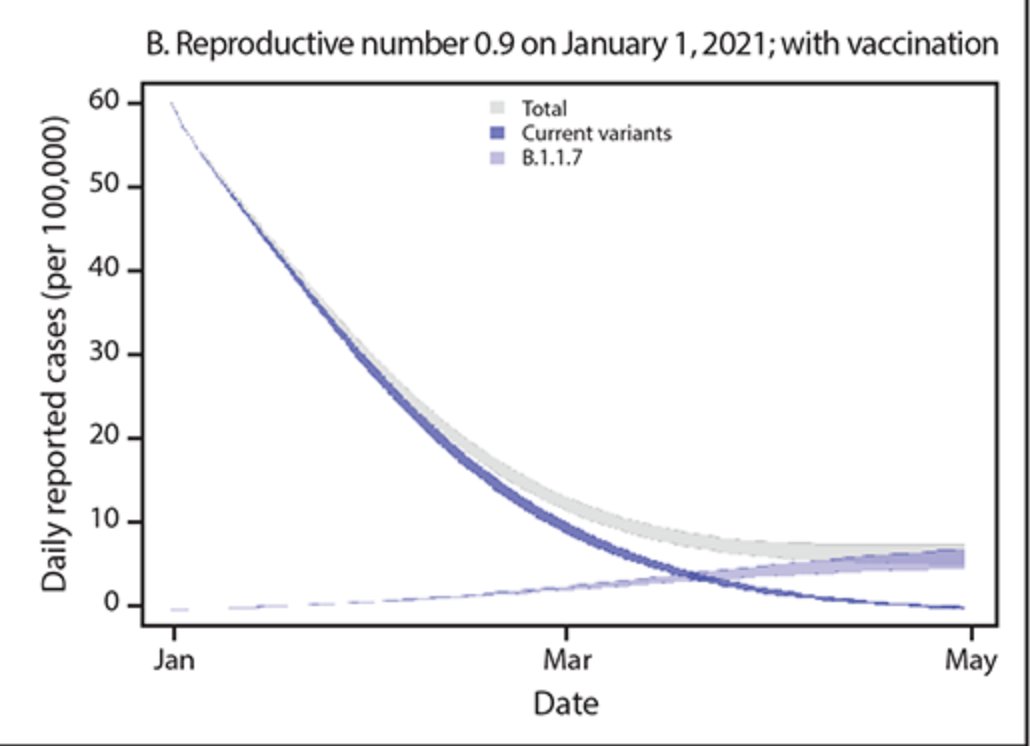
Just because a variant becomes the dominant strain does not automatically mean we will see a repeat of Fall 2020.
Let's look at UK and South Africa, where cases have been falling for the past month, in unison with the US (albeit with tougher restrictions):
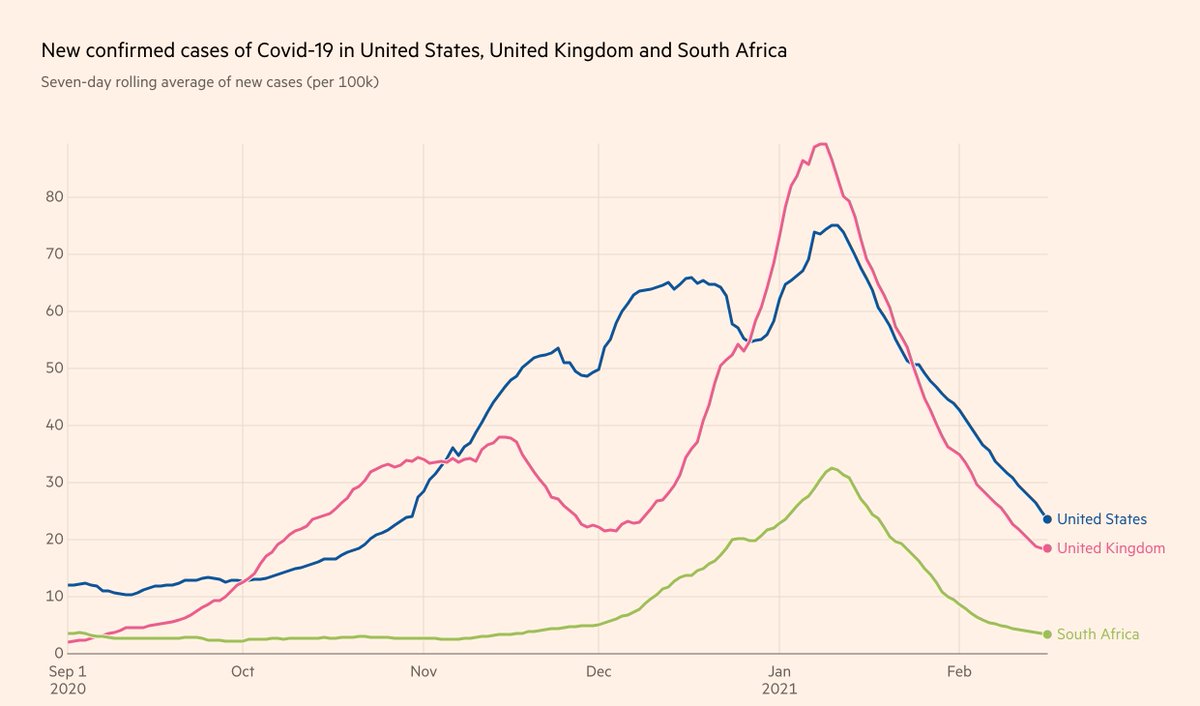
Furthermore, the claim that the "variant is doubling every 10 days" is false. It's the *proportion of the variant* that is doubling every 10 days.
If overall prevalence drops during the studied time period, the true doubling time of the variant is actually much longer 10 days.
Simple example:
Day 0: 10 variant / 100 cases -> 10% variant
Day 10: 15 variant / 75 cases -> 20% variant
Day 20: 20 variant / 50 cases -> 40% variant
1) Proportion of variant doubles every 10 days
2) Doubling time of variant is actually 20 days
3) Total cases still drop by 50%
While this will likely to be the case, this should not be an automatic cause for concern. Cases could still remain contained.
Here's how: 🧵
One of @CDCgov's own models has tracked the true decline in cases quite accurately thus far.
Their projection shows that the B.1.1.7 variant will become the dominant variant in March. But interestingly... there's no fourth wave. Cases simply level out:
https://t.co/tDce0MwO61
Just because a variant becomes the dominant strain does not automatically mean we will see a repeat of Fall 2020.
Let's look at UK and South Africa, where cases have been falling for the past month, in unison with the US (albeit with tougher restrictions):
Furthermore, the claim that the "variant is doubling every 10 days" is false. It's the *proportion of the variant* that is doubling every 10 days.
If overall prevalence drops during the studied time period, the true doubling time of the variant is actually much longer 10 days.
Simple example:
Day 0: 10 variant / 100 cases -> 10% variant
Day 10: 15 variant / 75 cases -> 20% variant
Day 20: 20 variant / 50 cases -> 40% variant
1) Proportion of variant doubles every 10 days
2) Doubling time of variant is actually 20 days
3) Total cases still drop by 50%