I've heard a lot of scientists claim these three - including most recently the chief advisor to the CDC, where the claim that most transmission doesn't happen within the walls of schools. There is strong evidence to rebut this claim. Let's look at this.
https://t.co/NiNHZV6TDO
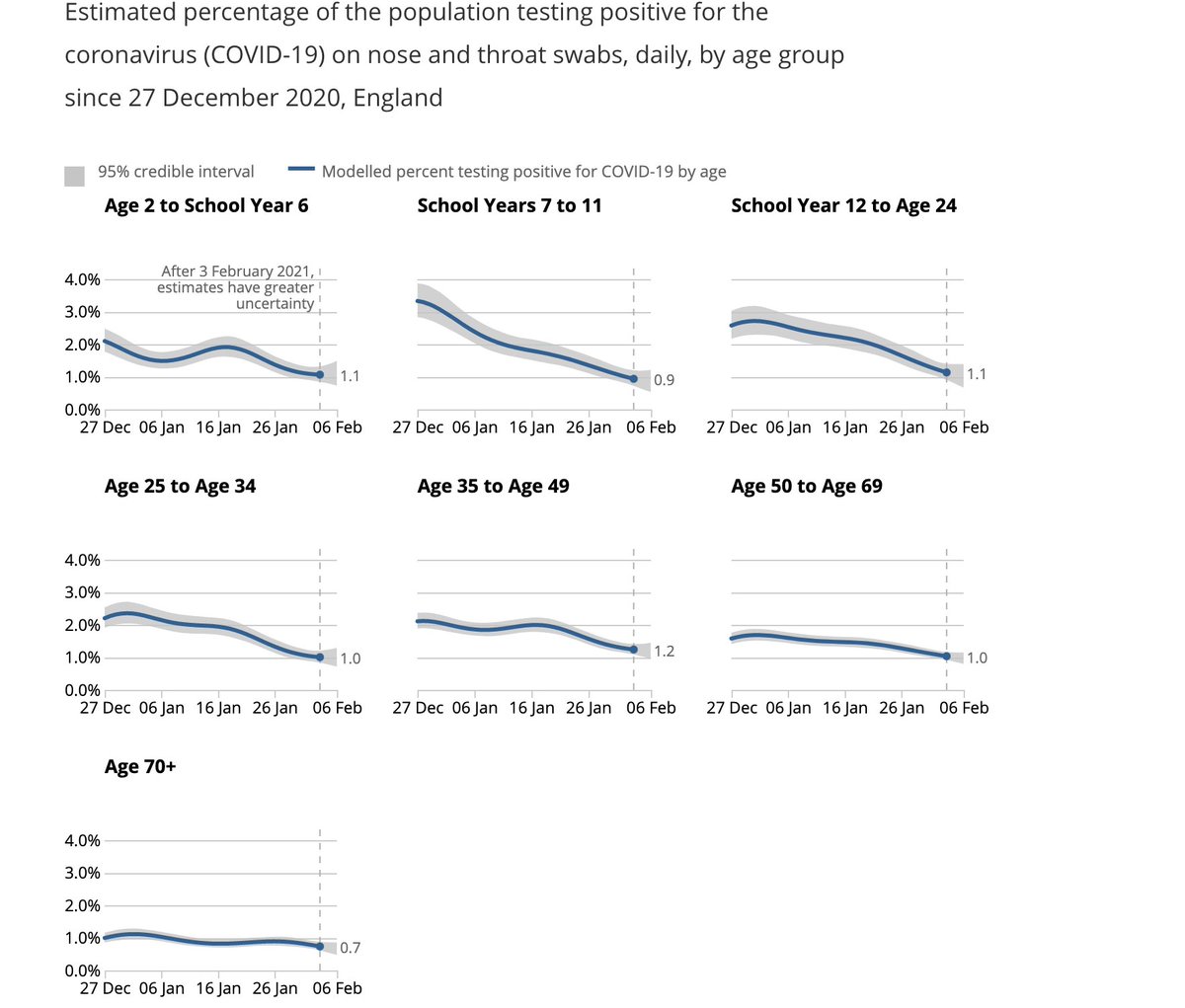
Let's look at the trends of infection in different age groups in England first- as reported by the ONS. Being a random survey of infection in the community, this doesn't suffer from the biases of symptom-based testing, particularly important in children who are often asymptomatic
A few things to note:
1. The infection rates among primary & secondary school children closely follow school openings, closures & levels of attendance. E.g. We see a dip in infections following Oct half-term, followed by a rise after school reopening.
We see steep drops in both primary & secondary school groups after end of term (18th December), but these drops plateau out in primary school children, where attendance has been >20% after re-opening in January (by contrast with 2ndary schools where this is ~5%).
Concerningly, the REACT-1 study data released today show that prevalence of infection across England is now highest in primary school children & young adults, with the drops being less steep in primary school children compared to other age groups.
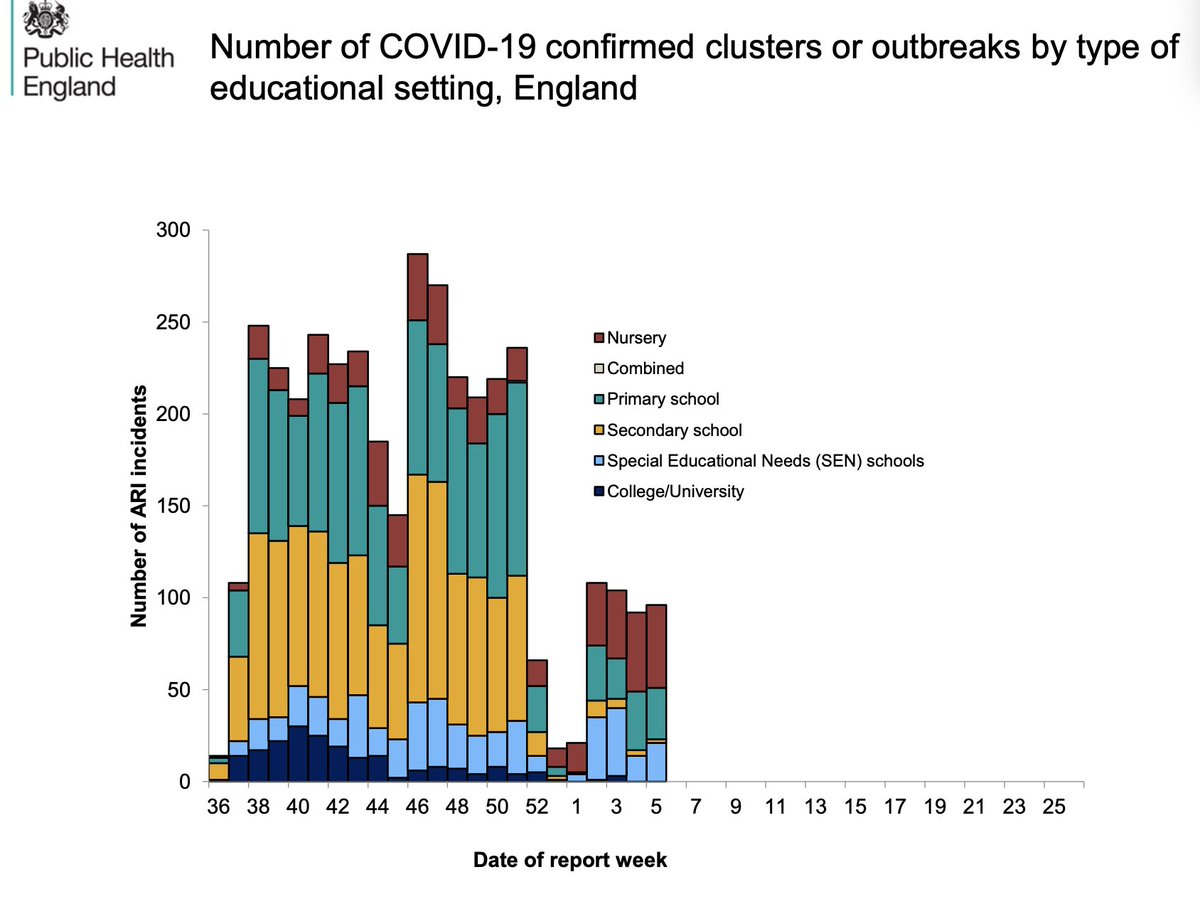
These data are consistent with outbreak data from PHE surveillance, showing that outbreaks in primary schools & pre-school settings continue to occur (albeit at a lower rate than before in primaries), but much more than in secondary schools- in line with higher attendance.
This evidence also feeds into the second myth we hear about - that primary school children don't contribute substantively to transmission. This simply doesn't hold up to scrutiny. The plot from the PHE shows that the number of clusters of cases has been very similar in both.
We also see from the ONS data that primary and secondary school children had the highest prevalence of infection in the community compared to all age groups in December, prior to school closures -prevalence was 2% among primary school children and 3% in 2ndary school children.
All this evidence strongly suggests that infection among children is not simply 'a reflection of infection in the community'. It makes no sense to think that children are getting infected in their households and not within schools.
It's clear that infection in children closely tracks school openings, closure, & the level of attendance. We've seen this in England time and time again. And it's not just secondary schools. It's clear that primary schools play an important role. What about global evidence?
This comprehensive study in Nature Human Behaviour that looked at thousands of interventions implemented at different time points in >200 countries showed that closure of educational institutions was one of the most effective interventions in reducing R.
https://t.co/ANWt3OiiZv
But what about the impact of closure of preschool vs primary vs secondary schools. There was no difference- all of them were similarly effective in reducing R- and closure of any setting had a substantial impact on reducing R.
We also have evidence from the UK from our last lockdown in November, when schools were open, and regions where the new variant was dominant (as it is across the UK now) were showing increases in cases (R>1). R in these regions dropped to below 1 only after schools were closed.
This real-world evidence is reflected in recent modelling by LSHTM that also suggests that in almost all scenarios opening primary or secondary schools would lead to rises of R above 1 in England.
https://t.co/opkso4Nx2S
It's astonishing that despite all this evidence, the need for mitigatory measures in schools in England has been ignored, and we still promote the myth that primary school settings don't contribute significantly to transmission, and that transmission doesn't happen within schools
We don't have to even look to the 8th of March when the govt is planning to reopen schools. We're having outbreaks in schools now - in preschool & primary school settings. Primary school children have the highest prevalence of infection along with young adults. When will we act?
Want to end on the ONS data on school transmission from last year that showed that primary school children were 2x more likely than adults to be the first case in the household, and once infected, 2x more likely to infect contacts than adults.
https://t.co/suNOYlSYgy
This is some of the least biased evidence we have - as it's based on random surveys of children so not dependent on them being symptomatic, and tested. Why are we ignoring this breadth of evidence to the detriment of children, teachers, and communities?