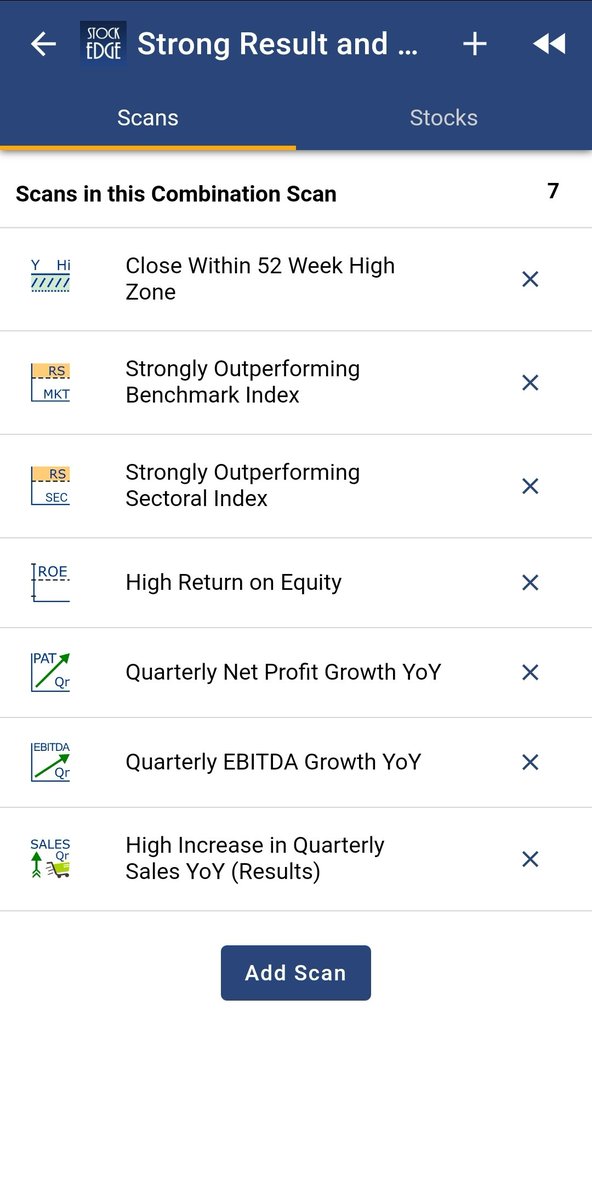
Strong stocks.
Good latest quarterly results.
Trading at 52week high zone.
Good balance sheet performance.
These stocks should be in your buying watchlist.
Try your hand using the simplest scanner in town @mystockedge
More from Learner Vivek Bajaj
This thread will give you access to all our FREE initiatives till date.
1. https://t.co/bPnddzO9NR is India's largest repository of interviews conducted by me, of real market participants.
2. https://t.co/QvERyyhWaE has A2Z of learning related to Trading.
1/n
3. https://t.co/f4yiFFxQ2p for learning basics of Options Trading
4. https://t.co/u56DYdqQAC for comprehensive text modules on Finance in simple school level language
5. https://t.co/dKr2tfcKI1 for practical value added learnings
2/n
6. @mystockedge , simple and effective research tool for serious market participants who want to do-it-on-their-own
7. https://t.co/PgELBirufd for useful market insights.
And more coming soon.
3/n
We have done fair bit of work in democratising financial education and financial data plus analytics in India by making them affordable and effective. Our Free initiatives are powerful and extremely value adding for:
Beginners
Traders
Investors
4/n
N/n
Premium offerings are meant for next level workings. You should checkout all the advance work we are doing in both @elearnmarkets and @mystockedge to make sure that your financial market journey takes the right path of wealth creation.
Follow both the handles for details.
1. https://t.co/bPnddzO9NR is India's largest repository of interviews conducted by me, of real market participants.
2. https://t.co/QvERyyhWaE has A2Z of learning related to Trading.
1/n
3. https://t.co/f4yiFFxQ2p for learning basics of Options Trading
4. https://t.co/u56DYdqQAC for comprehensive text modules on Finance in simple school level language
5. https://t.co/dKr2tfcKI1 for practical value added learnings
2/n
6. @mystockedge , simple and effective research tool for serious market participants who want to do-it-on-their-own
7. https://t.co/PgELBirufd for useful market insights.
And more coming soon.
3/n
We have done fair bit of work in democratising financial education and financial data plus analytics in India by making them affordable and effective. Our Free initiatives are powerful and extremely value adding for:
Beginners
Traders
Investors
4/n
N/n
Premium offerings are meant for next level workings. You should checkout all the advance work we are doing in both @elearnmarkets and @mystockedge to make sure that your financial market journey takes the right path of wealth creation.
Follow both the handles for details.




More from Screeners


You May Also Like




One of the most successful stock trader with special focus on cash stocks and who has a very creative mind to look out for opportunities in dark times
Covering one of the most unique set ups: Extended moves & Reversal plays
Time for a 🧵 to learn the above from @iManasArora
What qualifies for an extended move?
30-40% move in just 5-6 days is one example of extended move
How Manas used this info to book
Post that the plight of the
Example 2: Booking profits when the stock is extended from 10WMA
10WMA =
Another hack to identify extended move in a stock:
Too many green days!
Read
Covering one of the most unique set ups: Extended moves & Reversal plays
Time for a 🧵 to learn the above from @iManasArora
What qualifies for an extended move?
30-40% move in just 5-6 days is one example of extended move
How Manas used this info to book
The stock exploded & went up as much as 63% from my price.
— Manas Arora (@iManasArora) June 22, 2020
Closed my position entirely today!#BroTip pic.twitter.com/CRbQh3kvMM
Post that the plight of the
What an extended (away from averages) move looks like!!
— Manas Arora (@iManasArora) June 24, 2020
If you don't learn to sell into strength, be ready to give away the majority of your gains.#GLENMARK pic.twitter.com/5DsRTUaGO2
Example 2: Booking profits when the stock is extended from 10WMA
10WMA =
#HIKAL
— Manas Arora (@iManasArora) July 2, 2021
Closed remaining at 560
Reason: It is 40+% from 10wma. Super extended
Total revenue: 11R * 0.25 (size) = 2.75% on portfolio
Trade closed pic.twitter.com/YDDvhz8swT
Another hack to identify extended move in a stock:
Too many green days!
Read
When you see 15 green weeks in a row, that's the end of the move. *Extended*
— Manas Arora (@iManasArora) August 26, 2019
Simple price action analysis.#Seamecltd https://t.co/gR9xzgeb9K