#Mahabhashiam #GovindaBhagavatpada #AdiShankara

Adi Shankara's guru was Govinda Bhagavatpada who in turn was a shishya of Sree Gaudapadacharya. Interestingly, his story is connected to Mahabhashiam by Patanjali and his 4 sons are prodigies in their own right.

1/

Sage Patanjali was very kind at heart, but extremely short tempered. After composing the colossal Mahabhashiam, he started to spread the knowledge by conducting classes.

Once, one of his students stepped out of class. Patanjali was very furious & flames came out of his eyes.

2/
The flames burnt all 999 students in the class. The student who stepped out came in and said, "Gurudeva, don't worry. I am alive. I can propogate the knowledge of Mahabhashiam"

Patanjali was furious that because of him he lost others & landed up burning him down too

3/
There was a Gandharva who comes & says, "Master, I have learnt the Mahabhashiam from the nearby Peepal tree. I can help spread the knowledge"

Patanjali was livid and anger and curses him that he has cheated and hence, should become Brahmarakshasa.

4/
Gandharva begs for forgiveness. Patanjali says that he will meet a befitting student to whom he should teach Mahaabhashiam. Once the student learns, he will be rid of curse

Brahmarakshasa starts to pose questions to passing by Brahmins. When they dont answer, he eats them

5/
One day, a Brahmin boy comes across. The Brahmarakshasa poses the same question to which the Brahmin boy answers correctly.

Pleased with his answer, he takes the Brahmin boy under his tutelage and starts his education on Mahaabhashiam

6/
Before he starts the class, he gives a special medicine to the student that rids him of hunger and sleep. For 6 months, the Brahmarakshasa writes on peepal leaves and drops them to the ground.

Student is very good and picks up the concepts in a very quick time

7/
When the education is completed, Gandharva resumes his original form and blesses the Brahmin kid. Before he leaves, he mentions that the drug will lose its effect if he touches water.

If he comes in touch with water, he will sleep for 6 months.

8/
The Brahmin boy collects all his peepal leaves into a bundle and starts his journey to spread the word

Once he comes across a river, but without any boat to cross. Thinking the water is shallow, he tries to cross the river, but falls in the river.

9/
Immediately, he falls asleep. Nearby a shudra lady would observe this and rescue him with the help of nearby people.

She takes care of him for 6 months during which he sleeps. Based on a doctor's advice, they cover him with rice (Annalepanam) to keep him rejuvenated

10/
After 6 months, he wakes up and eagerly searches for the bundle of leaves. Miraculously, he finds them near the river, but some leaves would be missing.

He observes nearby cows and checks on the owner who turns out to be the same lady.

11/
Next morning, he goes to the cowshed and checks the dung. As expected, the peepal leaves were untouched. He washes and categorizes the leaves.

It's the blessings of Rsi Patanjali & mahima of Mahaabhashiam that it was saved thus

12/
Pleased by the care of the Shudra woman, he requests her to ask for a boon. She says that since I took care of you, I can't take care of another man. I would like you to marry me.

The Brahmin who would be contemplating sanyaasa is now in a fix.

13/
After some thought, he says : Look I need to marry a woman of each varna before I marry you. Please wait for me.

True to his word, he marries a Brahmin lady, a Kshatriya, a Vaisya lady and finally the shudra lady.

He starts his family life with his 4 wives.

14/
Over a period of time, 4 sons are born from each mother. He teaches them with the restrictions applicable to varnas as was the norm of that time.

Hence, the son born to the shudra lady had to sit behind a curtain and he had to promise not to spread the holy text..

15/
The Brahmin's sons are:

1. Vararuchi - renowned Scholar of Prakrutaprakasham & Dhanapanchakam

2. Vikramaaditya - Emperor of Ujjaini

3. Bhatti - Minister of Vikramaaditya & author of Bhattivakyam

4. Bharthruhari - celebrated write of Hariteeka and Vakiapadyam

16/
After his sons were established, he left home and took up sanyaasa. His guru was Sree Gaudapadacharya.

The name the person took was Govindaswami / Govinda Bhagavatpaada, whose illustrious student is none other than Adi Shankara

17/
Ref: AithiyaMaala by Kottarathil Sankunni

Thank you @/swamy64 Sir for this wonderful reference. I learnt a lot through this wonderful episode. Hope you too enjoyed the same.

🙏🕉️🙏
@threadreaderapp compile please

More from GunduHuduga| ಗುಂಡು ಹುಡುಗ|🕉

#Ramayana #LecturesOnTheRamayana

Today, I will quote a few verses on Lakshmana's famous anger and his unflinching devotion towards Sri Rama. There are couple of instances where his Bhakti towards his brother is intense.

Thread below

1/

In Ayodhya Kanda, Sarga 21, Lakshmana on being told about the course of events goes into his famous rage. He even threatens to kill anyone who supports Bharatha.

However, what he says to Kausalya is what touches one's soul. A couple of shlokas below

2/

अनुरक्तोऽस्मि भावेन भ्रातरं देवि तत्त्वतः।
सत्येन धनुषा चैव दत्तेनेष्टेन ते शपे।।16।।

O mother, (Lakshmana says to Kausalya) I am truly loyal to my brother from the bottom of my heart. I swear this by my bow, on my merits earned through charity, ...

3/

by my truthfulness & by the good deeds I have done

दीप्तमग्निमरण्यं वा यदि रामः प्रवेक्ष्यति।
प्रविष्टं तत्र मां देवि त्वं पूर्वमवधारय।।17।।

O mother rest assured should Rama enter a blazing fire or a forest I must have already entered it

4/

This is fiercely violent sentiment .. One of pure unbridled emotion where he swears by all his karma that he will be the first face dangers before Rama has to endure it.

Is this unlimited Bhakti ? Or protective nature towards his Rama?

5/
#Ramayana #LecturesOnTheRamayana

In the past, we had a glimpse of Lakshmana's devotion towards Sri Rama, his brother and father figure.

However, it is interesting to note his unique relationship with Sita, especially as seen by from her perspective.

Thread below

1/

We all know about the Golden Deer / Maricha incident and the way Sita influences Lakshmana to go in search of his brother.

Personally, I am unable to get 2 strong emotional points in one thread and hence, I will skip this incident for today.

2/

In Sundara Kanda, when Hanuman meets Sita, she says the following

सिंहस्कन्धो महाबाहुर्मनस्वी प्रियदर्शिनः।
पितृवद्वर्तते रामे मातृवन्मां समाचरन्।।

Lakshmana, who has lionshoulders and strong arms, who is handsome, who takes Rama as his father & treats me as his own mother

3/

ह्रियमाणां तदा वीरो न तु मां वेद लक्ष्मणः।
वृद्धोपसेवी लक्ष्मीवान् शक्तो न बहुभाषिता।।

Heroic Lakshmana, did not know while I was borne away. He is prosperous, foremost in serving elders. He is energetic and reserved in his speech like my father-in-law ..

4/

He is a prince dear (to his brother).

These are from Sarga-38, shlokas 60 and 61.

There are 3 distinct points which I want to draw the attention of the reader to.

1. She also compares Lakshmana to Dasaratha much like how Rama did when he constructed the hut in panchavati

5/

More from Religion

MDZS is laden with buddhist references. As a South Asian person, and history buff, it is so interesting to see how Buddhism, which originated from India, migrated, flourished & changed in the context of China. Here's some research (🙏🏼 @starkjeon for CN insight + citations)

1. LWJ’s sword Bichen ‘is likely an abbreviation for the term 躲避红尘 (duǒ bì hóng chén), which can be translated as such: 躲避: shunning or hiding away from 红尘 (worldly affairs; which is a buddhist teaching.) (
https://t.co/zF65W3roJe) (abbrev. TWX)

2. Sandu (三 毒), Jiang Cheng’s sword, refers to the three poisons (triviṣa) in Buddhism; desire (kāma-taṇhā), delusion (bhava-taṇhā) and hatred (vibhava-taṇhā).

These 3 poisons represent the roots of craving (tanha) and are the cause of Dukkha (suffering, pain) and thus result in rebirth.

Interesting that MXTX used this name for one of the characters who suffers, arguably, the worst of these three emotions.

3. The Qian kun purse “乾坤袋 (qián kūn dài) – can be called “Heaven and Earth” Pouch. In Buddhism, Maitreya (मैत्रेय) owns this to store items. It was believed that there was a mythical space inside the bag that could absorb the world.” (TWX)

You May Also Like

@EricTopol @NBA @StephenKissler @yhgrad B.1.1.7 reveals clearly that SARS-CoV-2 is reverting to its original pre-outbreak condition, i.e. adapted to transgenic hACE2 mice (either Baric's BALB/c ones or others used at WIV labs during chimeric bat coronavirus experiments aimed at developing a pan betacoronavirus vaccine)

@NBA @StephenKissler @yhgrad 1. From Day 1, SARS-COV-2 was very well adapted to humans .....and transgenic hACE2 Mice


@NBA @StephenKissler @yhgrad 2. High Probability of serial passaging in Transgenic Mice expressing hACE2 in genesis of SARS-COV-2


@NBA @StephenKissler @yhgrad B.1.1.7 has an unusually large number of genetic changes, ... found to date in mouse-adapted SARS-CoV2 and is also seen in ferret infections.
https://t.co/9Z4oJmkcKj


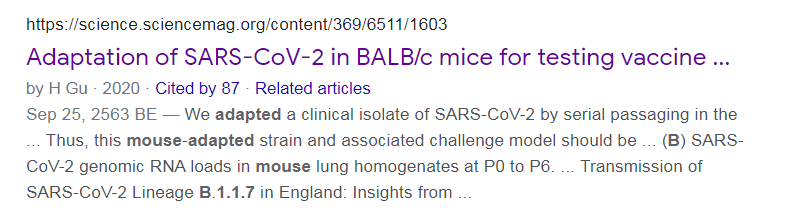
@NBA @StephenKissler @yhgrad We adapted a clinical isolate of SARS-CoV-2 by serial passaging in the ... Thus, this mouse-adapted strain and associated challenge model should be ... (B) SARS-CoV-2 genomic RNA loads in mouse lung homogenates at P0 to P6.
https://t.co/I90OOCJg7o
Still wondering about this 🤔


save as q