Good morning, post-election frivolous performative litigation followers - we've got another new filing in Seditionists v 117th Congress et al.
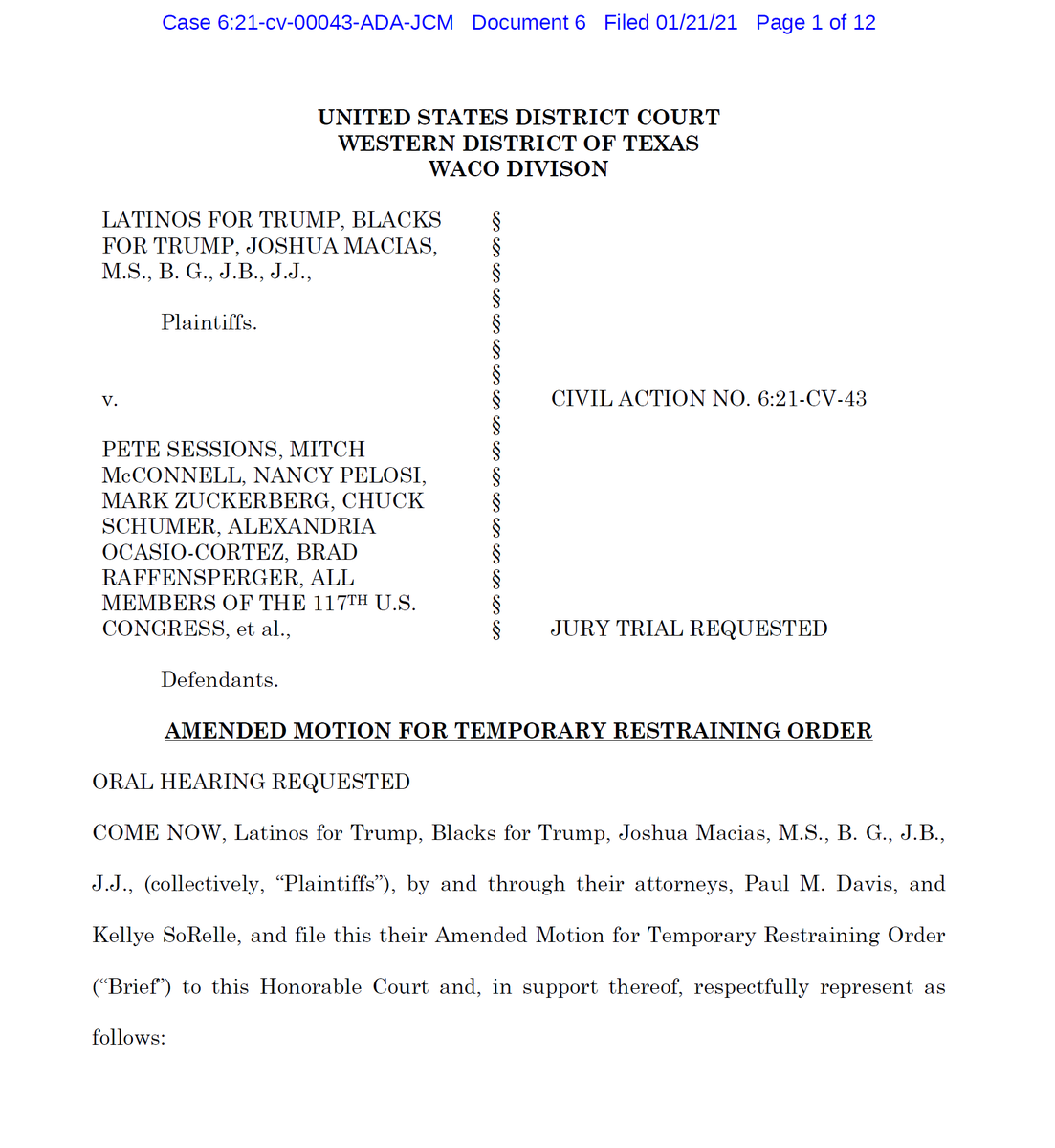
It's yet another motion for a Temporary Restraining Order - making it the 3rd in 3 days.
And it's a
So they're still stuck at Step 1.
But that's honestly the least of their issues.
I'm not a litigator but I don't think that's a recognized alternative to attempting to provide notice to the adverse party.
...unique.
Do they think this is the Lord of the Rings? Should this pleading be titled "Waiting for Aragorn"?

First of all, they forgot to include a proper citation and pincite.
Second, no, really, what the bloody hell are you people SMOKING?

I just keep staring at the boldface and italicized "Gondor has no King" on the screen.
My eyes are refusing to move further into the document.
MY.
GOD.
They want the entire government (less the judiciary) placed into "a state of stewardship" on an ex parte basis *pending* actual proceedings.
I can't even.

Pro tip:
Invest in a good dictionary. A printed one. Cite to that.
Also, don't end citations in the middle of words.

Not only does that LOTR footnote exist but there's a callback to it IN THE SAME PARAGRAPH?


Seriously, no. Even if anything they argued was a thing, there's plenty of time to deal with it before the next election.

"We're so cuckoo for cocopuffs that we've forgotten how to do even relatively simple legal analysis."

YOU TWO SEDITIOUS DINGBATS ARE NOMINALLY LAWYERS!!
Why are you talking about having the marksman-aviator-assclown help you with a basic legal task????


No. You can not use purported injuries to potential plaintiffs as a basis for demanding relief.
No. That does not change if you sneak in the capital letter.


The only named plaintiff in a nutso lawsuit brought against literally every lawmaker by Texas lawyer Paul Davis (of Capitol riot fame) was also arrested for bringing guns to Philadelphia to "inspect" the ballots. But: No record of him voting in North Carolina. Sworn affidavit \U0001f447 pic.twitter.com/E9Ggn8BQ6r
— Roger Sollenberger (@SollenbergerRC) January 21, 2021
But Gondor.


They have no clue what they're talking about and it's painfully obvious.


They also included a proposed TRO. And it's even more bonkers (that's a term of art) than the motion.
https://t.co/THSEVgsMwa

THIS IS A PROPOSED ORDER NOT AN ACTUAL ONE.
It's written as if it's drafted by the court, but it is not (and never will be) a court order. Writing proposed orders is, in general, normal. It's this specific proposed order that's pure bat guano.


More from Mike Dunford

Happy Monday! Dominion Voting Systems is suing Rudy Giuliani for $1.3 billion.
As Akiva notes, the legal question is going to boil down to something known as "actual malice."
That's a tricky concept for nonlawyers (and often for lawyers) so an explainer might help.
What I'm going to do with this thread is a bit different from normal - I'm going to start by explaining the underlying law so that you can see why lawyers are a little skeptical of the odds of success, and only look at the complaint after that.
So let's start with the most basic basics:
If you want to win a defamation case, you have to prove:
(1) that defendant made a false and defamatory statement about you;
(2) to a third party without privilege;
(3) with the required degree of fault;
(4) causing you to suffer damage.
For Dominion's defamation cases, proving 1 and 4 is easy. 2 is, in the case of the lawyers they're suing, slightly more complex but not hard. And 3 - degree of fault - is really really hard to prove.
A false statement of fact that is defamatory is a slam dunk element here - all the fraud allegations against dominion are totally banana-pants. They are also allegations which are clearly going to harm Dominion's reputation.
As Akiva notes, the legal question is going to boil down to something known as "actual malice."
That's a tricky concept for nonlawyers (and often for lawyers) so an explainer might help.
So Dominion sued Rudy for defamation. How are they ever going to allege actual malice? https://t.co/p8d3flDkGm
— Akiva Cohen (@AkivaMCohen) January 25, 2021
What I'm going to do with this thread is a bit different from normal - I'm going to start by explaining the underlying law so that you can see why lawyers are a little skeptical of the odds of success, and only look at the complaint after that.
So let's start with the most basic basics:
If you want to win a defamation case, you have to prove:
(1) that defendant made a false and defamatory statement about you;
(2) to a third party without privilege;
(3) with the required degree of fault;
(4) causing you to suffer damage.
For Dominion's defamation cases, proving 1 and 4 is easy. 2 is, in the case of the lawyers they're suing, slightly more complex but not hard. And 3 - degree of fault - is really really hard to prove.
A false statement of fact that is defamatory is a slam dunk element here - all the fraud allegations against dominion are totally banana-pants. They are also allegations which are clearly going to harm Dominion's reputation.
This is an excellent question, and it's something that I've thought about some over the last couple of months.
Honestly, I think the answer is that the rationales for these rulings are not likely to unreasonably harm meritorious progressive OR conservative challenges.
The first thing to keep in mind is that, by design, challenges to the outcomes of elections are supposed to be heard by state courts, through the process set out in state law.
That happened this year, and the majority of those challenges were heard on the merits.
The couple of cases where laches determined the outcome of state election challenges were ones where it was pretty clear that the challenges were brought in bad faith - where ballots cast in good faith in reliance on laws that had been in force for some time were challenged.
The PA challenge to Act 77 is one example. The challengers, some of whom had voted for passage of the bill, didn't make use of the initial, direct-to-PA-SCt challenge built into the law or sue pre-election; they waited until post-election.
The WI case is another. That one had a challenge to ballots cast using a form that had been in use for a literal decade.
Those are cases where laches is clear - particularly the prejudice element.
Honestly, I think the answer is that the rationales for these rulings are not likely to unreasonably harm meritorious progressive OR conservative challenges.
Any merit to the notion that the rationales for some of these rulings will harm progressive challenges in future elections?
— Andrew Broering (@AndrewBroering) January 3, 2021
One says laches, another moot, another standing, sometimes with almost the same type of plaintiff.
The first thing to keep in mind is that, by design, challenges to the outcomes of elections are supposed to be heard by state courts, through the process set out in state law.
That happened this year, and the majority of those challenges were heard on the merits.
The couple of cases where laches determined the outcome of state election challenges were ones where it was pretty clear that the challenges were brought in bad faith - where ballots cast in good faith in reliance on laws that had been in force for some time were challenged.
The PA challenge to Act 77 is one example. The challengers, some of whom had voted for passage of the bill, didn't make use of the initial, direct-to-PA-SCt challenge built into the law or sue pre-election; they waited until post-election.
The WI case is another. That one had a challenge to ballots cast using a form that had been in use for a literal decade.
Those are cases where laches is clear - particularly the prejudice element.
More from Politics


You May Also Like






Recently, the @CNIL issued a decision regarding the GDPR compliance of an unknown French adtech company named "Vectaury". It may seem like small fry, but the decision has potential wide-ranging impacts for Google, the IAB framework, and today's adtech. It's thread time! 👇
It's all in French, but if you're up for it you can read:
• Their blog post (lacks the most interesting details): https://t.co/PHkDcOT1hy
• Their high-level legal decision: https://t.co/hwpiEvjodt
• The full notification: https://t.co/QQB7rfynha
I've read it so you needn't!
Vectaury was collecting geolocation data in order to create profiles (eg. people who often go to this or that type of shop) so as to power ad targeting. They operate through embedded SDKs and ad bidding, making them invisible to users.
The @CNIL notes that profiling based off of geolocation presents particular risks since it reveals people's movements and habits. As risky, the processing requires consent — this will be the heart of their assessment.
Interesting point: they justify the decision in part because of how many people COULD be targeted in this way (rather than how many have — though they note that too). Because it's on a phone, and many have phones, it is considered large-scale processing no matter what.