
Dear @HouseDemocrats:
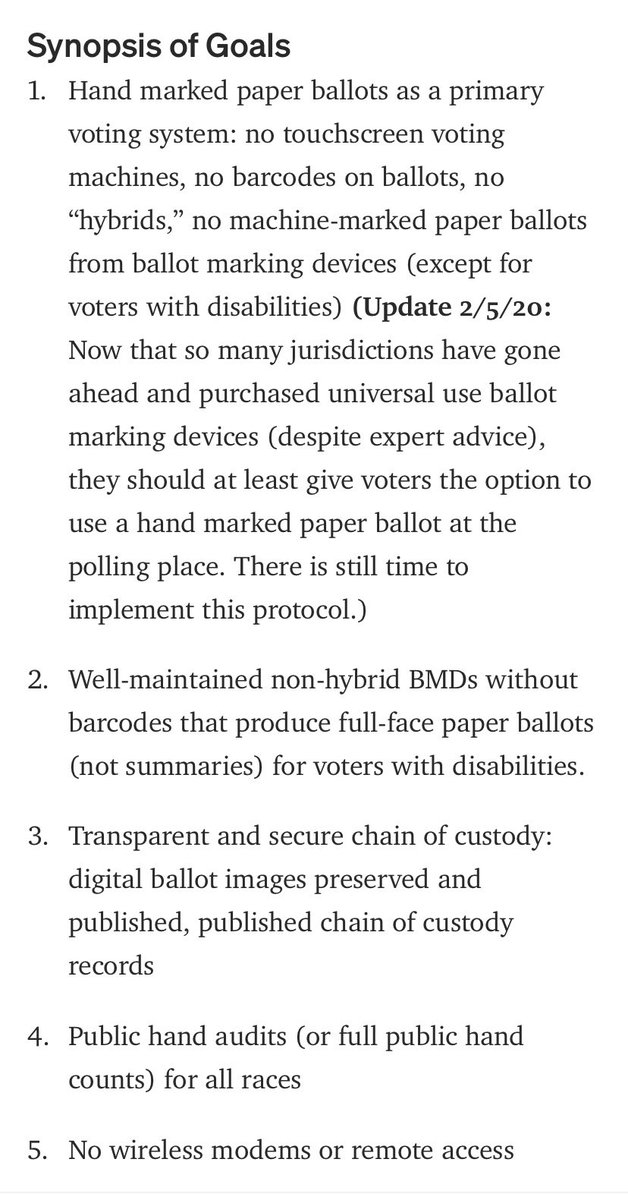
HR 1 requires that the voter “have the option to mark his or her ballot by hand.”
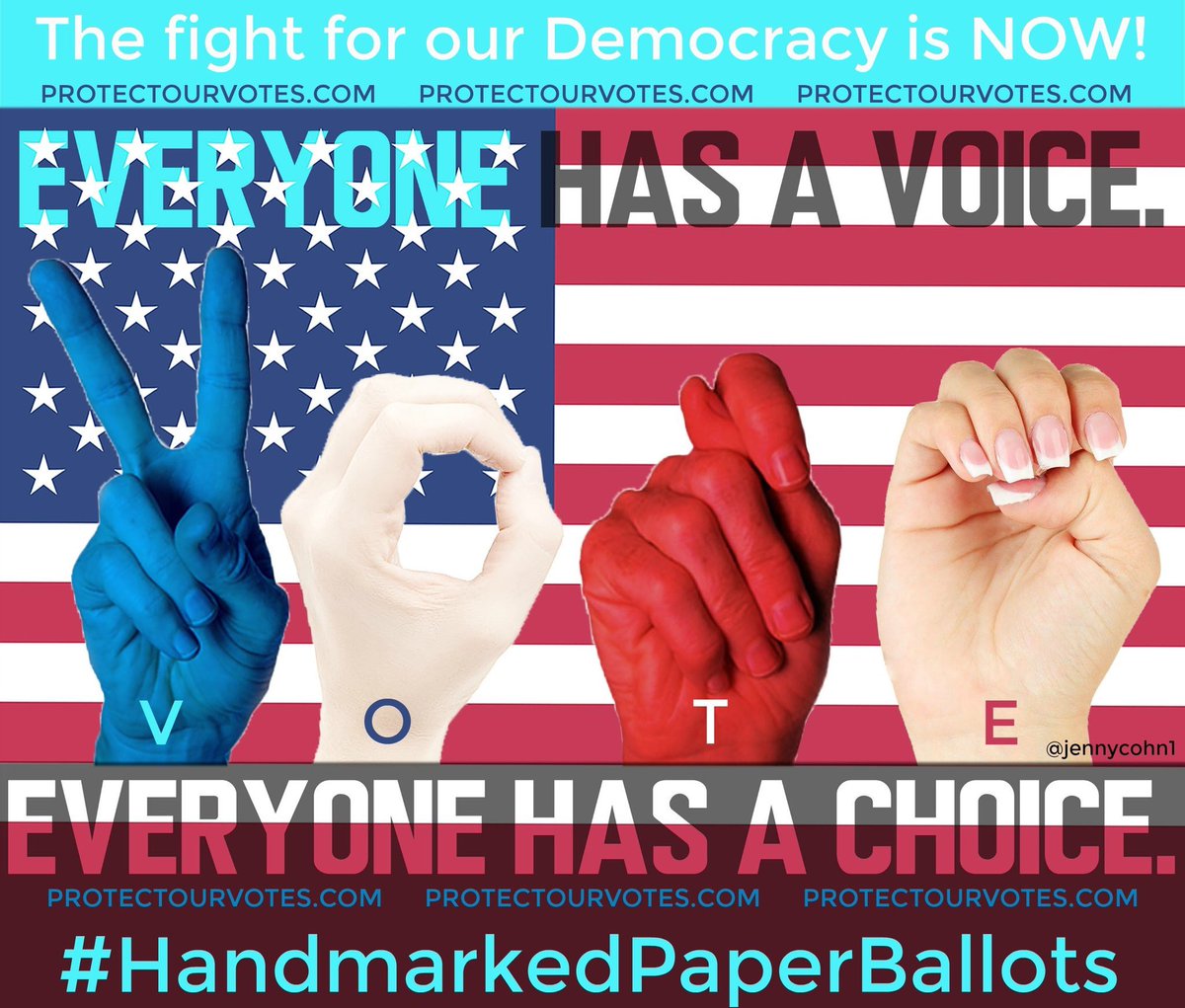
Pls add the following for clarity: “For jurisdictions w/ in person voting, this option shall be provided to the voter at the polling place.” @RepTedLieu @katieporteroc 1/


More from Jennifer Cohn ✍🏻 📢
Agree. Also Bannon suggesting that Fauci shld be beheaded & Lyn Wood calling for Pence’s execution. These are Trump’s close advisors. Did Trump ever publicly disavow?
Very good that Rep Raskin is showing the long, consistent history of Trump instigating violence. This context is necessary. They should extend documentation to Trump's advisors -- like Roger Stone calling for a "bloodbath" since 2016 if Trump loses an election #ImpeachmentTrial
— Sarah Kendzior (@sarahkendzior) February 11, 2021
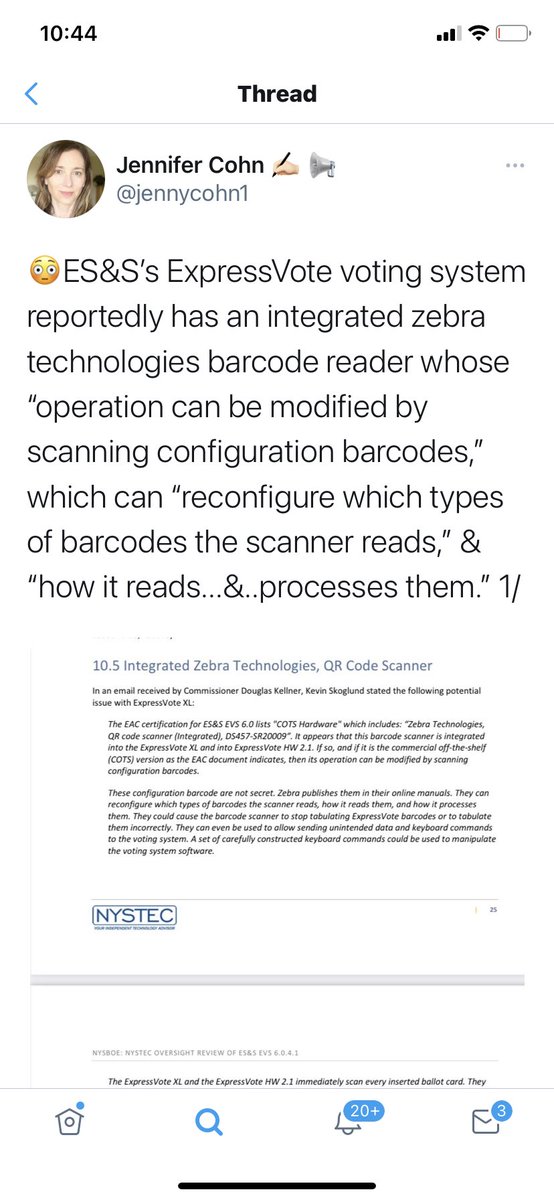
Good news! The New York State Board of Elections voted yesterday to REJECT certification of ES&S’s ExpressVote XL all-in-one barcode ballot marking device (BMD), a glitchy & hackable touchscreen that ES&S has hoped officials would stupidly buy in lieu of pen and paper. 1/
I’m still trying to find out @NYSBOE’s reasoning, but I know one problem was that the ExpressVote XL runs on Windows 7 and can only mark ballots in English. If the XL were a person, it would be a MAGA. 2/
The XL has other problems. It runs the barcode “paper ballot” back under the printout AFTER the voter reviews it, which experts say means it could be maliciously programmed to eff with the barcode that is the only part of the “paper ballot” counted as your vote. 3/
Unfortunately, Philadelphia did choose the ES&S ExpressVote XL all-in-one ballot marking device (BMD), ignoring expert advice. I wrote about that unfortunate decision here in 2019. 4/
Here, for @NYRBooks, I also discuss problems involving the ES&S ExpressVote XL in PA in 2019. ES&S lobbyists had secretly donated to the two decision makers who then chose this system in Philly in lieu of #HandMarkedPaperBallots (pen & paper). 5/
It\u2019s official. The @NYSBOE rejected the certification of the ExpressVote XL.
— Common Cause NY (@commoncauseny) January 28, 2021
Now lawmakers should pass legislation that bans hybrid machines like the ExpressVote XL for good. https://t.co/hE83CTdgiJ
I’m still trying to find out @NYSBOE’s reasoning, but I know one problem was that the ExpressVote XL runs on Windows 7 and can only mark ballots in English. If the XL were a person, it would be a MAGA. 2/
The XL has other problems. It runs the barcode “paper ballot” back under the printout AFTER the voter reviews it, which experts say means it could be maliciously programmed to eff with the barcode that is the only part of the “paper ballot” counted as your vote. 3/
Unfortunately, Philadelphia did choose the ES&S ExpressVote XL all-in-one ballot marking device (BMD), ignoring expert advice. I wrote about that unfortunate decision here in 2019. 4/
Here, for @NYRBooks, I also discuss problems involving the ES&S ExpressVote XL in PA in 2019. ES&S lobbyists had secretly donated to the two decision makers who then chose this system in Philly in lieu of #HandMarkedPaperBallots (pen & paper). 5/
.@CharlieKirk11’s “Turning Point Action was listed as a participant in [the] ... rally, which preceded the attack on Capitol Hill. Prior to the rally, in a tweet he later deleted, Kirk said the group wld be involved w/ sending over 80 buses...” 1/
2/ “CNBC captured a screenshot of tweet before it was deleted.
Kirk recently said on his podcast that those from Turning Point got back on their buses & left following the conclusion of the rally.”
3/ Thread
4/ 😳
5/
2/ “CNBC captured a screenshot of tweet before it was deleted.
Kirk recently said on his podcast that those from Turning Point got back on their buses & left following the conclusion of the rally.”
3/ Thread
Here are some of the mainstream donor advised funds who contributed to Turning Point USA, a cosponsor of the protest that preceded the deadly attack on the Capitol.
— Eli Clifton (@EliClifton) January 11, 2021
They helped anonymize contributions for donors.
These numbers are just from each group's most recent tax filing.
4/ 😳
when you brought 80 buses of people to an insurrection and want your audience of republican millionaires to forget it pic.twitter.com/phnvCVzJw9
— John Whitehouse (@existentialfish) January 11, 2021
5/
How did 26-year-old Charlie Kirk go from living with his parents to a waterfront condo? Over a short period of time, his pay from the pro-Trump charity he co-founded rose to 300k. https://t.co/k9UO83awsi
— ProPublica (@propublica) January 13, 2021
More from Politics



You May Also Like








1/ Some initial thoughts on personal moats:
Like company moats, your personal moat should be a competitive advantage that is not only durable—it should also compound over time.
Characteristics of a personal moat below:
2/ Like a company moat, you want to build career capital while you sleep.
As Andrew Chen noted:
3/ You don’t want to build a competitive advantage that is fleeting or that will get commoditized
Things that might get commoditized over time (some longer than
4/ Before the arrival of recorded music, what used to be scarce was the actual music itself — required an in-person artist.
After recorded music, the music itself became abundant and what became scarce was curation, distribution, and self space.
5/ Similarly, in careers, what used to be (more) scarce were things like ideas, money, and exclusive relationships.
In the internet economy, what has become scarce are things like specific knowledge, rare & valuable skills, and great reputations.
Like company moats, your personal moat should be a competitive advantage that is not only durable—it should also compound over time.
Characteristics of a personal moat below:
I'm increasingly interested in the idea of "personal moats" in the context of careers.
— Erik Torenberg (@eriktorenberg) November 22, 2018
Moats should be:
- Hard to learn and hard to do (but perhaps easier for you)
- Skills that are rare and valuable
- Legible
- Compounding over time
- Unique to your own talents & interests https://t.co/bB3k1YcH5b
2/ Like a company moat, you want to build career capital while you sleep.
As Andrew Chen noted:
People talk about \u201cpassive income\u201d a lot but not about \u201cpassive social capital\u201d or \u201cpassive networking\u201d or \u201cpassive knowledge gaining\u201d but that\u2019s what you can architect if you have a thing and it grows over time without intensive constant effort to sustain it
— Andrew Chen (@andrewchen) November 22, 2018
3/ You don’t want to build a competitive advantage that is fleeting or that will get commoditized
Things that might get commoditized over time (some longer than
Things that look like moats but likely aren\u2019t or may fade:
— Erik Torenberg (@eriktorenberg) November 22, 2018
- Proprietary networks
- Being something other than one of the best at any tournament style-game
- Many "awards"
- Twitter followers or general reach without "respect"
- Anything that depends on information asymmetry https://t.co/abjxesVIh9
4/ Before the arrival of recorded music, what used to be scarce was the actual music itself — required an in-person artist.
After recorded music, the music itself became abundant and what became scarce was curation, distribution, and self space.
5/ Similarly, in careers, what used to be (more) scarce were things like ideas, money, and exclusive relationships.
In the internet economy, what has become scarce are things like specific knowledge, rare & valuable skills, and great reputations.


