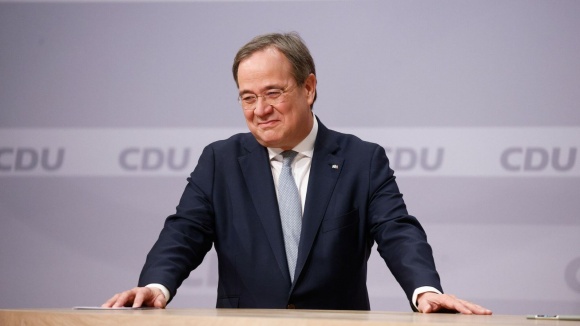
OK, so it's a fortnight away - the "Digital Party Conference" of the CDU to decide who the next party leader will be

And whoever wins this is going to have a good chance of being Chancellor, succeeding Merkel after the election in September this year

There are three main candidates in the running - all middle aged men from Nordrhein Westfalen
- Friedrich Merz
- Armin Laschet
- Norbert Röttgen
So who's going to win?

For ages it looked like Laschet was the clear front runner. Prime Minister of Nordrhein Westfalen (NRW), and with a kind of folksy-beergarten manner, it looked good for him.
But then came COVID, and in the first wave it looked like NRW was pushing to open up too early, and questions started to be raised as to whether he would be up to the job...

Laschet's star is falling
The candidate profiting is Merz. The comeback kid at 65 years of age would take the CDU more to the right - which seems to be what a slew of the 1001 delegates (esp those from the states of eastern Germany) want. That despite the pragmatic line of Merkel being +popular than ever.
The problem is that while the party faithful might like him, does anyone else? The CDU might find it hard to find coalition partners were it to go for Merz, and the SPD would be rubbing its hands with glee were he to win.
Röttgen is both more pragmatic and more centrist than Merz, and a much more compelling character than Laschet. But hasn't got a chance. Such is party politics...
A couple of news stories in German trying to make sense of the discussion currently - this today from Bild
https://t.co/24tiw4EaTm

And this trying to assess delegate intentions
https://t.co/DOWldt6u6G
How this pans out is going to have a major impact on both Germany and Europe... A victory for Merz is both a scary prospect, but also opens up the opportunity for a German government without the CDU in it for the first time since 2005
I'll have a close eye on this over the next fortnight - and beyond!

/ends

More from Jon Worth

Next week is shaping up to be one hell of a week in 🇬🇧 politics

It all revolves around parliamentary sovereignty, Tory party shenanigans, and Johnson's need to survive and if that contradicts with doing the right thing

Bear with me - this is messy but important

1/12

Why will it be hellish?

We *know* that there will be a vote on Coronavirus Tier system on Tue 1 Dec, with the system to come into force from the end of 2 Dec

There *might* be a Brexit Deal at the start of next week as well, and Johnson having to OK it or not

2/12

Coronavirus first

I am not well placed to judge whether the Tier system is right (don't @ - reply me about that), but it's enough to say there are 3 grounds for critique
- do lockdowns work?
- does THIS lockdown system work?
- has my town/region been harshly treated?

3/12

Those are enough grounds for plenty of parliamentary opposition on the Tory benches, and on opposition benches too.

Labour could easily justify voting against in that some of the judgments on Tiers are not strictly based on the science

But what does voting *against* mean?

4/12

Were the vote lost, there would be little or no actual practical consequence regarding the Coronavirus restrictions - as discussed with Adam Wagner the government would almost certainly table Regulations using its emergency powers
OK, it can be avoided no more.

This is perhaps the most complex 🧵 on #Brexit I've ever attempted. But this issue really matters.

Business, possibly even lives, depend on getting this stuff right.

It is about the complexity of Brexit delay, and what to do about it.

1/25

If negotiations had gone to plan, it would have worked thus:

1️⃣ 🇬🇧&🇪🇺 agree a Deal, politically
2️⃣ That is then turned into a legally ratifiable text
3️⃣ Both sides then ratify - on 🇪🇺 side Member States and the EP, 🇬🇧 side the Houses of Parliament
4️⃣ Deal in force 1.1.2021

2/25

The problem: we do not have 1️⃣ yet.

And with just over 16 days to go - including 🌲 - we do not have time for 2️⃣ and 3️⃣ and hence no 4️⃣.

We *might* have time for 2️⃣ - and that could prove to be significant (see tweet 7 below), but definitely not 3️⃣ on 🇪🇺 side.

3/25

*Essential* problem: by having spent so long talking (I think 🇬🇧 tactic has been to run down the clock -
https://t.co/8EJZAJZHqz ) the path to a normal ratification is now ⛔️.

Now ratification becomes harder - legally, politically, practically - with every passing hour.

4/25

The most obvious stumbling block is...

🥁🥁🥁

... the European Parliament!

Parliamentary sovereignty, eh? A topic for another time.

Anyway, the EP has said it will not vote on a Brexit Deal this

More from Politics

You May Also Like