100%. Need clear separation of powers.

With direct elections for an executive President, who appoints the Cabinet of Ministers and sets government policy.

In parliament, the Speaker to be seen as the leader of the legislature. MPs responsible only for laws, amendments, repeals.

The Constitution and laws need to be democratised.

Rewritten in simple language, translated into every state language, and made available as original sources online, so people can access them and understand laws themselves instead of being dependent on self-appointed custodians.
We need more local democracy and fewer regional satraps.

Dissolve the current states and upgrade 740 districts into elected Janapadas/Prefectures, to improve policy outcomes on the ground.

No more MLAs and DMs acting like local feudal lords. Bottom-up, accessible institutions.
In each Janapada, assign community policing/crime prevention to local police, accountable to local citizens.

Assign law and order, crime investigation, counter-terrorism to a new central police force, independent of executive. Like the armed forces, with parliamentary oversight.
Split the Supreme Court into a Constitutional Court and Court of Final Appeal, with clear and separate functions and duties.

Give each Janapada a system a decentralised system of courts and alternative dispute resolution mechanisms, working in local languages and jargon-free.
The issue is not that we have too much democracy, we have too little.

The current unelected and unaccountable bureaucratic and judicial institutions suffer from a "democratic deficit" and are all designed to thwart any aspirations of the people that can challenge the status quo.
"In most democratic countries, ... the police work under the control of local self-government bodies.

But in India, the police is not answerable or accountable to the local people whose lives and properties it is supposed to protect." - @MNageswarRaoIPS

https://t.co/g9timGDlWX
Many of the suggestions in the above thread may sound radical or utopian, but they exist worldwide, including here in the Indian subcontinent.

Sri Lanka being an example, which enacted such reforms despite similar levels of religious diversity and colonial administrative legacy.
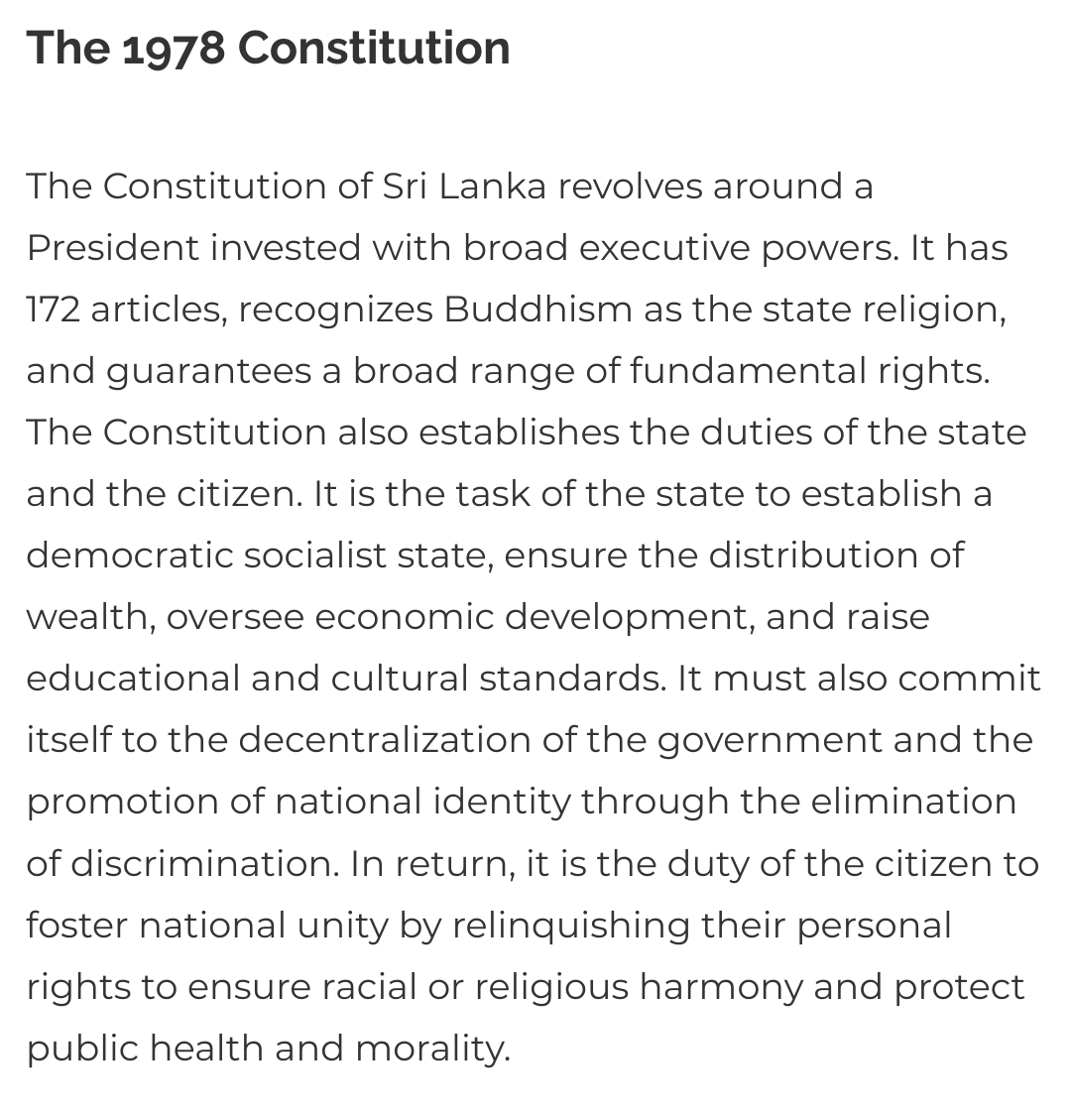
For those looking for inspiration for what our next Constitution could look like, instead of copying dysfunctional and discredited models from the Anglosphere, let's learn from and improve on other Asian countries with similar challenges and experiences.

https://t.co/ECRjzl7vto

More from Politics

You May Also Like

Ivor Cummins has been wrong (or lying) almost entirely throughout this pandemic and got paid handsomly for it.

He has been wrong (or lying) so often that it will be nearly impossible for me to track every grift, lie, deceit, manipulation he has pulled. I will use...


... other sources who have been trying to shine on light on this grifter (as I have tried to do, time and again:


Example #1: "Still not seeing Sweden signal versus Denmark really"... There it was (Images attached).
19 to 80 is an over 300% difference.

Tweet: https://t.co/36FnYnsRT9


Example #2 - "Yes, I'm comparing the Noridcs / No, you cannot compare the Nordics."

I wonder why...

Tweets: https://t.co/XLfoX4rpck / https://t.co/vjE1ctLU5x


Example #3 - "I'm only looking at what makes the data fit in my favour" a.k.a moving the goalposts.

Tweets: https://t.co/vcDpTu3qyj / https://t.co/CA3N6hC2Lq
The YouTube algorithm that I helped build in 2011 still recommends the flat earth theory by the *hundreds of millions*. This investigation by @RawStory shows some of the real-life consequences of this badly designed AI.


This spring at SxSW, @SusanWojcicki promised "Wikipedia snippets" on debated videos. But they didn't put them on flat earth videos, and instead @YouTube is promoting merchandising such as "NASA lies - Never Trust a Snake". 2/


A few example of flat earth videos that were promoted by YouTube #today:
https://t.co/TumQiX2tlj 3/

https://t.co/uAORIJ5BYX 4/

https://t.co/yOGZ0pLfHG 5/
IMPORTANCE, ADVANTAGES AND CHARACTERISTICS OF BHAGWAT PURAN

It was Ved Vyas who edited the eighteen thousand shlokas of Bhagwat. This book destroys all your sins. It has twelve parts which are like kalpvraksh.

In the first skandh, the importance of Vedvyas


and characters of Pandavas are described by the dialogues between Suutji and Shaunakji. Then there is the story of Parikshit.
Next there is a Brahm Narad dialogue describing the avtaar of Bhagwan. Then the characteristics of Puraan are mentioned.

It also discusses the evolution of universe.(
https://t.co/2aK1AZSC79 )

Next is the portrayal of Vidur and his dialogue with Maitreyji. Then there is a mention of Creation of universe by Brahma and the preachings of Sankhya by Kapil Muni.


In the next section we find the portrayal of Sati, Dhruv, Pruthu, and the story of ancient King, Bahirshi.
In the next section we find the character of King Priyavrat and his sons, different types of loks in this universe, and description of Narak. ( https://t.co/gmDTkLktKS )


In the sixth part we find the portrayal of Ajaamil ( https://t.co/LdVSSNspa2 ), Daksh and the birth of Marudgans( https://t.co/tecNidVckj )

In the seventh section we find the story of Prahlad and the description of Varnashram dharma. This section is based on karma vaasna.