
An investigation into Dominion Voting Systems by Austin Security and Investigation Solutions showed Staple Street Capital acquired Dominion Voting Systems in 2018.
1/12
Biden Partners And Sponsors Invested In Dominion Voting Systems.
We know Hunter Biden owns 10% of a private-equity firm called Bohai Harvest RST (Shanghai) Equity Investment Fund Management Co (BHR); he acquired this interest in 2017 after leaving the BHR board.
An investigation into Dominion Voting Systems by Austin Security and Investigation Solutions showed Staple Street Capital acquired Dominion Voting Systems in 2018.
As noted by the Gateway Pundit(https://t.co/x5ZeV478Y4), “On Oct 8, 2020, Staple Street Capital filed SEC Form D offerings and sales amount of $400,000,000 with the Sales Compensation Recipient identified as UBS Securities.
“UBS Securities is a swiss investment bank which owns 24.99% of UBS Securities Co LTD, a Chinese Investment Bank. The remaining 75% of UBS Securities CO LTD is owned by the Chinese government,” states the report.
What we didn’t know was Biden’s sponsors and investors in BHR are strategic partners with COFCO Group which owns 14% of UBS Securities, hence own an interest in Dominion Voting Systems.
COFCO Group is a state-owned enterprise under the control SASAC (The State-owned Assets Supervision and Administration Commission of the State Council).
Hunter Biden’s BHR partner https://t.co/mUxWMS1cRR, China Life Insurance has a strategic cooperation framework agreement with COFCO dating back to 2013.CLI and Biden’s BHR are invested together in other projectsChina’s DiDi which bought out Uber in China.
COFCO Corporation and China Life Insurance (Group) Company https://t.co/mdSRtqjQqe signed the strategic cooperation framework agreement in Beijing on February 25, 2013.
Where it gets interesting is Biden’s BHR investment with an Uber-like company called DiDi which is a major investment for BHR. DiDi Chuxing lost $1.6 billion in 2018. CLI backstopped DiDi’s losses with their own investment in 2016. DiDi received $21 billion in financing.
The real problem is influence. CLI as COFCO’s strategic partner is one phone call away from Dominion Voting Systems and Hunter Biden. Both of them are strategic partners. All have an interest in a Biden win.
More from Politics


My piece in the NY Times today: "the Trump administration is denying applications submitted to the United States Citizenship and Immigration Services at a rate 37 percent higher than the Obama administration did in 2016."
Based on this analysis: "Denials for immigration benefits—travel documents, work permits, green cards, worker petitions, etc.—increased 37 percent since FY 2016. On an absolute basis, FY 2018 will see more than about 155,000 more denials than FY 2016." https://t.co/Bl0naOO0sh
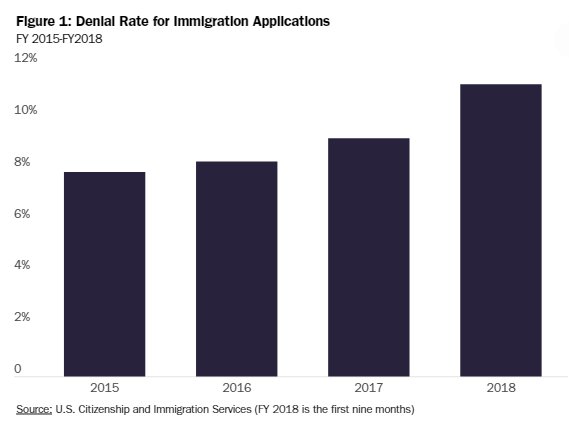
"This increase in denials cannot be credited to an overall rise in applications. In fact, the total number of applications so far this year is 2 percent lower than in 2016. It could be that the higher denial rate is also discouraging some people from applying at all.."
Thanks to @gsiskind for his insightful comments. The increase in denials, he said, is “significant enough to make one think that Congress must have passed legislation changing the requirements. But we know they have not.”
My conclusion:
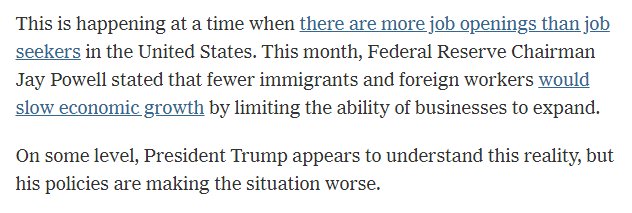
Based on this analysis: "Denials for immigration benefits—travel documents, work permits, green cards, worker petitions, etc.—increased 37 percent since FY 2016. On an absolute basis, FY 2018 will see more than about 155,000 more denials than FY 2016." https://t.co/Bl0naOO0sh
"This increase in denials cannot be credited to an overall rise in applications. In fact, the total number of applications so far this year is 2 percent lower than in 2016. It could be that the higher denial rate is also discouraging some people from applying at all.."
Thanks to @gsiskind for his insightful comments. The increase in denials, he said, is “significant enough to make one think that Congress must have passed legislation changing the requirements. But we know they have not.”
My conclusion:


You May Also Like

“We don’t negotiate salaries” is a negotiation tactic.
Always. No, your company is not an exception.
A tactic I don’t appreciate at all because of how unfairly it penalizes low-leverage, junior employees, and those loyal enough not to question it, but that’s negotiation for you after all. Weaponized information asymmetry.
Listen to Aditya
And by the way, you should never be worried that an offer would be withdrawn if you politely negotiate.
I have seen this happen *extremely* rarely, mostly to women, and anyway is a giant red flag. It suggests you probably didn’t want to work there.
You wish there was no negotiating so it would all be more fair? I feel you, but it’s not happening.
Instead, negotiate hard, use your privilege, and then go and share numbers with your underrepresented and underpaid colleagues. […]
Always. No, your company is not an exception.
A tactic I don’t appreciate at all because of how unfairly it penalizes low-leverage, junior employees, and those loyal enough not to question it, but that’s negotiation for you after all. Weaponized information asymmetry.
Listen to Aditya
"we don't negotiate salaries" really means "we'd prefer to negotiate massive signing bonuses and equity grants, but we'll negotiate salary if you REALLY insist" https://t.co/80k7nWAMoK
— Aditya Mukerjee, the Otterrific \U0001f3f3\ufe0f\u200d\U0001f308 (@chimeracoder) December 4, 2018
And by the way, you should never be worried that an offer would be withdrawn if you politely negotiate.
I have seen this happen *extremely* rarely, mostly to women, and anyway is a giant red flag. It suggests you probably didn’t want to work there.
You wish there was no negotiating so it would all be more fair? I feel you, but it’s not happening.
Instead, negotiate hard, use your privilege, and then go and share numbers with your underrepresented and underpaid colleagues. […]
