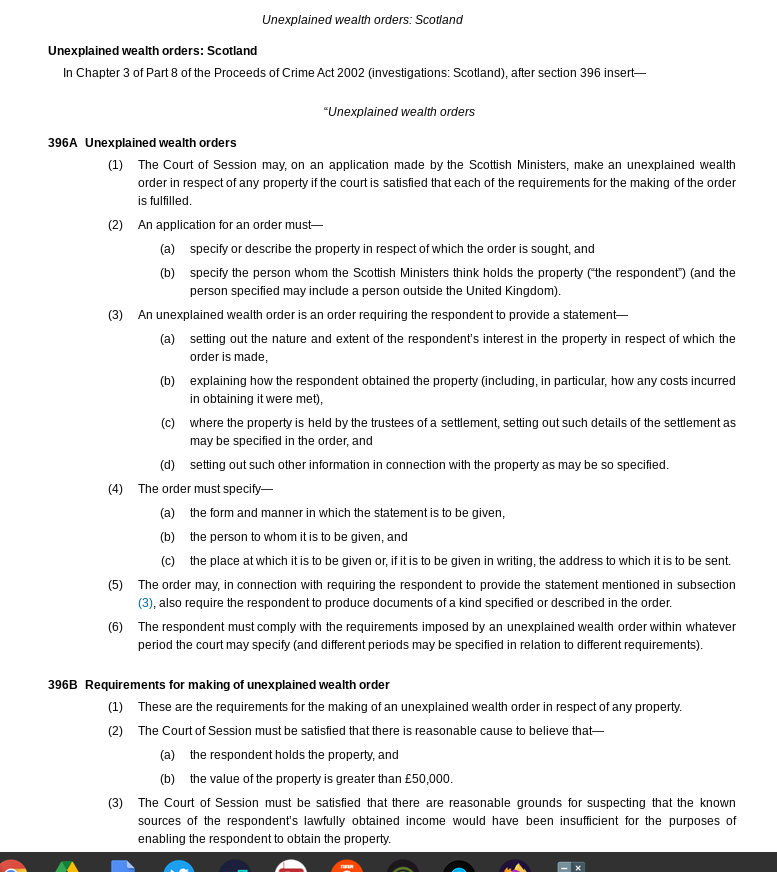
Here's a quick thread on the chronology leading up to today's vote in the Scottish Parliament on whether ministers should go to court to investigate the finances of Donald Trump's Scottish resorts via a legal mechanism known as an Unexplained Wealth Order.👇
https://t.co/xvBIEAc0t3
More from Politics

So let's see a show of hands: how many of you even knew Huber was digging into the Clinton Foundation? While he was assisting Horowitz in his digging into the FISC/Steele Dossier/Fusion GPS/Perkins Coie/DNC/Hillary campaign stuff?
I'm sure Huber is coming to DC *only* to discuss Clinton Foundation things with Meadows and his committee.
He for certain, like, won't be huddling with Horowitz or that new guy, Whitaker while he's in town. That would NEVER HAPPEN. [wink wink wink!] 😉
I just spent a year and a half telling you they will SHOW YOU what they are REALLY DOING when they are READY.
Not before.
No matter how much whining is done about it.
I'm exhausted but it's worth it.
Now you know why they're f**king TERRIFIED of Whitaker, the closer tapped by Trump to come in late for the hysterical fireworks that will ensue soon.
Look who's suddenly fund raising for his legal defen- er, I mean, ha ha - his reelection campaign!
Breaking News: House GOP to hold investigative hearing into DOJ\u2019s handling of Clinton Foundation probe. Top prosecutor to be summoned. https://t.co/HogyXHHcvo
— John Solomon (@jsolomonReports) November 21, 2018
I'm sure Huber is coming to DC *only* to discuss Clinton Foundation things with Meadows and his committee.
He for certain, like, won't be huddling with Horowitz or that new guy, Whitaker while he's in town. That would NEVER HAPPEN. [wink wink wink!] 😉
I just spent a year and a half telling you they will SHOW YOU what they are REALLY DOING when they are READY.
Not before.
No matter how much whining is done about it.
I'm exhausted but it's worth it.
Now you know why they're f**king TERRIFIED of Whitaker, the closer tapped by Trump to come in late for the hysterical fireworks that will ensue soon.
Look who's suddenly fund raising for his legal defen- er, I mean, ha ha - his reelection campaign!
President Trump just attacked Adam on Twitter with his most profane insult yet. Will you chip in $5 to send Trump a message and show him you stand with Adam?
— Adam Schiff (@AdamSchiff) November 19, 2018


You May Also Like

1/12
RT-PCR corona (test) scam
Symptomatic people are tested for one and only one respiratory virus. This means that other acute respiratory infections are reclassified as
2/12
It is tested exquisitely with a hypersensitive non-specific RT-PCR test / Ct >35 (>30 is nonsense, >35 is madness), without considering Ct and clinical context. This means that more acute respiratory infections are reclassified as
3/12
The Drosten RT-PCR test is fabricated in a way that each country and laboratory perform it differently at too high Ct and that the high rate of false positives increases massively due to cross-reaction with other (corona) viruses in the "flu
4/12
Even asymptomatic, previously called healthy, people are tested (en masse) in this way, although there is no epidemiologically relevant asymptomatic transmission. This means that even healthy people are declared as COVID
5/12
Deaths within 28 days after a positive RT-PCR test from whatever cause are designated as deaths WITH COVID. This means that other causes of death are reclassified as
RT-PCR corona (test) scam
Symptomatic people are tested for one and only one respiratory virus. This means that other acute respiratory infections are reclassified as
4/10
— Dr. Thomas Binder, MD (@Thomas_Binder) October 22, 2020
...indication, first of all that testing for a (single) respiratory virus is done outside of surveillance systems or need for specific therapy, but even so the lack of consideration of Ct, symptoms and clinical findings when interpreting its result. https://t.co/gHH6kwRdZG
2/12
It is tested exquisitely with a hypersensitive non-specific RT-PCR test / Ct >35 (>30 is nonsense, >35 is madness), without considering Ct and clinical context. This means that more acute respiratory infections are reclassified as
6/10
— Dr. Thomas Binder, MD (@Thomas_Binder) October 22, 2020
The neither validated nor standardised hypersensitive RT-PCR test / Ct 35-45 for SARS-CoV-2 is abused to mislabel (also) other diseases, especially influenza, as COVID-19.https://t.co/AkFIfTCTkS
3/12
The Drosten RT-PCR test is fabricated in a way that each country and laboratory perform it differently at too high Ct and that the high rate of false positives increases massively due to cross-reaction with other (corona) viruses in the "flu
External peer review of the RTPCR test to detect SARS-CoV-2 reveals 10 major scientific flaws at the molecular and methodological level: consequences for false positive results.https://t.co/mbNY8bdw1p pic.twitter.com/OQBD4grMth
— Dr. Thomas Binder, MD (@Thomas_Binder) November 29, 2020
4/12
Even asymptomatic, previously called healthy, people are tested (en masse) in this way, although there is no epidemiologically relevant asymptomatic transmission. This means that even healthy people are declared as COVID
Thread web\u2b06\ufe0f\u2b07\ufe0f
— Dr. Thomas Binder, MD (@Thomas_Binder) December 16, 2020
The fabrication of the "asymptomatic (super) spreader" is the coronation of the total nons(ci)ense in the belief system of #CoronasWitnesses.
Asymptomatic transmission 0.7%; 95% CI 0%-4.9% - could well be 0%!https://t.co/VeZTzxXfvT
5/12
Deaths within 28 days after a positive RT-PCR test from whatever cause are designated as deaths WITH COVID. This means that other causes of death are reclassified as
8/8
— Dr. Thomas Binder, MD (@Thomas_Binder) March 24, 2020
By the way, who the f*** created this obviously (almost) worldwide definition of #CoronaDeath?
This is not only medical malpractice, this is utterly insane!https://t.co/FFsTx4L2mw