
the US runs its covid testing at 40Ct.
this is 1024X the amplification level of this cutoff for finding live virus that is in any way clinically relevant.
but please, tell me again how demanding more such testing is "science" and not "flooding the data w/ meaningless positives"
A systematic review published 12/3/20 by the Oxford U Ctr for Evidence-Based Med has confirmed that C19 rtPCR testing patient sample cycle thresholds (Cts) >30 (mean from 6-studies) are associated with NEGATIVE viral cultures, i.e., are non-infectious https://t.co/t79dSHnHgn
— Andrew Bostom (@andrewbostom) December 6, 2020
More from el gato malo
also attaching 2 past debunkings of widely disseminated US studies that health officials have attempted to
first, the kansas study spread by CDC and so many "twitterdocs" and politicians.
it's a master class in cherry picking and misusing data through truncation.
the data proving it was false was widely available at the time it was
CDC claims that masks stopped the spread of covid in kansas by comparing masked and non-masked counties.
— el gato malo (@boriquagato) November 23, 2020
counterpoint: this was a cherry pick in terms of date and seasonality.
they ended the "study" aug 23.
then, covid season hit and the masks look to have made no difference. https://t.co/LgyjqPodOC pic.twitter.com/P2cfuZRtDs
also the mass general study, a classic of the "sun-dance" variant: use no control group and then presume that any action undertaken was the result of some thing you did.
ignore the fact that the whole rest of (unmasked) massachusetts got the same
this is from the study that CDC head robert redfield showcased the other night to "prove masks work"
— el gato malo (@boriquagato) July 28, 2020
it it the epidemiological equivalent of doing a sun dance at 5.30 AM and claiming you made that ball of fire in the sky appear
it's assumptive, lacks a control, & proves nothing pic.twitter.com/yTdBa7UFit
the fact that CDC has been spreading studies like these and using them alongside flimsy lab bench experiments with no clinical outcomes or even real world measurement speaks poorly of both CDC & the evidence for masks
the good studies do not support use
back in the halcyon days of 2019, before the great politicization of epidemiology turned up into down and down into sideways, the WHO performed a survey of randomized, controlled trials on masks
— el gato malo (@boriquagato) September 28, 2020
1100 citations were winnowed to the 10 best for review.
masks looked ineffective. pic.twitter.com/A04MVVmXhu
and lab bench droplet projection studies are meaningless.
it's one tiny aspect of a large system and may actually be counterproductive if masks are nebulizing droplets and making virus more aerosol in spread and more deeply
this is a fascinating thread on possible physical properties of masks, viral spread, & infectivity
— el gato malo (@boriquagato) October 24, 2020
in essence, even if a mask stops large droplets, the force of expulsion may nebulize them into aerosols
so, it's possible that aerosol spread of cov is caused/accentuated by masks https://t.co/FiHfMU3NKD
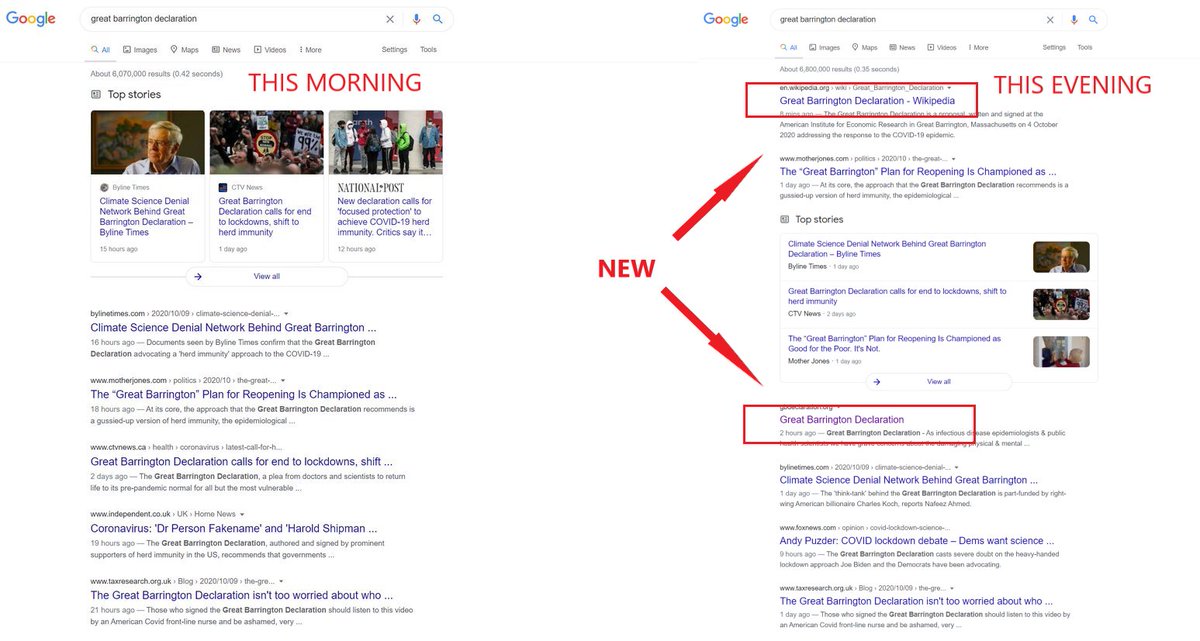
this morning, there was no link to it in a direct google search.
now, there is.
could this be because certain internet felines noticed this and @chiproytx and @tedcruz helped call them out on this?
we may never know.
but i'd like to think so.
the google page is still a mess. it's still mostly fringe publication hit pieces and conspiracy theories.
when "mother jones" is your top media result for a science search, well, that says it all, doesn't it?
yikes.
i mean, why would we trust THESE people instead of a reporter at one of the most partisan rags on earth? oh, wait..
they are not being censored for being wrong. they're being censored for being right and being credible
they're censored because the other side cannot rebut them
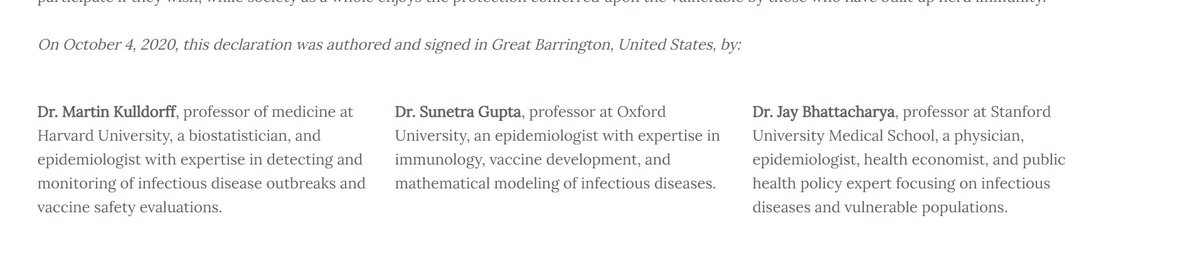
and that is simply not a thing we can or should tolerate, especially not in a search engine.
so remember this. look for it in the future. demand primary sources.
use other search engines.
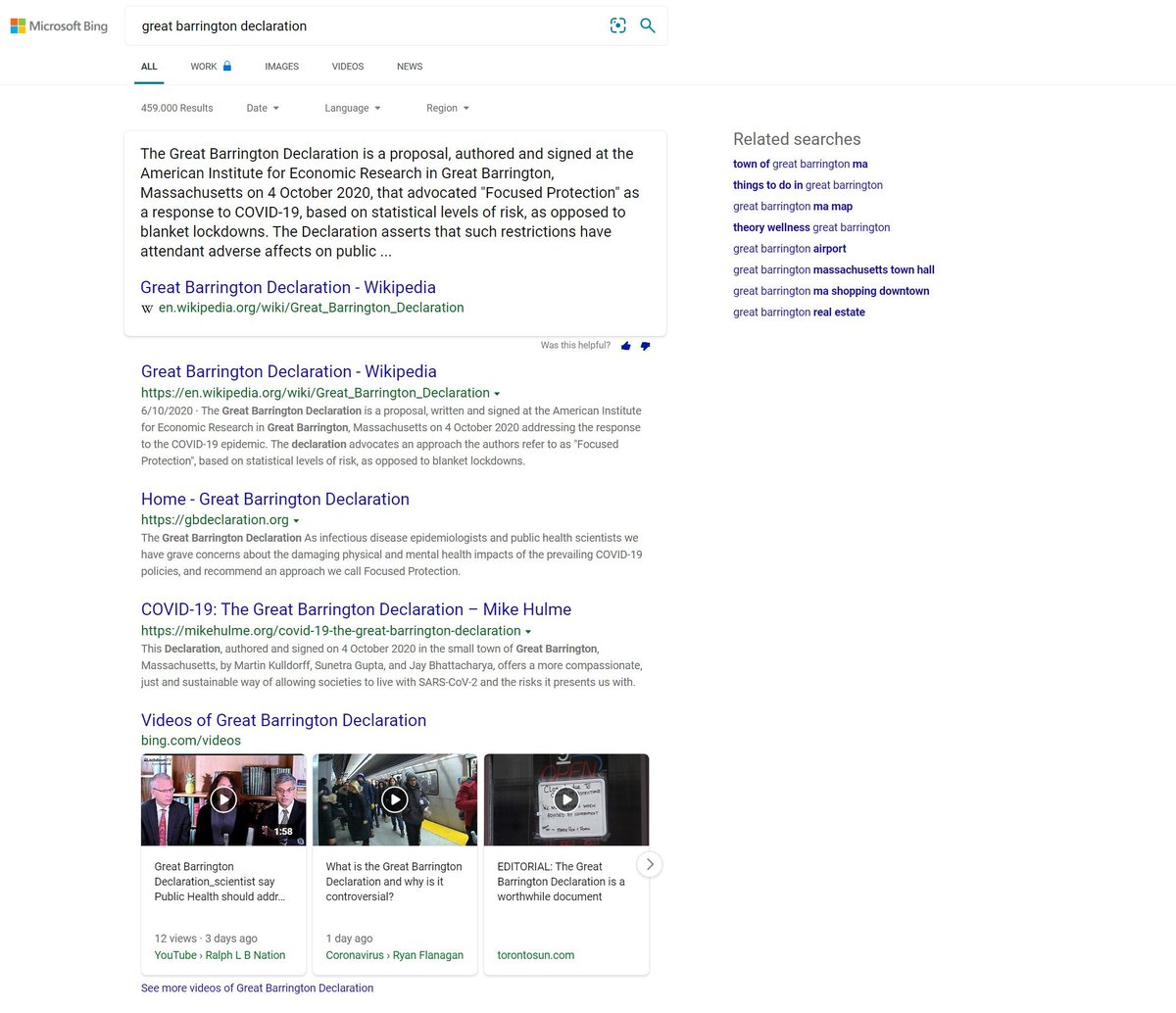
bing seems to be seeking to inform, not to inflame and mislead.
if you missed it, the original thread was here:
(and yes, lots of people duplicated my finding this morning)
i'd be curious to see what they are all seeing
from the "make orwell fiction again" files:
— el gato malo (@boriquagato) October 10, 2020
google has memory holed the great barrington declaration
not only have they wiped it from the top results, they have salted it with false claims about "climate denial"
it's pure, simple propaganda
here's bing (who plays it straight) pic.twitter.com/kTdhH8zXia
these have been sold as a way to stop infection as though this were science.
this was never true and that fact was known and knowable.
let's look.
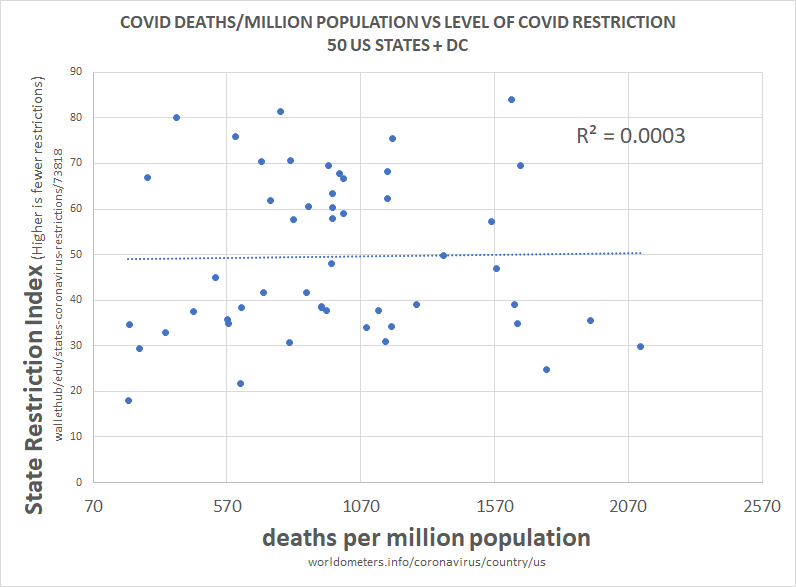
above is the plot of social restriction and NPI vs total death per million. there is 0 R2. this means that the variables play no role in explaining one another.
we can see this same relationship between NPI and all cause deaths.
this is devastating to the case for NPI.
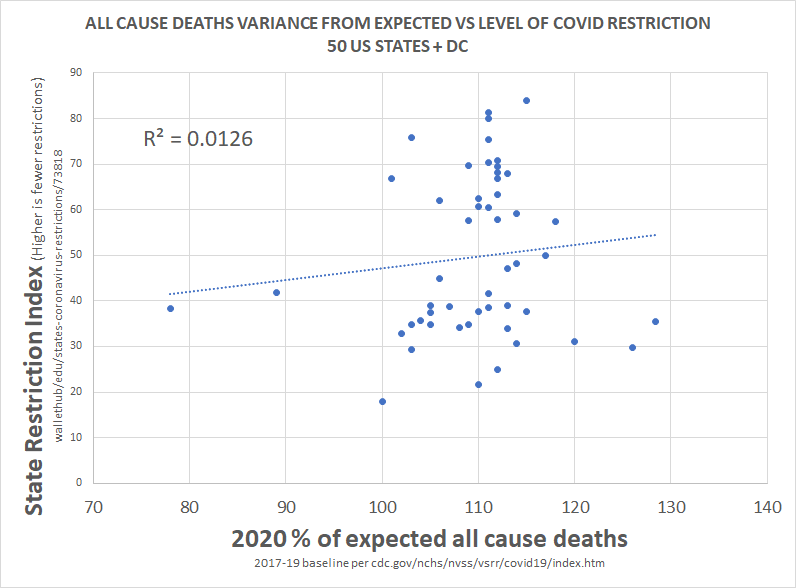
clearly, correlation is not proof of causality, but a total lack of correlation IS proof that there was no material causality.
barring massive and implausible coincidence, it's essentially impossible to cause something and not correlate to it, especially 51 times.
this would seem to pose some very serious questions for those claiming that lockdowns work, those basing policy upon them, and those claiming this is the side of science.
there is no science here nor any data. this is the febrile imaginings of discredited modelers.
this has been clear and obvious from all over the world since the beginning and had been proven so clearly by may that it's hard to imagine anyone who is actually conversant with the data still believing in these responses.
everyone got the same R
this methodology is a little complex, so let me explain what i did.
— el gato malo (@boriquagato) May 30, 2020
a few EU countries provide real day of death data. this lets us plot meaningful curves to show rate of disease change.
what struck me is how similar all the curves were.
everyone got the same shape. pic.twitter.com/bN0hILzoSl




hospital and ICU utilization has been and remains low this year.
it's terribly curious that so few of these monitoring tools provide historical baselines.
getting them is like pulling teeth.
It took a Freedom of Information request but @Covid19DataUK acquired 2017-2019 averages for England hospitalizations.
— Yinon Weiss (@yinonw) December 31, 2020
2020 had 18% fewer hospitalizations than prior years.
All around the world, using hospital data without context of prior years is just a fear generating lie. pic.twitter.com/DJDpqhIQuw
we might think of this as an oversight until you see stuff like this:
this woman was arrested for filming and sharing the fact that their are empty hospitals in the UK.
that's full blown soviet. what possible honest purpose does that
this is the action of a police state and a propaganda ministry, not a well intentioned government and a public heath agency.
"we cannot let people see the truth for fear they might base their actions on real facts" is not much of a mantra for just governance.

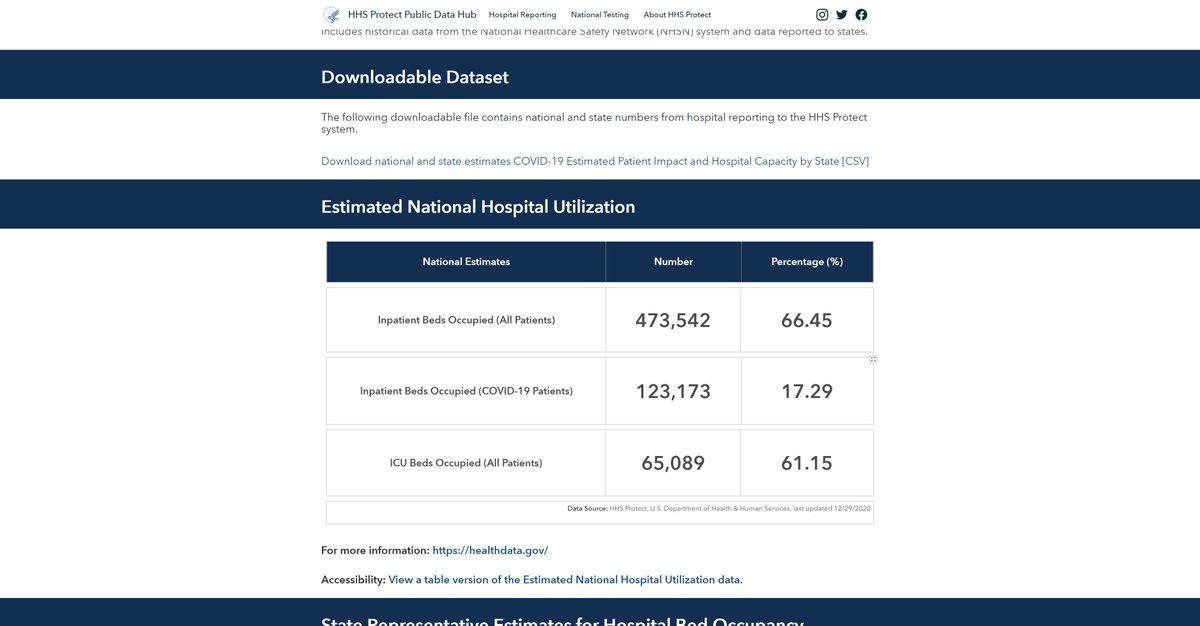
90% full ICU sounds scary until you realize that 90-100% full is normal in flu season.
staffed ICU beds are expensive to leave empty. it's like flying with 15% of the plane empty. hospitals don't do that.
and all US hospitals are mandated to be able to flex to 120% ICU.
the US is currently at historically low ICU utilization for this time of year.
61% is "you're all going to go out of business" territory as is 66% full hospital use.
can you blame them for mining CARES act money? they'll die without it.
You May Also Like







Like company moats, your personal moat should be a competitive advantage that is not only durable—it should also compound over time.
Characteristics of a personal moat below:
I'm increasingly interested in the idea of "personal moats" in the context of careers.
— Erik Torenberg (@eriktorenberg) November 22, 2018
Moats should be:
- Hard to learn and hard to do (but perhaps easier for you)
- Skills that are rare and valuable
- Legible
- Compounding over time
- Unique to your own talents & interests https://t.co/bB3k1YcH5b
2/ Like a company moat, you want to build career capital while you sleep.
As Andrew Chen noted:
People talk about \u201cpassive income\u201d a lot but not about \u201cpassive social capital\u201d or \u201cpassive networking\u201d or \u201cpassive knowledge gaining\u201d but that\u2019s what you can architect if you have a thing and it grows over time without intensive constant effort to sustain it
— Andrew Chen (@andrewchen) November 22, 2018
3/ You don’t want to build a competitive advantage that is fleeting or that will get commoditized
Things that might get commoditized over time (some longer than
Things that look like moats but likely aren\u2019t or may fade:
— Erik Torenberg (@eriktorenberg) November 22, 2018
- Proprietary networks
- Being something other than one of the best at any tournament style-game
- Many "awards"
- Twitter followers or general reach without "respect"
- Anything that depends on information asymmetry https://t.co/abjxesVIh9
4/ Before the arrival of recorded music, what used to be scarce was the actual music itself — required an in-person artist.
After recorded music, the music itself became abundant and what became scarce was curation, distribution, and self space.
5/ Similarly, in careers, what used to be (more) scarce were things like ideas, money, and exclusive relationships.
In the internet economy, what has become scarce are things like specific knowledge, rare & valuable skills, and great reputations.
