https://t.co/JSNC0mN7h2
Alright, folks. You may have seen that the FDA was in a fight with distilleries last week.
Let's unpack what happened, why it happened, and why it's now resulting in some extremely unusual behavior by HHS.
Thread below. Follow if you're interested.
https://t.co/JSNC0mN7h2
It basically sounded like "no good deed goes unpunished by the government." Reddit's take:
https://t.co/N75y14ZSvb
So let's look at what did happen, and you can decide for yourself where the blame lies.
Hand sanitizer is regulated as an over-the-counter (OTC) product. Under that regulatory approach, entities which adhere to an FDA "monograph" may market an OTC drug without obtaining explicit FDA approval.
Here's the sanitizer monograph: https://t.co/OicqzGEhvF
So on March 20, 2020, FDA released a new policy intended to help alleviate those shortages.
https://t.co/MobkmU2g5F
This policy was commonly understood to primarily target distillers of alcohol.
This requirement is longstanding and typically applies to traditional drug manufacturers.
- it allows the FDA to know the identities of all companies that make drugs
- Helps FDA conduct inspections and safety surveillance
- Indicates which companies owe fees to FDA
These fees are used to help fund the FDA, and make up more than half of its overall budget.
- Application fees, assessed each time a company wants FDA to review a new drug or medical product, and
- Facility fees, assessed on an annual basis and used to offset the costs of inspections and routine regulatory work.
But never for nonprescription (OTC) drugs.
As a result, OTC companies had to register, but didn't have to pay fees.
March 20, 2020. That's when FDA released its guidance document.
A week later, on March 27th, Congress passed the Coronavirus Aid, Relief, and Economic Security (CARES) Act.
This is where things get interesting.
It also established a user fee program called the OTC Monograph Drug User Fee Program (OMUFA). https://t.co/A6ued6pmRo
Here's the relevant explanation from my writeup for AgencyIQ:
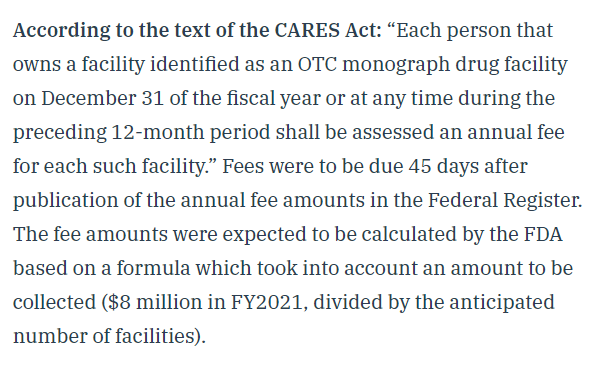
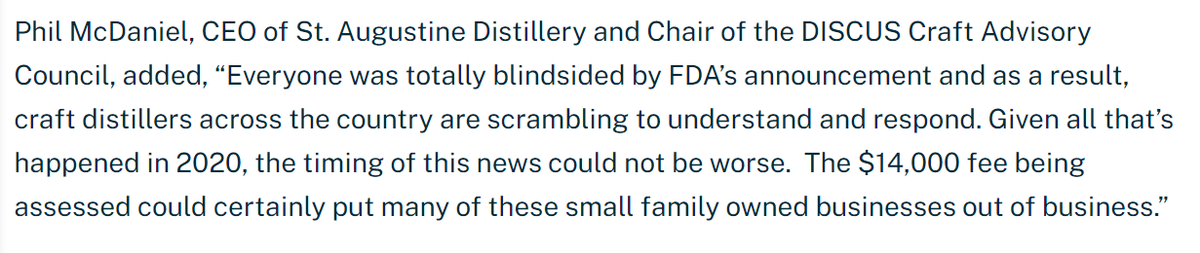
That changed on December 29, when FDA announced the OMUFA fees for FY2021: https://t.co/zkcfavN8xs
And because distilleries had been required to register, that would now include distilleries, too.
Some had even donated these supplies, meaning they would have lost even more $.
https://t.co/ekIkzjs3lf
This actually has a pretty simple answer: Congress.
Basically: Congress gives FDA a formula, and tells it to use the formula to determine the fees. (This formula is usually signed off by industry groups prior to passage, as it was here).
Those *do* exist for other user fee programs.
Given that it had 45 days to do so, that seemed like a possible timeline.
https://t.co/jM5Ox8BjVr

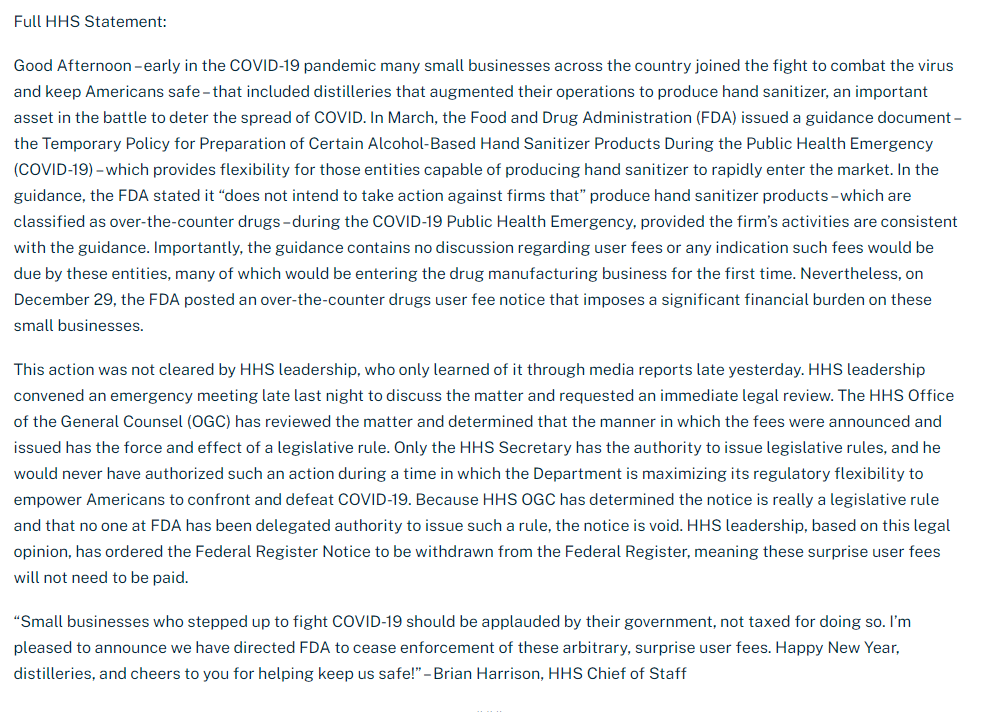
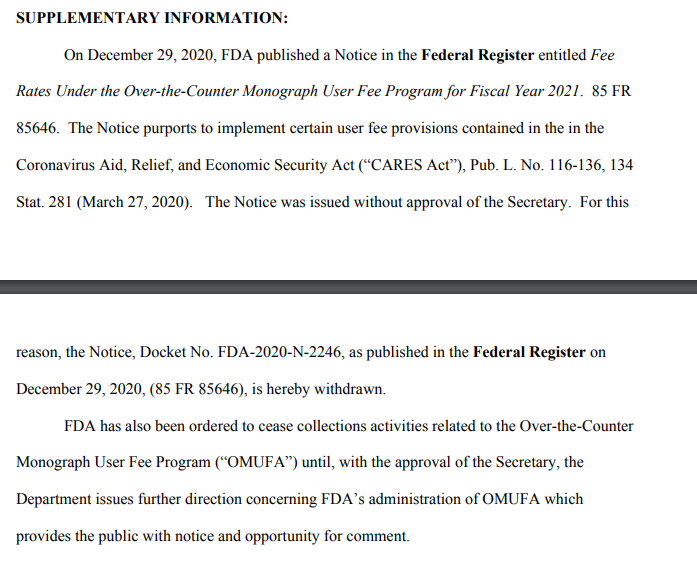
https://t.co/F1mqF1zZ07
Proof: https://t.co/ZflKfKtS6J
The order: https://t.co/TWIsTB3F8n
OTC groups I spoke with are... not pleased.
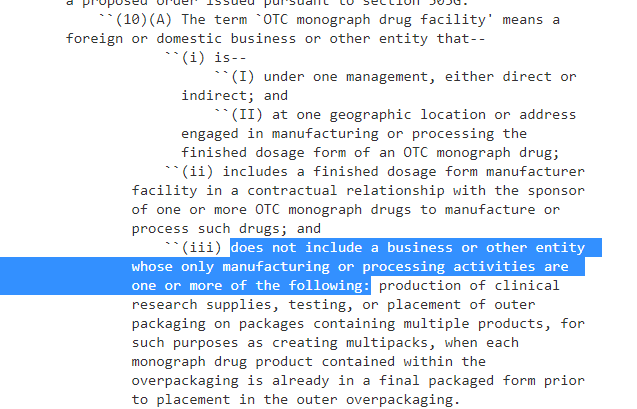
It applies a basic formula to determine what the annual fee should be by taking a base amount mandated by Congress and then dividing by the number of active facilities.
Alternatively, anything that HHS doesn’t like is “significant” and therefore a “legislative rule.”
The only online version I could find was here: https://t.co/DpaKdsQp24
You can read it here: https://t.co/TWIsTB3F8n
Folks, this is not how government normally works. Now, this isn’t the first time that FDA and HHS have been at odds in recent weeks…
See my colleagues @DanDiamond and @DavidALim’s story: https://t.co/bf3E3oRAOc
So withdrawing them just punts the issue down the road.
- Public Health Emergency waiver
- First-time-filer waiver
- Small business waiver
Easy fixes that wouldn’t be difficult to implement and are common to other programs.
More from News

Is this the second BOOM?
video
Gaza strip being bombed ~ 1 hour ago
— Nabeel Yakzan (@MarxistBastard) December 26, 2020
Absolutely 0 media coverage locally or internationally pic.twitter.com/ZLwWcQDwXb
video
\u0647\u0644 \u0647\u0630\u0627 \u0647\u0648 \u0627\u0644\u0633\u0644\u0627\u0645 \u0627\u0644\u0630\u064a \u062a\u062f\u0639\u0648 \u0639\u0644\u064a\u0647 \u0625\u0633\u0631\u0627\u0626\u064a\u0644 \u0645\u0646\u0630 \u0627\u062d\u062a\u0644\u0627\u0644\u0647\u0627 \u0644\u0647\u0630\u0647 \u0627\u0644\u0623\u0631\u0636\u061f
— \u0645\u062d\u0645\u062f \u0627\u0644\u062a\u0648\u064a\u062c\u064a (@mohammed500s) December 26, 2020
\u0627\u0644\u0642\u0635\u0641 \u0627\u0644\u0627\u0633\u0631\u0627\u0626\u064a\u0644\u064a \u0639\u0644\u0649 \u063a\u0632\u0629 \u0627\u0644\u0644\u064a\u0644 \u0627\u0644\u0645\u0627\u0636\u064a\u0629#\u063a\u0632\u0629#\u0627\u0644\u062a\u0637\u0628\u064a\u0639_\u062e\u064a\u0627\u0646\u0629_\u0644\u0644\u0627\u0646\u0633\u0627\u0646\u064a\u0629
Is this the peace that Israel claims to have spread since its occupation of this land?
The Israeli bombing of Gaza last night#Gaza#\u063a\u0632\u0629_\u062a\u062d\u062a_\u0627\u0644\u0642\u0635\u0641 pic.twitter.com/8ouV1nuXc7