https://t.co/PtU69Touv6
Resignations in the news 12/21/2020 thru 12/25/2020
From Anon
Longtime executive at Maine Public retiring after 40
https://t.co/Vq4IBTHE9j
https://t.co/PnEtmHe3RN
https://t.co/C8YrtZnIjb
https://t.co/nQ4lRwbn9U
https://t.co/H6f2ivrb1b
https://t.co/LBONH7Z0Y9
https://t.co/rcSnBW07wt
https://t.co/HxdqhnqRnK
https://t.co/7TIteZcCPl
https://t.co/4bBrwtp4EN
https://t.co/QpWO11Rxf5
https://t.co/1rQo2WuNpV
https://t.co/vlCtGhNeEJ
More from News


To mark the occasion of @mtgreenee entering Congress, I’m going to delineate her history with QAnon, based on two livestream videos and her own tweets.
This thread will clarify why I believe it’s fair and accurate to describe Greene as a “QAnon follower” or “QAnon believer.”
This thread will clarify why I believe it’s fair and accurate to describe Greene as a “QAnon follower” or “QAnon believer.”
Earlier, I filmed new Congresswoman @mtgreenee.
— Ford Fischer (@FordFischer) January 3, 2021
She is wearing a mask that says \u201cTrump Won.\u201d
(Photos of playback from my videocamera.) pic.twitter.com/YaWs3eXQCz

.@louiscasiano from @FoxNews reached out to ask if we are actually planning on contaminating the hotel rooms of Proud Boys with bedbugs. The short answer is no, we don't even know if that's possible. But here's our full response.
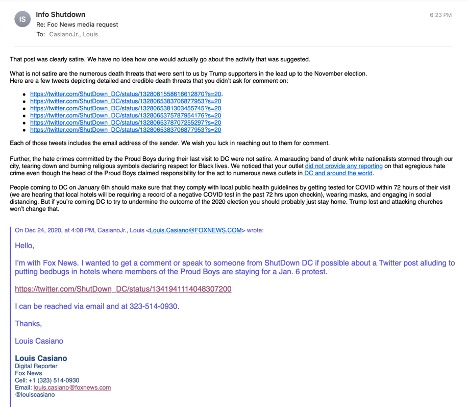
That post was clearly satire. We have no idea how one would actually go about the activity that was suggested.
What is not satire are the numerous death threats that were sent to us by Trump supporters in the lead up to the November election.
Here are a few tweets depicting detailed and credible death threats that you didn’t ask for comment on:
https://t.co/UiI12M0Aey.
https://t.co/PPe75XWImX
https://t.co/4Ia8659wK8
https://t.co/n5ov6R8Gyh
Each of those tweets includes the email address of the sender. We wish you luck in reaching out to them for comment.
Further, the hate crimes committed by the Proud Boys during their last visit to DC were not satire. A marauding band of drunk white nationalists stormed through our city, tearing down and burning religious symbols declaring respect for Black lives.
That post was clearly satire. We have no idea how one would actually go about the activity that was suggested.
What is not satire are the numerous death threats that were sent to us by Trump supporters in the lead up to the November election.
Here are a few tweets depicting detailed and credible death threats that you didn’t ask for comment on:
https://t.co/UiI12M0Aey.
https://t.co/PPe75XWImX
https://t.co/4Ia8659wK8
https://t.co/n5ov6R8Gyh
Yup. They have no interest in public safety. Inspector Glover is doing everything he can to support @realDonaldTrump's coup. @MayorBowser get your cops in line. pic.twitter.com/VAAu58v7N5
— ShutDownDC (@ShutDown_DC) November 15, 2020
Each of those tweets includes the email address of the sender. We wish you luck in reaching out to them for comment.
Further, the hate crimes committed by the Proud Boys during their last visit to DC were not satire. A marauding band of drunk white nationalists stormed through our city, tearing down and burning religious symbols declaring respect for Black lives.


Is this the second BOOM?
video
Gaza strip being bombed ~ 1 hour ago
— Nabeel Yakzan (@MarxistBastard) December 26, 2020
Absolutely 0 media coverage locally or internationally pic.twitter.com/ZLwWcQDwXb
video
\u0647\u0644 \u0647\u0630\u0627 \u0647\u0648 \u0627\u0644\u0633\u0644\u0627\u0645 \u0627\u0644\u0630\u064a \u062a\u062f\u0639\u0648 \u0639\u0644\u064a\u0647 \u0625\u0633\u0631\u0627\u0626\u064a\u0644 \u0645\u0646\u0630 \u0627\u062d\u062a\u0644\u0627\u0644\u0647\u0627 \u0644\u0647\u0630\u0647 \u0627\u0644\u0623\u0631\u0636\u061f
— \u0645\u062d\u0645\u062f \u0627\u0644\u062a\u0648\u064a\u062c\u064a (@mohammed500s) December 26, 2020
\u0627\u0644\u0642\u0635\u0641 \u0627\u0644\u0627\u0633\u0631\u0627\u0626\u064a\u0644\u064a \u0639\u0644\u0649 \u063a\u0632\u0629 \u0627\u0644\u0644\u064a\u0644 \u0627\u0644\u0645\u0627\u0636\u064a\u0629#\u063a\u0632\u0629#\u0627\u0644\u062a\u0637\u0628\u064a\u0639_\u062e\u064a\u0627\u0646\u0629_\u0644\u0644\u0627\u0646\u0633\u0627\u0646\u064a\u0629
Is this the peace that Israel claims to have spread since its occupation of this land?
The Israeli bombing of Gaza last night#Gaza#\u063a\u0632\u0629_\u062a\u062d\u062a_\u0627\u0644\u0642\u0635\u0641 pic.twitter.com/8ouV1nuXc7