
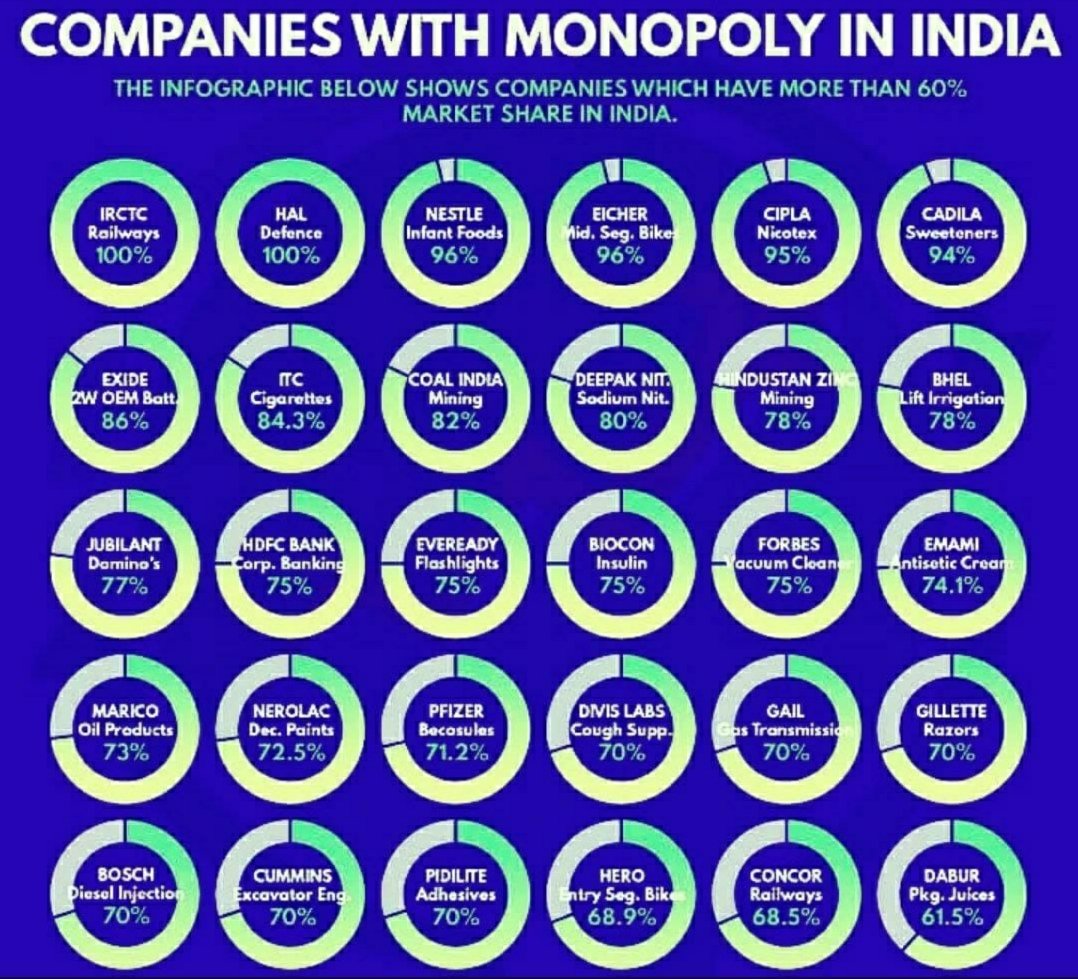
Companies with Monopoly in India and having more than 60% market share.
More from yashstocks
(1/4)
12 to 15% is easily achievable nowadays without taking much risk even though the capital is 10 crores due to leverage :)
Invest 10 crore in liquid, debt, gilt, T-bills, 10-20% equity that will give 6 to 7% average returns every year.
(2/4)
Rest can be made by selling far otm penny options only on expiries. They are trading at good premiums due to leverage and can be easily manageable if goes wrong. Thus targeting only 0.15% returns in a week
0.15% x 52 weeks = 7.8%
6% in MFs + 7.8% in trading = 14% returns
(3/4)
Now comes the hard part, doing this every week without getting bored and without affecting one's psychology is the most difficult part. And since we start making money, we take higher risks which can eventually wipe out profits.
(4/4)
And those who think about blackswan event all the time can do it only call side. And it's purely intraday & only will be done on expiry days, so chance of Black Swan, that too on upper side is mostly impossible. If there is any case as such before, do let know in comments
12 to 15% is easily achievable nowadays without taking much risk even though the capital is 10 crores due to leverage :)
Invest 10 crore in liquid, debt, gilt, T-bills, 10-20% equity that will give 6 to 7% average returns every year.
What kind of % return in a year is considered very best with capital more than 10 cr?
— Mitesh Patel (@Mitesh_Engr) October 12, 2021
(2/4)
Rest can be made by selling far otm penny options only on expiries. They are trading at good premiums due to leverage and can be easily manageable if goes wrong. Thus targeting only 0.15% returns in a week
0.15% x 52 weeks = 7.8%
6% in MFs + 7.8% in trading = 14% returns
(3/4)
Now comes the hard part, doing this every week without getting bored and without affecting one's psychology is the most difficult part. And since we start making money, we take higher risks which can eventually wipe out profits.
(4/4)
And those who think about blackswan event all the time can do it only call side. And it's purely intraday & only will be done on expiry days, so chance of Black Swan, that too on upper side is mostly impossible. If there is any case as such before, do let know in comments

1/5
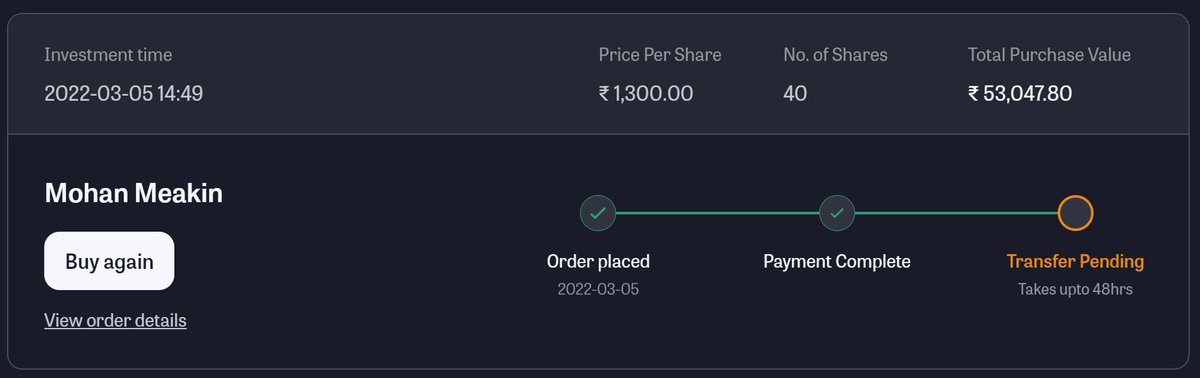
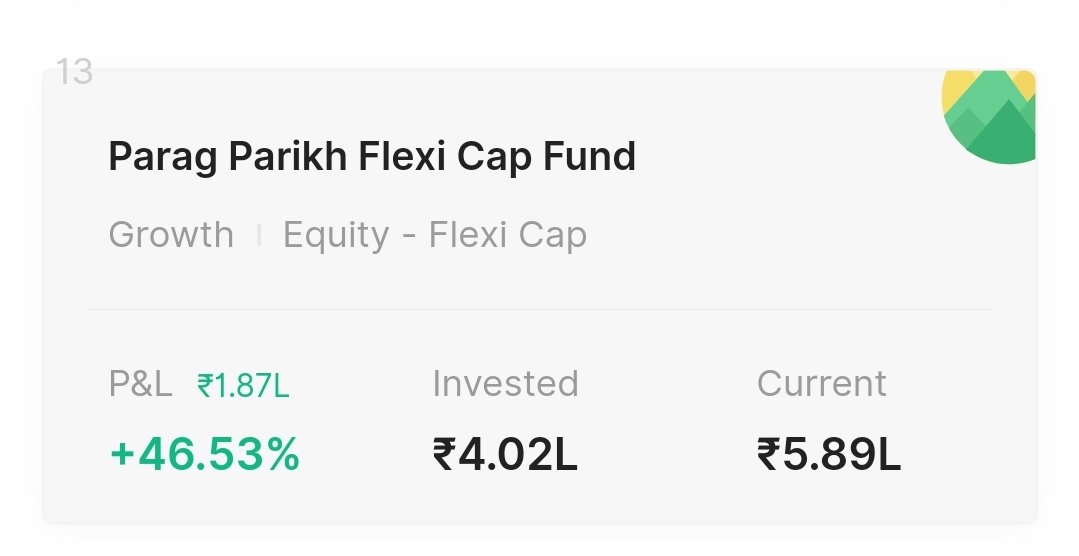
In equity funds, parag parikh flexi cap fund and mirae asset emerging bluechip funds are best. They have given superb returns in last 5 years.
Parag parikh flexi cap fund is diversified as it will invest in US stocks like Google, Facebook, Microsoft, Amazon along with Indian. https://t.co/RmoDMgXoRM
2/5
But one issue with this is if you exit before 2 years, there is an exit load of 2% in 1st year and 1% in 2nd year.
Mirae asset emerging bluechip funds stopped taking lump sum amounts and only can do SIP of Rs. 2500 currently.
3/5
But there is catch, you can do multiple SIPs in it, you can SIP on every day and still invest 75k in a month. I am doing this way only.
Coming to debt funds, ICICI prudential all seasons bond fund and hdfc corporate bond fund are good if consider 5 years performance.
4/5
In zerodha, all above 4 MFs can be pledged and haircut also very less just 7.5%. But you can use only 50% for positional margin, other 50% should come in cash or equivalent funds like gilt, liquid etc. For intraday, 100% can be used.
5/5
Nippon india gilt fund is also good, considering it will be cash component and only 10% haircut.
For tax saving, you need to invest in ELSS funds.
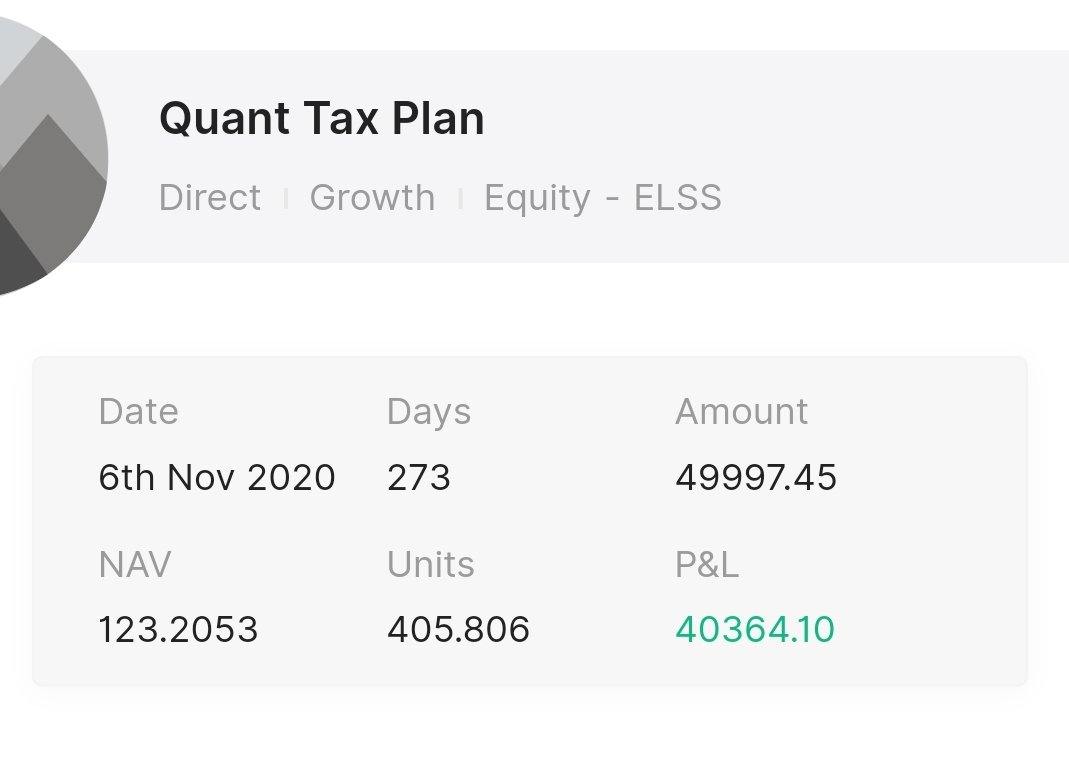
I invested in Quant Tax Plan and it gave 80% returns in just 273 days.
In equity funds, parag parikh flexi cap fund and mirae asset emerging bluechip funds are best. They have given superb returns in last 5 years.
Parag parikh flexi cap fund is diversified as it will invest in US stocks like Google, Facebook, Microsoft, Amazon along with Indian. https://t.co/RmoDMgXoRM
If I'm a layman in mutual fund territory N I wana invest Lumpsum of 1-2L N followed by SIP of 20k per month
— PythonTrader (Not a Python Coder) (@pythontrader999) August 6, 2021
1)Wat r the things I should look while scrutinising a MF
2)If I wana pledge it to broker so which kind of MF I should select @yashstocks@vishalmehta29@yogeshnanda1
2/5
But one issue with this is if you exit before 2 years, there is an exit load of 2% in 1st year and 1% in 2nd year.
Mirae asset emerging bluechip funds stopped taking lump sum amounts and only can do SIP of Rs. 2500 currently.
3/5
But there is catch, you can do multiple SIPs in it, you can SIP on every day and still invest 75k in a month. I am doing this way only.
Coming to debt funds, ICICI prudential all seasons bond fund and hdfc corporate bond fund are good if consider 5 years performance.
4/5
In zerodha, all above 4 MFs can be pledged and haircut also very less just 7.5%. But you can use only 50% for positional margin, other 50% should come in cash or equivalent funds like gilt, liquid etc. For intraday, 100% can be used.
5/5
Nippon india gilt fund is also good, considering it will be cash component and only 10% haircut.
For tax saving, you need to invest in ELSS funds.
I invested in Quant Tax Plan and it gave 80% returns in just 273 days.
You May Also Like





Keep dwelling on this:
Further Examination of the Motif near PRRA Reveals Close Structural Similarity to the SEB Superantigen as well as Sequence Similarities to Neurotoxins and a Viral SAg.
The insertion PRRA together with 7 sequentially preceding residues & succeeding R685 (conserved in β-CoVs) form a motif, Y674QTQTNSPRRAR685, homologous to those of neurotoxins from Ophiophagus (cobra) and Bungarus genera, as well as neurotoxin-like regions from three RABV strains
(20) (Fig. 2D). We further noticed that the same segment bears close similarity to the HIV-1 glycoprotein gp120 SAg motif F164 to V174.
https://t.co/EwwJOSa8RK
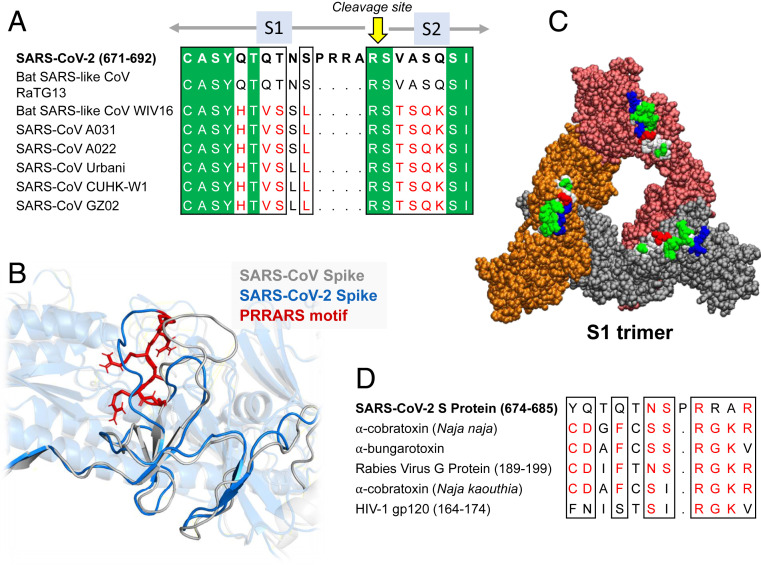
In (B), the segment S680PPRAR685 including the PRRA insert and highly conserved cleavage site *R685* is shown in van der Waals representation (black labels) and nearby CDR residues of the TCRVβ domain are labeled in blue/white
https://t.co/BsY8BAIzDa

Sequence Identity %
https://t.co/BsY8BAIzDa
Y674 - QTQTNSPRRA - R685
Similar to neurotoxins from Ophiophagus (cobra) & Bungarus genera & neurotoxin-like regions from three RABV strains
T678 - NSPRRA- R685
Superantigenic core, consistently aligned against bacterial or viral SAgs

Further Examination of the Motif near PRRA Reveals Close Structural Similarity to the SEB Superantigen as well as Sequence Similarities to Neurotoxins and a Viral SAg.
The insertion PRRA together with 7 sequentially preceding residues & succeeding R685 (conserved in β-CoVs) form a motif, Y674QTQTNSPRRAR685, homologous to those of neurotoxins from Ophiophagus (cobra) and Bungarus genera, as well as neurotoxin-like regions from three RABV strains
(20) (Fig. 2D). We further noticed that the same segment bears close similarity to the HIV-1 glycoprotein gp120 SAg motif F164 to V174.
https://t.co/EwwJOSa8RK
In (B), the segment S680PPRAR685 including the PRRA insert and highly conserved cleavage site *R685* is shown in van der Waals representation (black labels) and nearby CDR residues of the TCRVβ domain are labeled in blue/white
https://t.co/BsY8BAIzDa
Sequence Identity %
https://t.co/BsY8BAIzDa
Y674 - QTQTNSPRRA - R685
Similar to neurotoxins from Ophiophagus (cobra) & Bungarus genera & neurotoxin-like regions from three RABV strains
T678 - NSPRRA- R685
Superantigenic core, consistently aligned against bacterial or viral SAgs


Stan Lee’s fictional superheroes lived in the real New York. Here’s where they lived, and why. https://t.co/oV1IGGN8R6

Stan Lee, who died Monday at 95, was born in Manhattan and graduated from DeWitt Clinton High School in the Bronx. His pulp-fiction heroes have come to define much of popular culture in the early 21st century.
Tying Marvel’s stable of pulp-fiction heroes to a real place — New York — served a counterbalance to the sometimes gravity-challenged action and the improbability of the stories. That was just what Stan Lee wanted. https://t.co/rDosqzpP8i

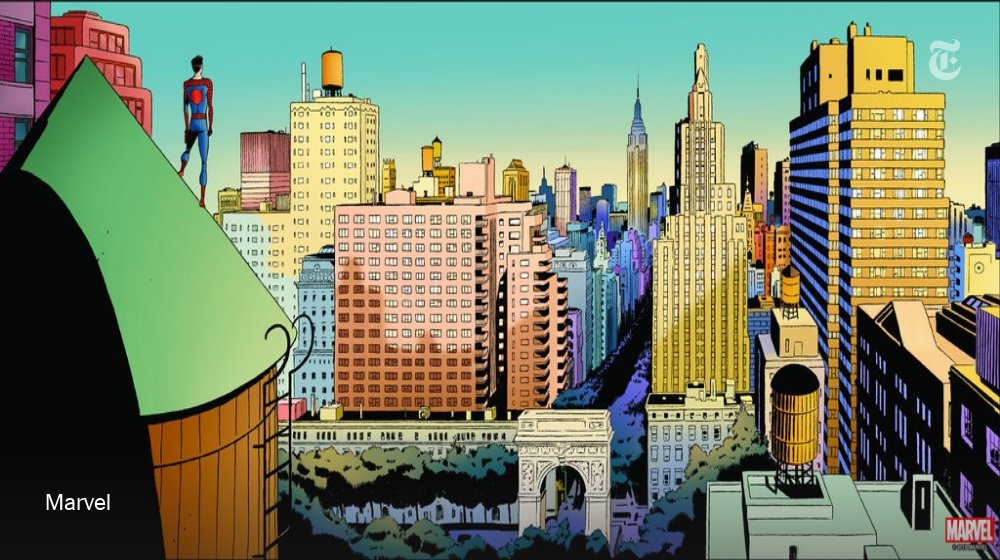
The New York universe hooked readers. And the artists drew what they were familiar with, which made the Marvel universe authentic-looking, down to the water towers atop many of the buildings. https://t.co/rDosqzpP8i
The Avengers Mansion was a Beaux-Arts palace. Fans know it as 890 Fifth Avenue. The Frick Collection, which now occupies the place, uses the address of the front door: 1 East 70th Street.
Stan Lee, who died Monday at 95, was born in Manhattan and graduated from DeWitt Clinton High School in the Bronx. His pulp-fiction heroes have come to define much of popular culture in the early 21st century.
Tying Marvel’s stable of pulp-fiction heroes to a real place — New York — served a counterbalance to the sometimes gravity-challenged action and the improbability of the stories. That was just what Stan Lee wanted. https://t.co/rDosqzpP8i
The New York universe hooked readers. And the artists drew what they were familiar with, which made the Marvel universe authentic-looking, down to the water towers atop many of the buildings. https://t.co/rDosqzpP8i
The Avengers Mansion was a Beaux-Arts palace. Fans know it as 890 Fifth Avenue. The Frick Collection, which now occupies the place, uses the address of the front door: 1 East 70th Street.