
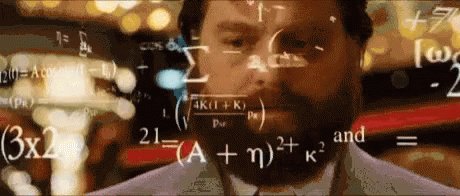
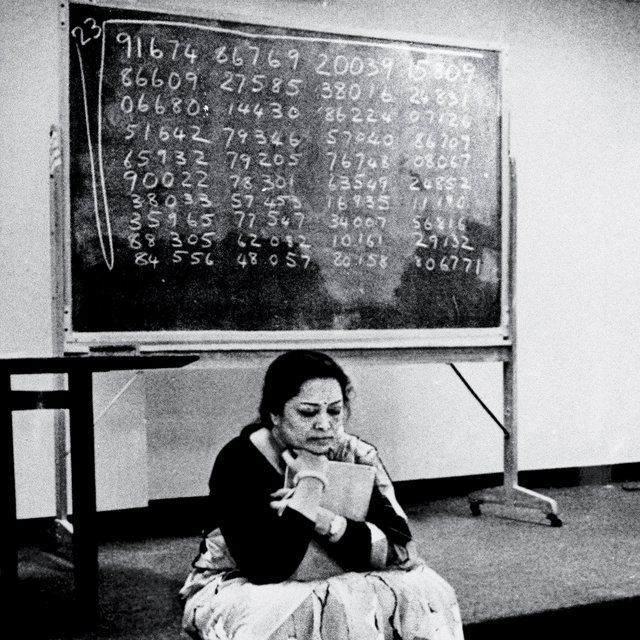
Shakuntala Devi is often described as "India's most famous woman mathematician". Her biopic led discussion like what does a mathematician do? Is mathematics all about performing massive computations? Or is there more to it?
A 🧵on Indian women mathematicians by @kaneenikasinha


https://t.co/Rsb2aLv4v1
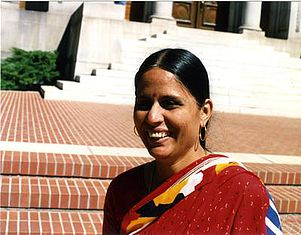

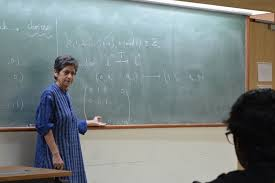
Prof. Ramdorai has also worked with the Indian government in several capacities for mathematics education in India. She was a member of the PM's Scientific Advisory Council from 2009-14.

More from Math


Ok, it's time for a #FUNctionalAnalysis thread! Let's talk about Hilbert spaces. (I hope you like linear algebra, because that's what we're
If you want to impress people, you can just say a Hilbert space is just a complete infinite dimensional inner product space and leave it at that, but let's talk about what that actually means.
When you first learn about vectors, you talk about them as arrows in space; things with a magnitude and a direction. These are elements of R^n where n is the number of dimensions of the space you care about.

You also talk about the dot product (or inner product) as a way to tell when vectors are orthogonal. (I'm purposely saying "orthogonal" instead of "perpendicular" here, but when you actually think about arrows, it's the same thing.)

As my linear algebra students are about to see, R^n is far from the only interesting vector space. A classic example is the space of polynomials of dimension less than or equal to n

— syzygay (@syzygay1) August 9, 2020
If you want to impress people, you can just say a Hilbert space is just a complete infinite dimensional inner product space and leave it at that, but let's talk about what that actually means.
When you first learn about vectors, you talk about them as arrows in space; things with a magnitude and a direction. These are elements of R^n where n is the number of dimensions of the space you care about.
You also talk about the dot product (or inner product) as a way to tell when vectors are orthogonal. (I'm purposely saying "orthogonal" instead of "perpendicular" here, but when you actually think about arrows, it's the same thing.)
As my linear algebra students are about to see, R^n is far from the only interesting vector space. A classic example is the space of polynomials of dimension less than or equal to n

You May Also Like


@franciscodeasis https://t.co/OuQaBRFPu7
Unfortunately the "This work includes the identification of viral sequences in bat samples, and has resulted in the isolation of three bat SARS-related coronaviruses that are now used as reagents to test therapeutics and vaccines." were BEFORE the

chimeric infectious clone grants were there.https://t.co/DAArwFkz6v is in 2017, Rs4231.
https://t.co/UgXygDjYbW is in 2016, RsSHC014 and RsWIV16.
https://t.co/krO69CsJ94 is in 2013, RsWIV1. notice that this is before the beginning of the project
starting in 2016. Also remember that they told about only 3 isolates/live viruses. RsSHC014 is a live infectious clone that is just as alive as those other "Isolates".
P.D. somehow is able to use funds that he have yet recieved yet, and send results and sequences from late 2019 back in time into 2015,2013 and 2016!
https://t.co/4wC7k1Lh54 Ref 3: Why ALL your pangolin samples were PCR negative? to avoid deep sequencing and accidentally reveal Paguma Larvata and Oryctolagus Cuniculus?
Unfortunately the "This work includes the identification of viral sequences in bat samples, and has resulted in the isolation of three bat SARS-related coronaviruses that are now used as reagents to test therapeutics and vaccines." were BEFORE the
chimeric infectious clone grants were there.https://t.co/DAArwFkz6v is in 2017, Rs4231.
https://t.co/UgXygDjYbW is in 2016, RsSHC014 and RsWIV16.
https://t.co/krO69CsJ94 is in 2013, RsWIV1. notice that this is before the beginning of the project
starting in 2016. Also remember that they told about only 3 isolates/live viruses. RsSHC014 is a live infectious clone that is just as alive as those other "Isolates".
P.D. somehow is able to use funds that he have yet recieved yet, and send results and sequences from late 2019 back in time into 2015,2013 and 2016!
https://t.co/4wC7k1Lh54 Ref 3: Why ALL your pangolin samples were PCR negative? to avoid deep sequencing and accidentally reveal Paguma Larvata and Oryctolagus Cuniculus?


