
@patel0phone and I have been working 1:1 w/all-star instructors (like @APompliano @lennysan). Now we're ready to apply these lessons to your course
Over the last 5 years, I’ve helped build courses taken by 40,000 students w/ $30M+ in revenue.
Today we’re launching a *free* cohort-based course on How to Build a CBC!
At the end of this, you’ll have a full course ready to launch.
Apply here: https://t.co/kp2vyBWE9K
Read on
@patel0phone and I have been working 1:1 w/all-star instructors (like @APompliano @lennysan). Now we're ready to apply these lessons to your course
It's not one-size-fits-all. We teach underlying skills & create an accountability system so you build a course that's uniquely yours.
It’s the same process I’ve used for @alt_MBA @david_perell @fortelabs @section_four
https://t.co/TxbH15QTpA
The course creation process is complex. There are lots of interconnected
decisions & second order effects.
We help you make sense of it with:
+ Step by step process
+ Clear deliverables
+ Feedback from us & peers
+ Gut checks
+ Weekly homework
It's an iterative process to get ideas out of your head, share feedback, discuss, build, refine, lock it in. Piece by piece, brick by brick
By the end of this course, you’ll have a CBC that's ready to launch. We’ll cover:
What to build: Figuring out your audience & course brief
How to build: Group exercises, lectures, projects, even slides
How to sell: Building buzz for your course & filling seats
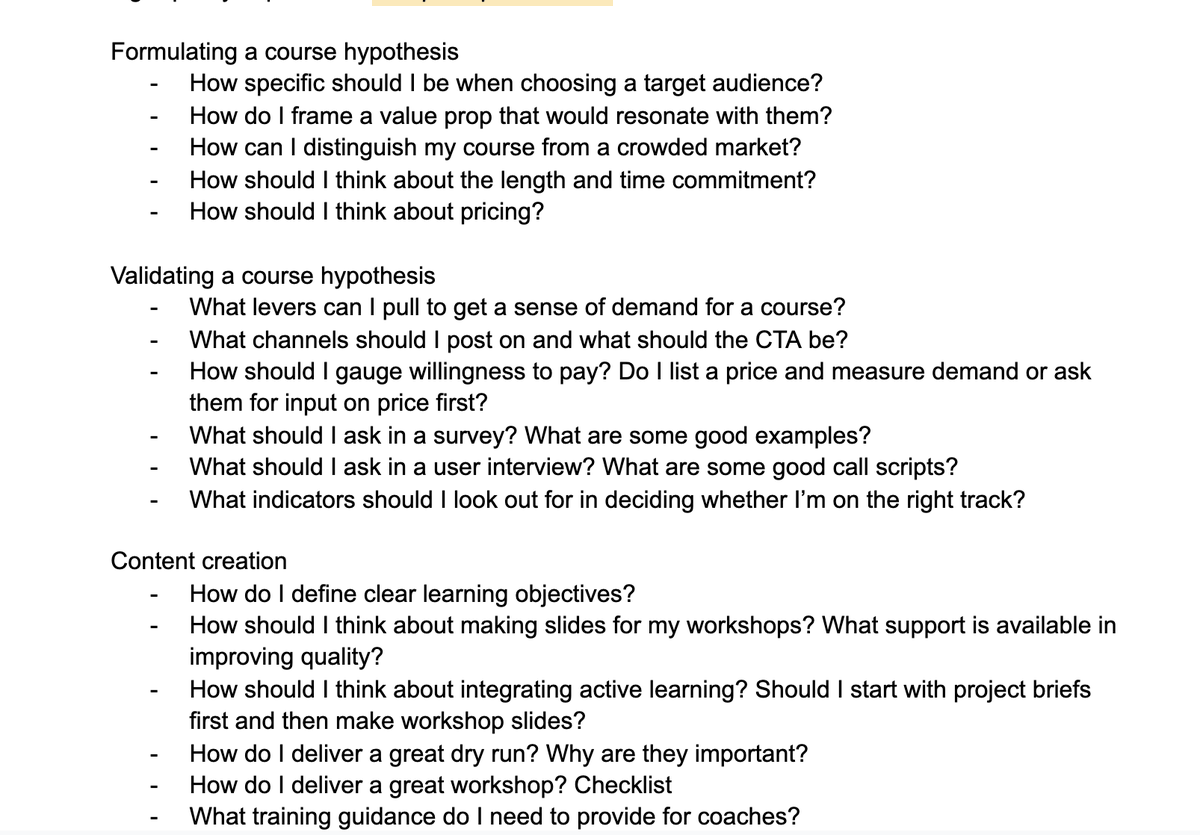
This is just a taste of the types of questions we’ll help you answer:
CBCs are not set it & forget it. They require work to build the first time; if you build it right, it’s easier to run in the future.
The upside: many courses I’ve worked on had 80-90%+ profit margins & premium pricing of $500-$5,000/student.
You can certainly build a course faster or lower quality, and you might still fill your first few cohorts. But it’s hard to grow and scale with a shoddy foundation.
That’s why we spend MORE time upfront bc your CBC is an investment.
Cohort-based courses are complex. There are lots more moving parts compared to pre-recorded, on-demand courses.
There’s a mix of live vs asynchronous. Coach-facilitated vs student-led. Solo vs group work. Too much or too little of one & students disengage
We believe in building courses that are modular--each course component can be reused & rearranged. The building blocks of CBCs are live lectures, small group discussions, projects/exercises, coaches, etc.
In a well-designed course you can mix & match w/minimal effort.
You have to constantly sell a student to make it to day 2, week 1, etc. The selling never ends. We help you reinforce the value students are getting because perceived value = value.
We focus on both curriculum & marketing bc they go hand in hand.
It’s easy to fill the first few cohorts. It’s cohort #4 - #100 that show whether you have course-market fit.
We’ll help you think about how to create a flywheel to drive new students.
https://t.co/jOHPncDssk
(a) You have a course (in-person workshop, recorded video course) but don't know how to turn it into an interactive CBC
OR
(b) You’re a subject matter expert on a topic your audience already wants to learn from you
+ Expect us to do all the work for you
+ Can’t commit to a rigorous schedule of 8-10 hours/week to produce your course
+ Are hard to coach and won’t take our advice
~10 hrs/wk for 6-8 weeks. The course will kick off in April/May 2021.
Courses are an upfront investment--with a strong foundation you can scale easily for future cohorts.
Even w/a process it still takes a lot of work to create a successful CBC though
On the spectrum of "do it for you" to "do it yourself," our approach is "do it w/you." This means we provide the structure, advisory, course work, and milestones to help you stay accountable.
But YOU are ultimately responsible for the success of your course.
We’re thoughtfully curating a cohort of course creators who you’ll build alongside, learn from, and support. These are folks who are at the top of their craft, humble, generous, and eager to contribute.
https://t.co/csTSiuy50u
+ course-market fit
+ mechanics of your course
+ ideal student profile
+ course length
+ number of students
+ price point
+ hands-on projects
+ format
+ growth / student acquisition
+ lots more
https://t.co/JNyyLVCXpD
The course is free. If you go thru it you'll be a beta customer for our new product. This product will be offered as a revenue-share.
We’ll invest signif effort in your course & you'll be part of our platform’s future launch. Will share details w/selected instructors
Apply here: https://t.co/kp2vyBWE9K
More from Marketing


big louis winthorpe III energy
i almost feel bad for the guy, because someone this absolutely clueless about how he sounds really shouldn't be allowed to post under his own name.
he seems like someone who *genuinely* means well most of the time, but it extremely easy to excite and wind up, and who is just profoundly dense about the wisdom of getting wound up the way he does in public.
on the other hand, the tara reade business was indefensible, exploitative, and gross. if there is ever a writer who desperately needs an editor to save him from himself, it's nathan robinson.
i had a few friends in high school who were well-meaning, wealthier than they realized, and in drama class, and most of them grew out of their nathan robinson stage because, well, it was oklahoma. there's almost something a little charming about the fact that he didn't.
they're the cheapest classic car on the market https://t.co/imorvNSZcI
— Zoomcock Archivist \U0001f30b (@canderaid) December 17, 2020
i almost feel bad for the guy, because someone this absolutely clueless about how he sounds really shouldn't be allowed to post under his own name.
he seems like someone who *genuinely* means well most of the time, but it extremely easy to excite and wind up, and who is just profoundly dense about the wisdom of getting wound up the way he does in public.
on the other hand, the tara reade business was indefensible, exploitative, and gross. if there is ever a writer who desperately needs an editor to save him from himself, it's nathan robinson.
i had a few friends in high school who were well-meaning, wealthier than they realized, and in drama class, and most of them grew out of their nathan robinson stage because, well, it was oklahoma. there's almost something a little charming about the fact that he didn't.

You May Also Like






Speech Delay is most common in children nowadays
In ancient times, our grandparents used to follow typical natural way of caring the needs of a child. All they used were more of natural products than chemical based for the growth of child.

One of major step followed was to feed Gurbach Jadd/ Vasa Kommu/ Acorus Calamus for initiating good speech ability in a child. This stem was needed to babies on Tuesdays and Sundays in mother's milk.
Vasa is feed to baby after the 1st bath on 12th day in week. Weekly only thrice it is fed and named as :
Budhwar - Budhi Vasa
Mangalwar - Vaak Vasa
Ravi Vaar - Aayush Vasa
This stem is burnt and rubbed against the grinding stone in mother's milk or warm water to get a paste
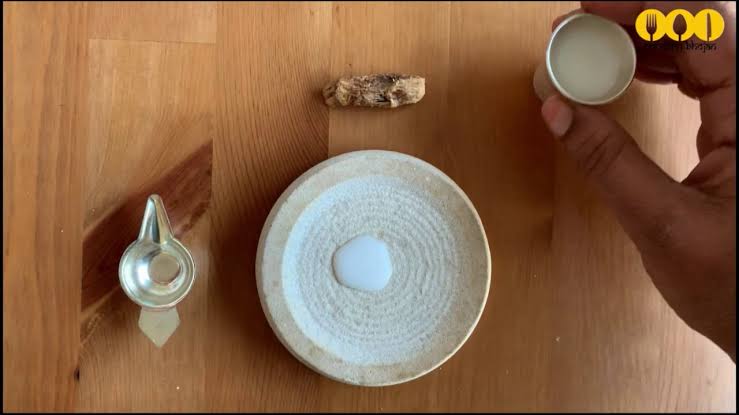
The procedure to make it is in the link
https://t.co/uo4sGp7mUm
It should not be given daily to the child. Other main benefits are
1. It clears the phlegm in child's throat caused due to continuous milk intake. It clears the tracts and breathing is effortless.
2. Digestion
For children who haven't got their speech and is delayed than usual should feed this vasa on these days in week atleast for 6months. Don't get carried away with this dialogue
"Some gain speech little late"
In ancient times, our grandparents used to follow typical natural way of caring the needs of a child. All they used were more of natural products than chemical based for the growth of child.
One of major step followed was to feed Gurbach Jadd/ Vasa Kommu/ Acorus Calamus for initiating good speech ability in a child. This stem was needed to babies on Tuesdays and Sundays in mother's milk.
Vasa is feed to baby after the 1st bath on 12th day in week. Weekly only thrice it is fed and named as :
Budhwar - Budhi Vasa
Mangalwar - Vaak Vasa
Ravi Vaar - Aayush Vasa
This stem is burnt and rubbed against the grinding stone in mother's milk or warm water to get a paste
The procedure to make it is in the link
https://t.co/uo4sGp7mUm
It should not be given daily to the child. Other main benefits are
1. It clears the phlegm in child's throat caused due to continuous milk intake. It clears the tracts and breathing is effortless.
2. Digestion
For children who haven't got their speech and is delayed than usual should feed this vasa on these days in week atleast for 6months. Don't get carried away with this dialogue
"Some gain speech little late"