
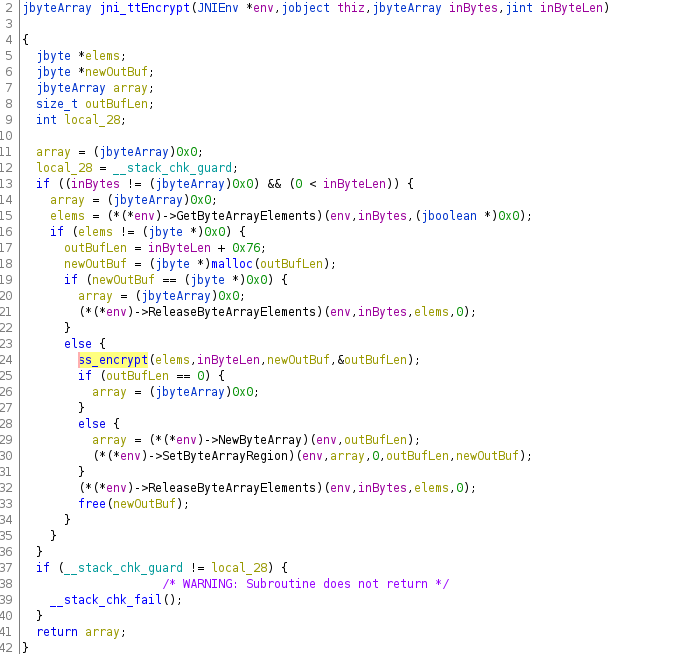
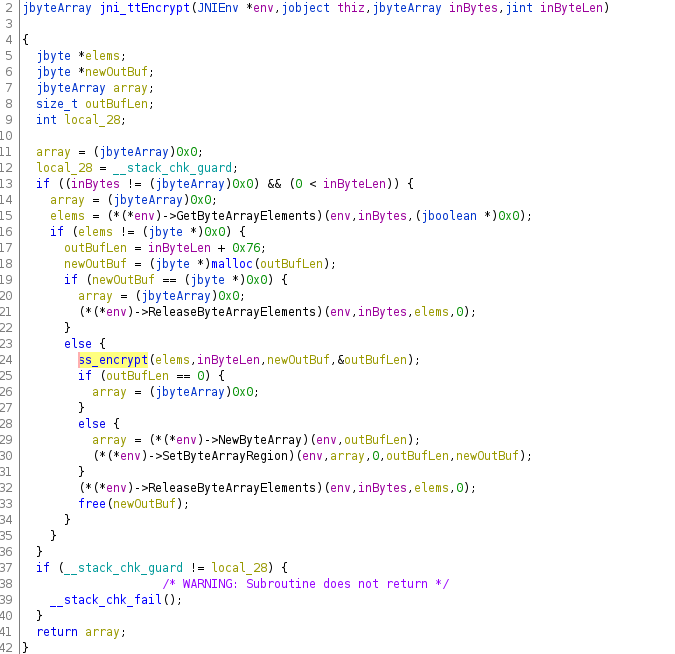
TikTok's (log data) encryption is accomplished by a native library. The Android Java code just serves as proxy function to the native function
Okay, doing my first baby steps with r2frida (which combines the power of @radareorg and @fridadotre).
Gonna share my progress in this thread (live, so keep calm).
The goal: Runtime inspection of data sent out by TikTok !!before!! it gets encrypted
1/many
TikTok's (log data) encryption is accomplished by a native library. The Android Java code just serves as proxy function to the native function
https://t.co/T63vo3N4fw
1) Unlike raw C-functions, JNI functions like the one showcased above, receive pointers to complex Java objects .
F.e. a function receiving a String on the Java layer...
In order to retrieve a C-String, to go on working with it in the native code, some translation functionality is required. This functionality is provided by the ...
If you look at the example screenshot again, you see exactly this. Functions provided by the 'env' pointer are used to parse the Java function arguments (f.e. jByteArrays) ...
2) There are two ways to expose JNI methods from a native library:
a) export them with proper naming convention, so that JNI could recognize same on library load
b) use the JNI functionality 'registerNatives'...
The second method of registering methods is wel suited for obfuscated code, as the methods neither have to follow naming convention, nor do they have to be exported.

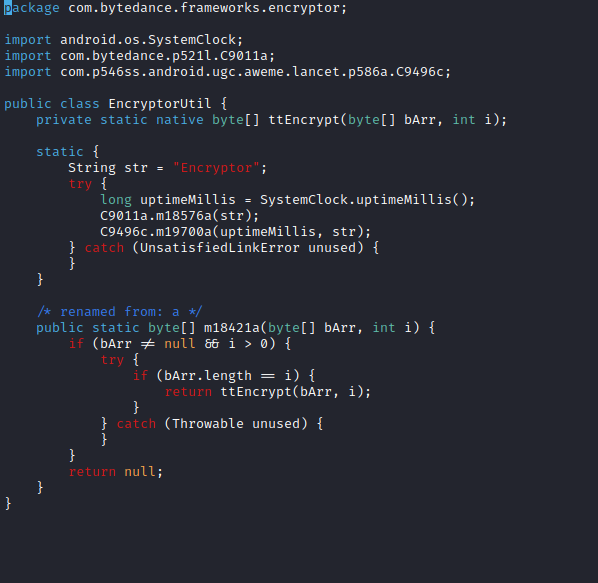
Internally, this data is forwarded to the native JNI method 'ttEncrypt'.
We already saw this signature in a previous screenshot

1) the call address of the native function implementation (0x7d70d1d5 in example)
2) The function name (ttEncrypt)
...
'(' start of parameters
'[B' byte[]
'I' int
')' end of parameters
'[B' byte[] (return value)
- the app is inspected on a physical device, running Android 9
- the device uses a !!32bit!! ARM application core
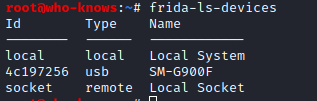
Now to get started, I already have the latest @fridadotre server running on my USB connected android device and 'frida-ls-device' shows it being ready-for-action
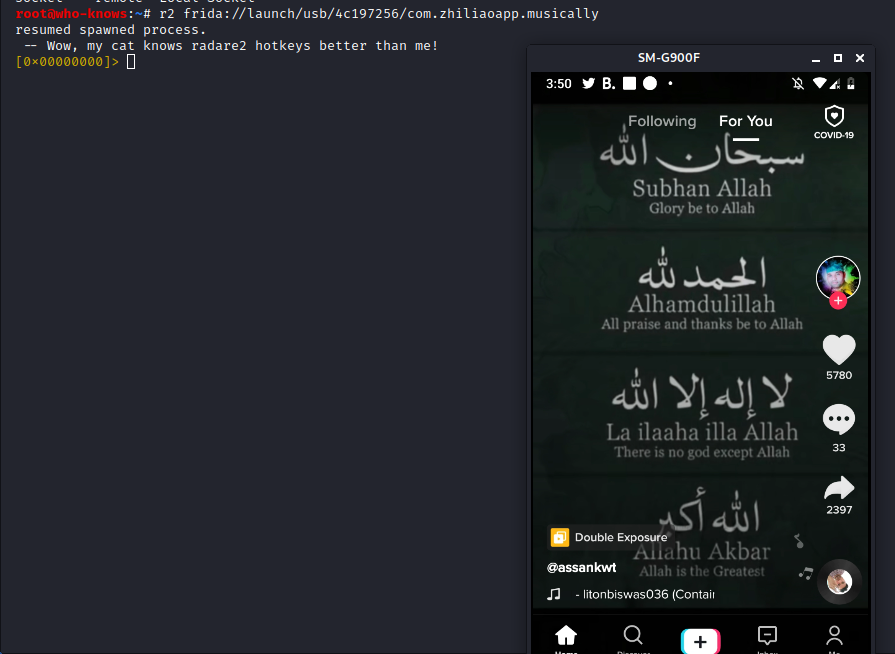
Instead of 'launch', two other options could be used:
- 'spawn' (like 'launch', but the process would not be resumed automatically after attaching)
Important: commands targeting the r2frida plugin have to be prefixed with '\'


The signature of the static method 'EncryptorUtil.a' should look familiar to us (if you read the first tweets). It represents the Java layer of the encryption method and is called 'a' in this version
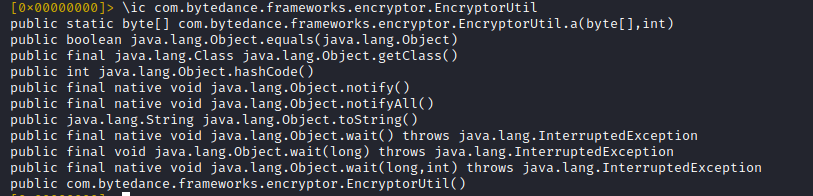
So lets search the whole address space for our native method name 'ttEncrypt'
Note: If you'd use r2's ascii search nothing would happen, you have to use the '\' prefix to search with r2frida
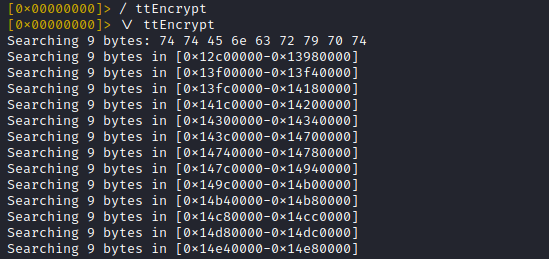
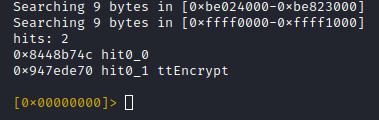
Reason: The memory region was not populated when r2 was started (encryption library was loaded after process launch)
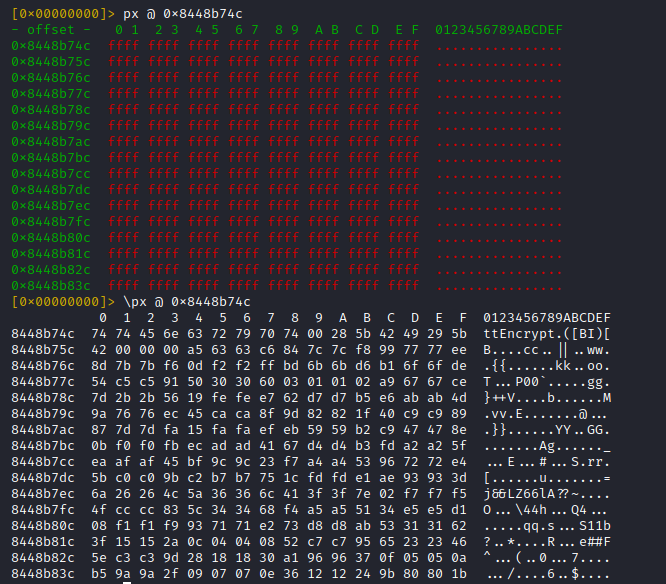
1) Quit r2
2) Open r2 with r2frida, again, but this time **attach** to the already running process
et voila ... the memory offset is mapped and dumpable with 'px' (without backslash prefix)
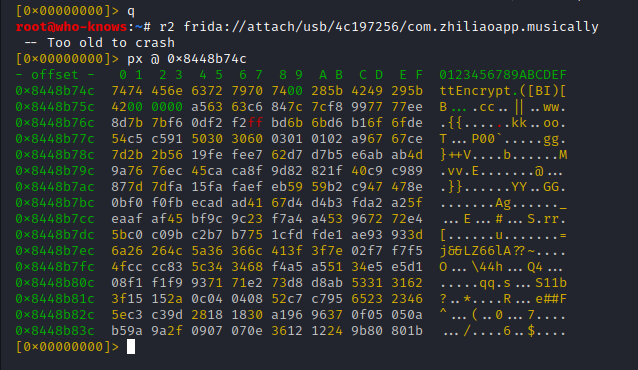
So chances are high, that this data is part of the structure which gets handed in to 'registerNatives'

- method name (C-string)
- method signature (C-string)
- method pointer (native pointer)
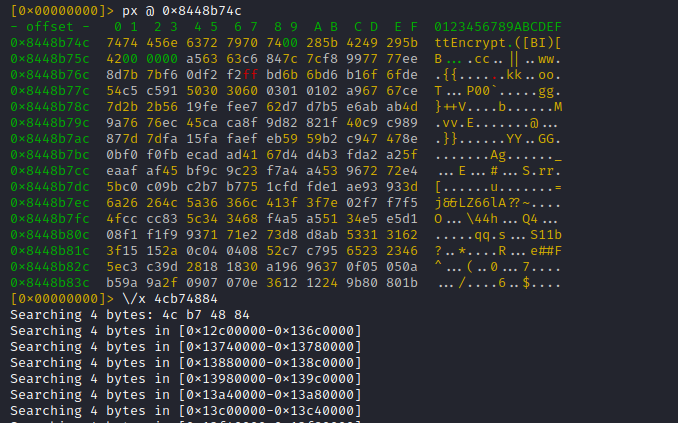
The result is promising: Only one hit, for a search across the whole address space:
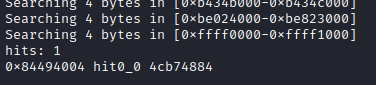
- 0x8448b74c (expected, method name pointer)
- 0x8448b756 (ptr to signature string, yay)
- 0x8448b1d5 (likely pointer to JNI method implementation)

Arm 32 supports two instruction sets "ARM mode" (32bit) and "Thumb mode" (16bit) which could be used interchangebly
For ARM the LSB is 0 (even address)
For THUMB the LSB is 1 (odd address)
This means the function address 0x8448b1d5 homes code in THUMB mode (16bit), while the first instruction resides at 0x8448b1d4
(sorry if it gets a bit complicated, will be clear in a second)
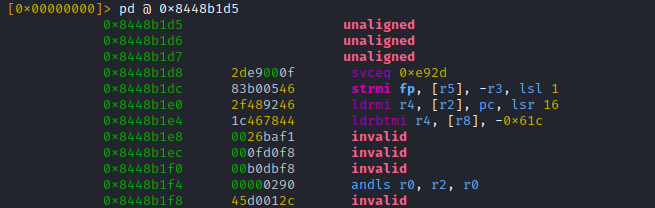
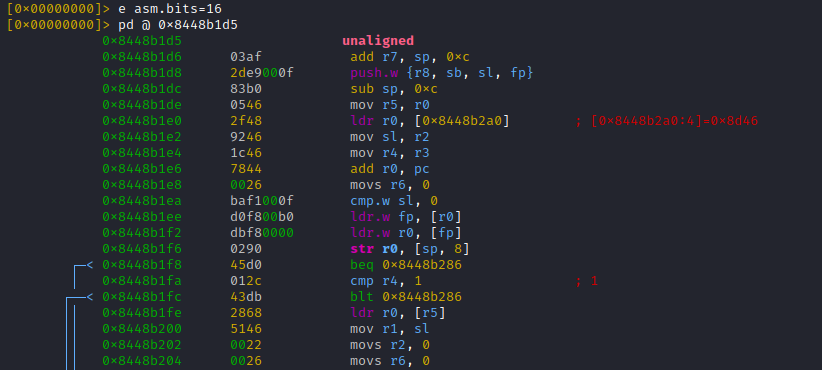
No seriously, as explained, on arm32 we have to disassemble at [THUMB mode address - 1] = 0x8448b1d4
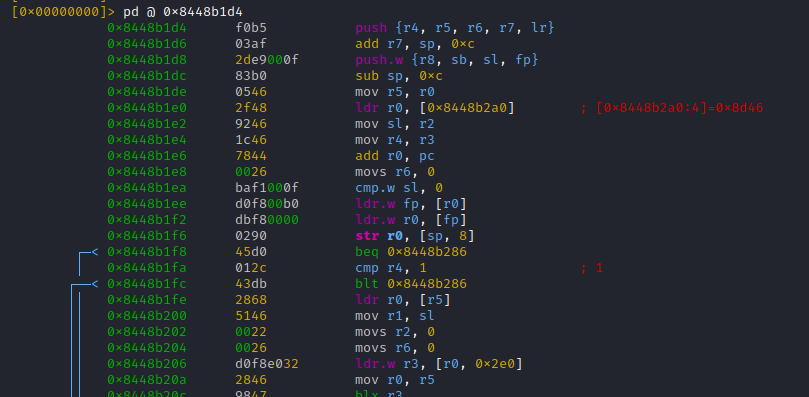
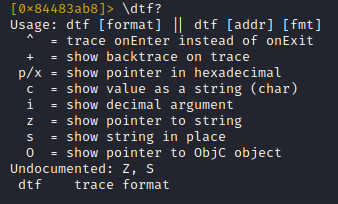
Now to get a feeling on how often this function is called, lets use 'r2frida' power to trace it.
Important: The thumb address has to be used here!!!

Some actions in the TikTok app ... trace logs for ttEncrypt-calls arrive

Trying to runtime-parse the function parameters, which represent Java object instances would be insane (maybe impossible)
It would be way easier to runtime-inspect these
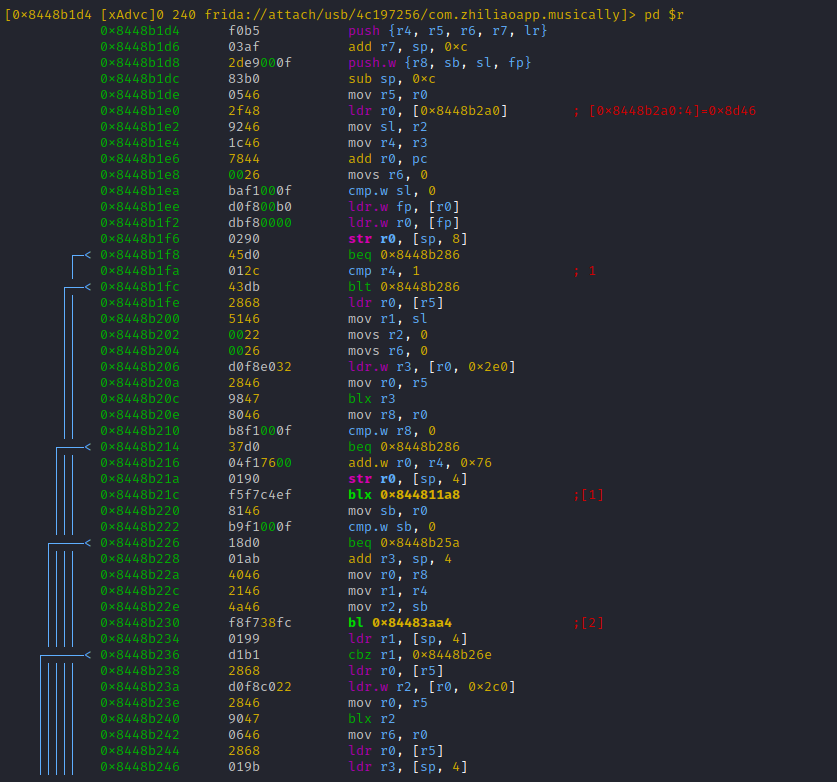
Hitting [alt+1] moves us straight to the marked branch offset:
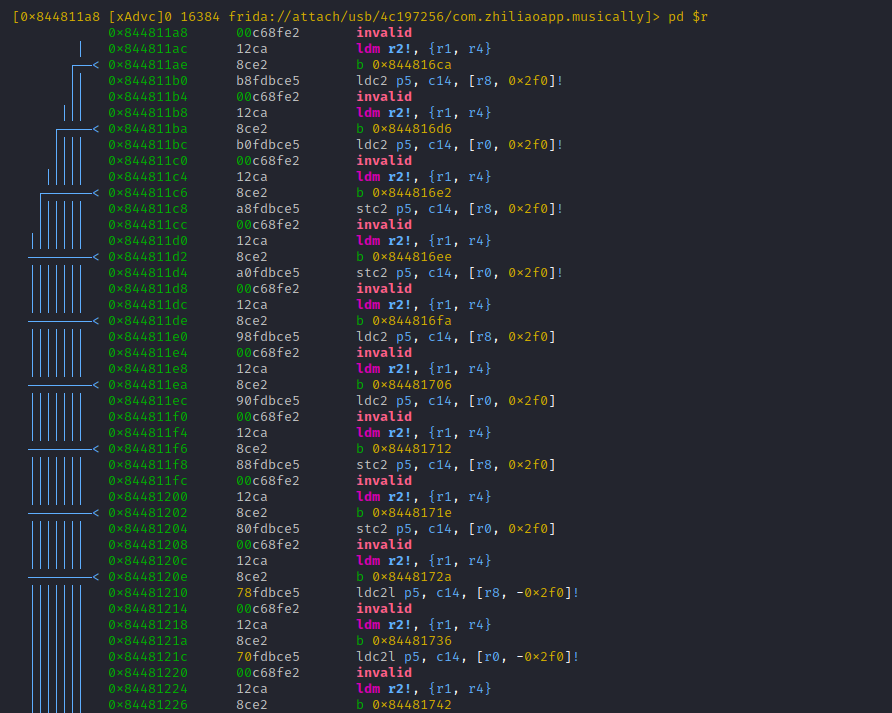
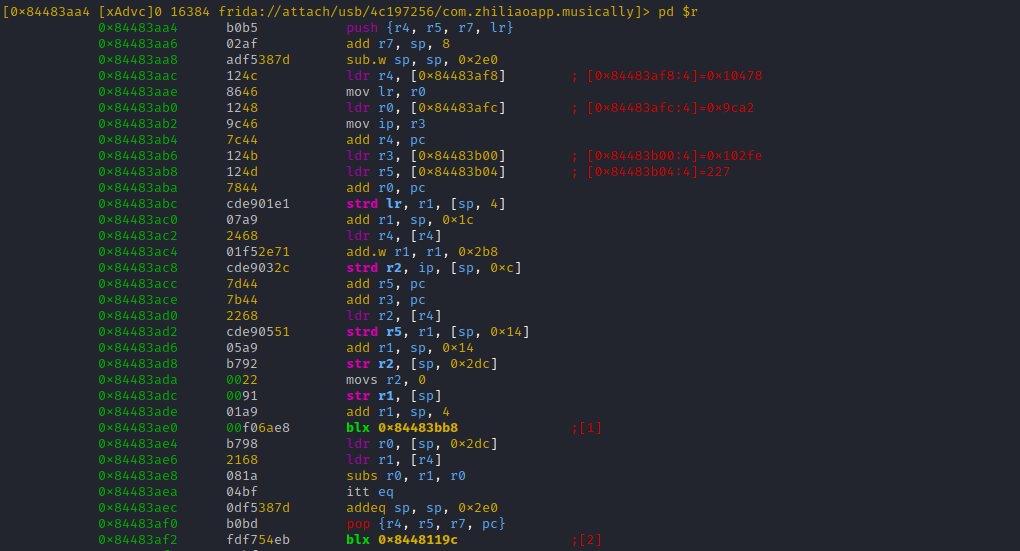
Hitting 'u' returns us to the parent function, followed by [alt+2] which brings us into the 2nd branch


More from Machine learning


10 PYTHON 🐍 libraries for machine learning.
Retweets are appreciated.
[ Thread ]

1. NumPy (Numerical Python)
- The most powerful feature of NumPy is the n-dimensional array.
- It contains basic linear algebra functions, Fourier transforms, and tools for integration with other low-level languages.
Ref: https://t.co/XY13ILXwSN
2. SciPy (Scientific Python)
- SciPy is built on NumPy.
- It is one of the most useful libraries for a variety of high-level science and engineering modules like discrete Fourier transform, Linear Algebra, Optimization, and Sparse matrices.
Ref: https://t.co/ALTFqM2VUo

3. Matplotlib
- Matplotlib is a comprehensive library for creating static, animated, and interactive visualizations in Python.
- You can also use Latex commands to add math to your plot.
- Matplotlib makes hard things possible.
Ref: https://t.co/zodOo2WzGx

4. Pandas
- Pandas is for structured data operations and manipulations.
- It is extensively used for data munging and preparation.
- Pandas were added relatively recently to Python and have been instrumental in boosting Python’s usage.
Ref: https://t.co/IFzikVHht4

Retweets are appreciated.
[ Thread ]
1. NumPy (Numerical Python)
- The most powerful feature of NumPy is the n-dimensional array.
- It contains basic linear algebra functions, Fourier transforms, and tools for integration with other low-level languages.
Ref: https://t.co/XY13ILXwSN
2. SciPy (Scientific Python)
- SciPy is built on NumPy.
- It is one of the most useful libraries for a variety of high-level science and engineering modules like discrete Fourier transform, Linear Algebra, Optimization, and Sparse matrices.
Ref: https://t.co/ALTFqM2VUo
3. Matplotlib
- Matplotlib is a comprehensive library for creating static, animated, and interactive visualizations in Python.
- You can also use Latex commands to add math to your plot.
- Matplotlib makes hard things possible.
Ref: https://t.co/zodOo2WzGx
4. Pandas
- Pandas is for structured data operations and manipulations.
- It is extensively used for data munging and preparation.
- Pandas were added relatively recently to Python and have been instrumental in boosting Python’s usage.
Ref: https://t.co/IFzikVHht4


You May Also Like


Facebook originally a CIA program called "LifeLog".
LifeLog, via DARPA, terminated on Feb 4th, 2004.
Facebook was launched on Feb 4th, 2004.
Many of the LifeLog team became execs at FB.
Zuckerberg is a figurehead.
CIA allowed Cambridge to help Trump win
https://t.co/enzOXDCogV

Pentagon Kills LifeLog
LifeLog, via DARPA, terminated on Feb 4th, 2004.
Facebook was launched on Feb 4th, 2004.
Many of the LifeLog team became execs at FB.
Zuckerberg is a figurehead.
CIA allowed Cambridge to help Trump win
https://t.co/enzOXDCogV
Project: Lifelog
— Robert Horan (@Robby12692) December 13, 2018
Started by DARPA in 1999, the goal of Lifelog was to create a database on civilians without their knowledge, and track everything they do.
The project "ended" on Feb 4th, 2004.
Facebook began the exact same day.
The CIA funneled tens of millions into Facebook. pic.twitter.com/r7hwF0v9kh
Pentagon Kills LifeLog

THREAD PART 1.
On Sunday 21st June, 14 year old Noah Donohoe left his home to meet his friends at Cave Hill Belfast to study for school. #RememberMyNoah💙

He was on his black Apollo mountain bike, fully dressed, wearing a helmet and carrying a backpack containing his laptop and 2 books with his name on them. He also had his mobile phone with him.
On the 27th of June. Noah's naked body was sadly discovered 950m inside a storm drain, between access points. This storm drain was accessible through an area completely unfamiliar to him, behind houses at Northwood Road. https://t.co/bpz3Rmc0wq
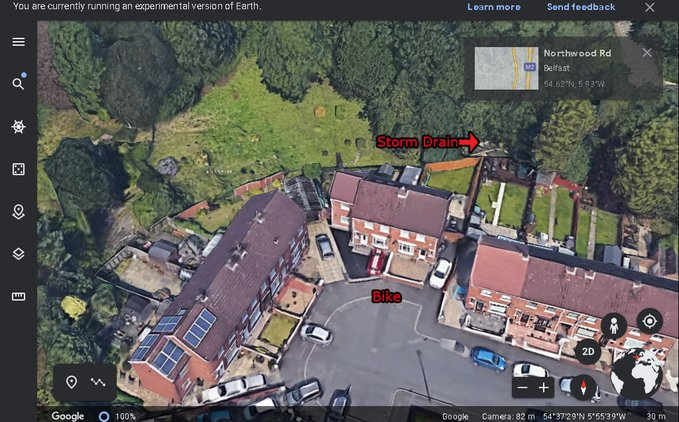
"Noah's body was found by specially trained police officers between two drain access points within a section of the tunnel running under the Translink access road," said Mr McCrisken."
Noah's bike was also found near a house, behind a car, in the same area. It had been there for more than 24 hours before a member of public who lived in the street said she read reports of a missing child and checked the bike and phoned the police.
On Sunday 21st June, 14 year old Noah Donohoe left his home to meet his friends at Cave Hill Belfast to study for school. #RememberMyNoah💙
He was on his black Apollo mountain bike, fully dressed, wearing a helmet and carrying a backpack containing his laptop and 2 books with his name on them. He also had his mobile phone with him.
On the 27th of June. Noah's naked body was sadly discovered 950m inside a storm drain, between access points. This storm drain was accessible through an area completely unfamiliar to him, behind houses at Northwood Road. https://t.co/bpz3Rmc0wq
"Noah's body was found by specially trained police officers between two drain access points within a section of the tunnel running under the Translink access road," said Mr McCrisken."
Noah's bike was also found near a house, behind a car, in the same area. It had been there for more than 24 hours before a member of public who lived in the street said she read reports of a missing child and checked the bike and phoned the police.