🤔 Python generators

What are they? How to use them?

#Python

🧵Let's find out 👇

1️⃣ Python generators are lazy iterators delivering the next value when their .next() is called.

They are created by using the yield keyword

next() can be called explicitly or implicitly inside for loop

They can be finite or infinite
2️⃣ yield - where a value is sent back to the caller, but the function doesn’t exit afterward as with the return statement

The state of function is remembered.

For example, the number is incremented and sent back from yield at the consecutive call next()
3️⃣ Generator stores only the current state of the function - it generates next element on next() call and forgets the previous one -> it saves memory

For example, we don't need to store 1mio elements in memory to do something with each element
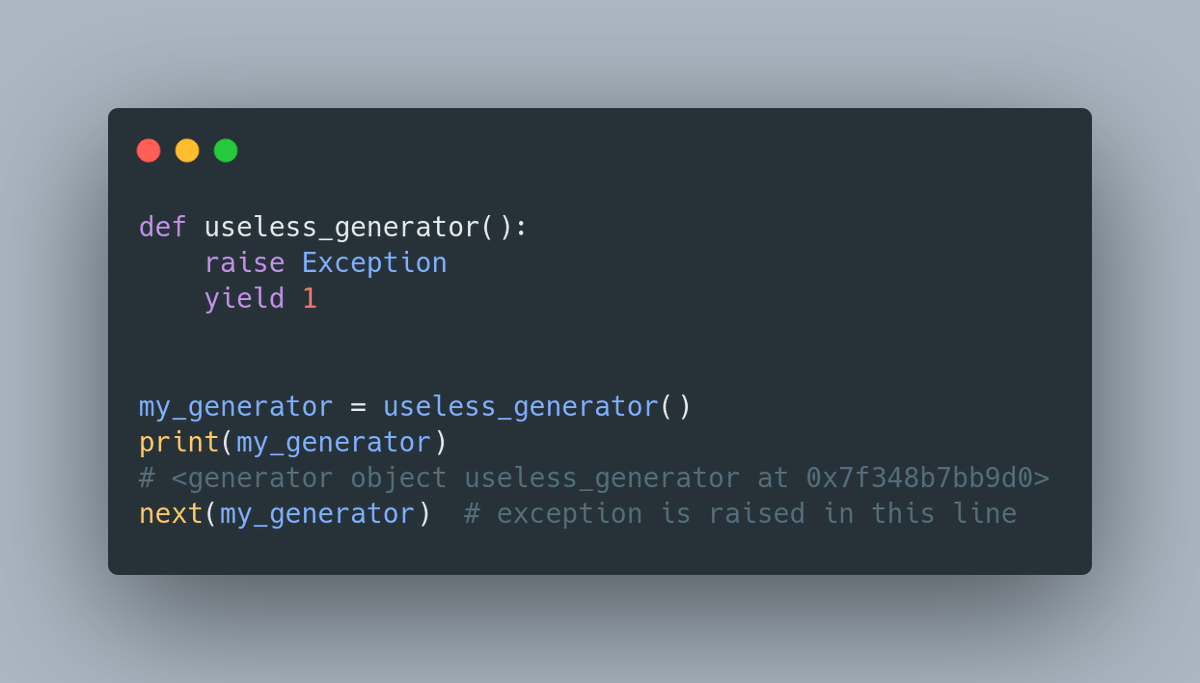
4️⃣ When you call a generator function generator object is returned - it's not executed yet

It executes only when next() is called

For example, that's why Exception is raised only on the next() call
5️⃣ When the generator goes out of elements it raises StopIteration exception
6️⃣ You can also create a class that behaves like a generator - it needs implemented methods:

- __iter__ -> to enable iteration
- __next__ -> to enable next element access
7️⃣ You can also create a generator with one-liner expression similar to list comprehension
8️⃣ You can read more:

https://t.co/mXp7L8l2Ai

More from Machine learning

This is a Twitter series on #FoundationsOfML.

❓ Today, I want to start discussing the different types of Machine Learning flavors we can find.

This is a very high-level overview. In later threads, we'll dive deeper into each paradigm... 👇🧵

Last time we talked about how Machine Learning works.

Basically, it's about having some source of experience E for solving a given task T, that allows us to find a program P which is (hopefully) optimal w.r.t. some metric


According to the nature of that experience, we can define different formulations, or flavors, of the learning process.

A useful distinction is whether we have an explicit goal or desired output, which gives rise to the definitions of 1️⃣ Supervised and 2️⃣ Unsupervised Learning 👇

1️⃣ Supervised Learning

In this formulation, the experience E is a collection of input/output pairs, and the task T is defined as a function that produces the right output for any given input.

👉 The underlying assumption is that there is some correlation (or, in general, a computable relation) between the structure of an input and its corresponding output and that it is possible to infer that function or mapping from a sufficiently large number of examples.

You May Also Like

1/ Some initial thoughts on personal moats:

Like company moats, your personal moat should be a competitive advantage that is not only durable—it should also compound over time.

Characteristics of a personal moat below:


2/ Like a company moat, you want to build career capital while you sleep.

As Andrew Chen noted:


3/ You don’t want to build a competitive advantage that is fleeting or that will get commoditized

Things that might get commoditized over time (some longer than


4/ Before the arrival of recorded music, what used to be scarce was the actual music itself — required an in-person artist.

After recorded music, the music itself became abundant and what became scarce was curation, distribution, and self space.

5/ Similarly, in careers, what used to be (more) scarce were things like ideas, money, and exclusive relationships.

In the internet economy, what has become scarce are things like specific knowledge, rare & valuable skills, and great reputations.