Craig Murray contempt of court case has begun.
I'll post updates on this thread.
1. Material published contains information likely to identify the complainers
2 Substantial risk of prejudicing the trial via his articles and readers comments on them.
3 information published breached court order.
Advocate Depute says it does.
Lady Dorian asks how an article published before the order (banning the names from being published) could be in breach of it.
Prentice says they are still online.
Notes 313 people on WebEx and hundreds of others are attending the hearing virtually. "More than would fit into the biggest courtroom"
Says this shows the public interest in the case
Says this shows a "sincere and genuine commitment"
Lady Dorian notes "The jury might take a scunner, to put it that way."
Defence say that depends on the case, and the court should look at the standard of "beyond a reasonable doubt." And that any other standard would mean no cases could be reported at all.
More from Law

Thread: This is Exhibit #19 in the MI case filed by @SidneyPowell1.
https://t.co/7dQtnTay5n
You can find all the affidavits
I don’t see how a court could ignore this evidence. Only corruption would explain ignoring it.
The affiant is an acknowledged expert in cyber security.

https://t.co/H7D5MIUzkI

https://t.co/PKwbBQWzXW

https://t.co/qo1l4kB7qt

https://t.co/7dQtnTay5n
You can find all the affidavits
I don’t see how a court could ignore this evidence. Only corruption would explain ignoring it.
The affiant is an acknowledged expert in cyber security.
https://t.co/H7D5MIUzkI
https://t.co/PKwbBQWzXW
https://t.co/qo1l4kB7qt




This is what he wants to do.
No matter how this trial plays out, the US will remain divided between those who choose truth, Democracy, and rule of law and the millions who reject these things.
1/
The question is how to move forward.
My mantra is that there are no magic bullets and these people will always be with us.
Except for state legislatures, they have less power now than they have for a while.
2/
The only real and lasting solutions are political ones. Get Democrats into local offices. Get people who want democracy to survive to the polls at every election, at every level.
It’s a constant battle.
3/
Maybe I should tell you all about Thurgood Marshall’s life to illustrate how hard the task is and how there will be backlash after each step of progress.
4/
Precisely. That's why Thurgood Marshall's life came to mind.
We are still riding the backlash that started after the Supreme Court decision in Brown v. Board of Education.
That's why I keep saying there are no easy
No matter how this trial plays out, the US will remain divided between those who choose truth, Democracy, and rule of law and the millions who reject these things.
1/
Wouldn't he just use this to repeat his Big Lie and have GOP echo him?
— Thel Marquez (@theljava) January 31, 2021
The question is how to move forward.
My mantra is that there are no magic bullets and these people will always be with us.
Except for state legislatures, they have less power now than they have for a while.
2/
The only real and lasting solutions are political ones. Get Democrats into local offices. Get people who want democracy to survive to the polls at every election, at every level.
It’s a constant battle.
3/
Maybe I should tell you all about Thurgood Marshall’s life to illustrate how hard the task is and how there will be backlash after each step of progress.
4/
Precisely. That's why Thurgood Marshall's life came to mind.
We are still riding the backlash that started after the Supreme Court decision in Brown v. Board of Education.
That's why I keep saying there are no easy
Yep. My relatives continue to support Trump and make false equivalencies as justification. I\u2019ve found it impossible to present factual information that changes minds. Trump\u2019s emotional appeal registers with them: that things were better before civil rights advances.
— Martha Brockenbrough INTO THE BLOODRED WOODS (@mbrockenbrough) January 31, 2021


You May Also Like

"I lied about my basic beliefs in order to keep a prestigious job. Now that it will be zero-cost to me, I have a few things to say."
We know that elite institutions like the one Flier was in (partial) charge of rely on irrelevant status markers like private school education, whiteness, legacy, and ability to charm an old white guy at an interview.
Harvard's discriminatory policies are becoming increasingly well known, across the political spectrum (see, e.g., the recent lawsuit on discrimination against East Asian applications.)
It's refreshing to hear a senior administrator admits to personally opposing policies that attempt to remedy these basic flaws. These are flaws that harm his institution's ability to do cutting-edge research and to serve the public.
Harvard is being eclipsed by institutions that have different ideas about how to run a 21st Century institution. Stanford, for one; the UC system; the "public Ivys".
As a dean of a major academic institution, I could not have said this. But I will now. Requiring such statements in applications for appointments and promotions is an affront to academic freedom, and diminishes the true value of diversity, equity of inclusion by trivializing it. https://t.co/NfcI5VLODi
— Jeffrey Flier (@jflier) November 10, 2018
We know that elite institutions like the one Flier was in (partial) charge of rely on irrelevant status markers like private school education, whiteness, legacy, and ability to charm an old white guy at an interview.
Harvard's discriminatory policies are becoming increasingly well known, across the political spectrum (see, e.g., the recent lawsuit on discrimination against East Asian applications.)
It's refreshing to hear a senior administrator admits to personally opposing policies that attempt to remedy these basic flaws. These are flaws that harm his institution's ability to do cutting-edge research and to serve the public.
Harvard is being eclipsed by institutions that have different ideas about how to run a 21st Century institution. Stanford, for one; the UC system; the "public Ivys".




BREAKING: @CommonsCMS @DamianCollins just released previously sealed #Six4Three @Facebook documents:
Some random interesting tidbits:
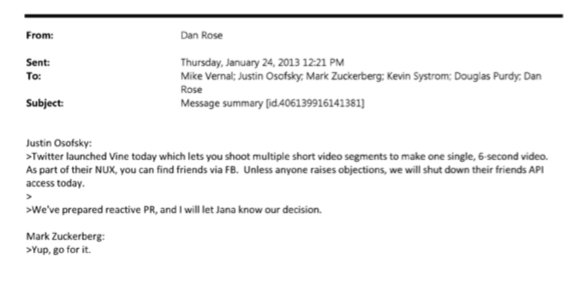
1) Zuck approves shutting down platform API access for Twitter's when Vine is released #competition
2) Facebook engineered ways to access user's call history w/o alerting users:
Team considered access to call history considered 'high PR risk' but 'growth team will charge ahead'. @Facebook created upgrade path to access data w/o subjecting users to Android permissions dialogue.
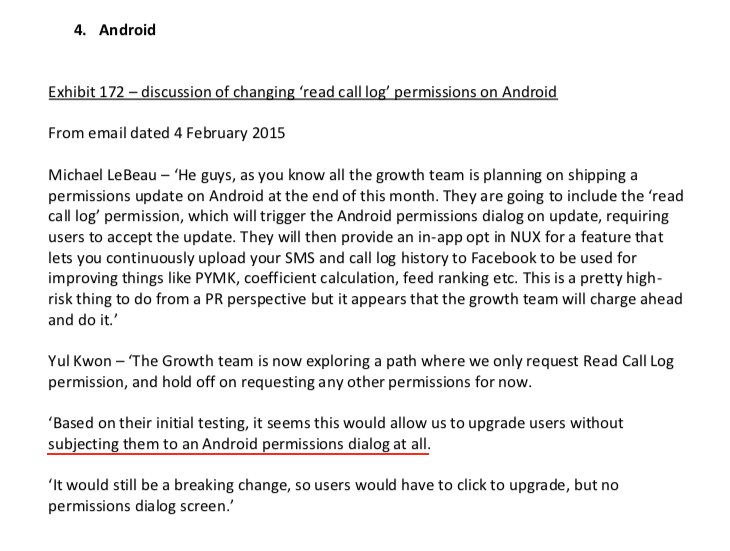
3) The above also confirms @kashhill and other's suspicion that call history was used to improve PYMK (People You May Know) suggestions and newsfeed rankings.
4) Docs also shed more light into @dseetharaman's story on @Facebook monitoring users' @Onavo VPN activity to determine what competitors to mimic or acquire in 2013.
https://t.co/PwiRIL3v9x
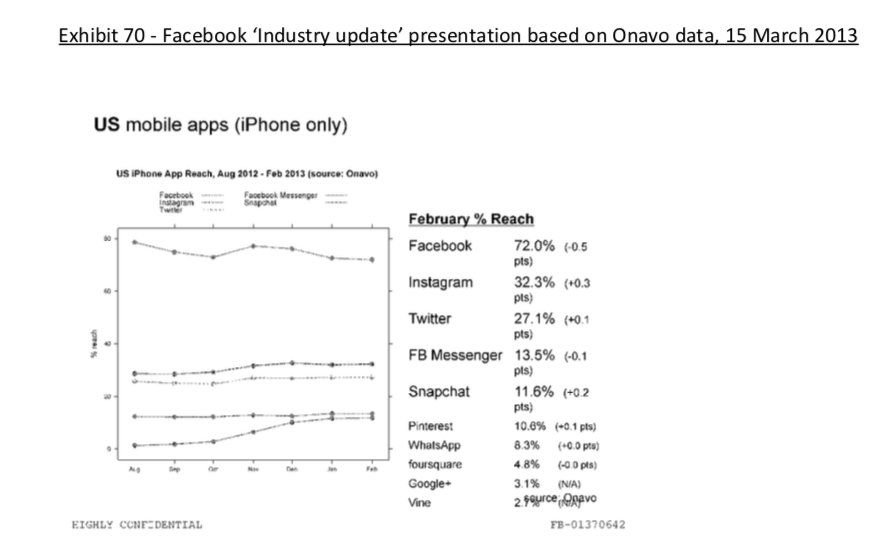
Some random interesting tidbits:
1) Zuck approves shutting down platform API access for Twitter's when Vine is released #competition
2) Facebook engineered ways to access user's call history w/o alerting users:
Team considered access to call history considered 'high PR risk' but 'growth team will charge ahead'. @Facebook created upgrade path to access data w/o subjecting users to Android permissions dialogue.
3) The above also confirms @kashhill and other's suspicion that call history was used to improve PYMK (People You May Know) suggestions and newsfeed rankings.
4) Docs also shed more light into @dseetharaman's story on @Facebook monitoring users' @Onavo VPN activity to determine what competitors to mimic or acquire in 2013.
https://t.co/PwiRIL3v9x