Since tweets by @rihanna and @miakhalifa are now considered 'external forces' and 'foreign interference', a small reminder... During the first Emergency, the Sangh's main line of dissent was through foreign press, governments, activists, and funding.
A short thread.

(2) The RSS has a fanciful mythology of its resistance within India, but there's not much evidence of it. @Swamy39 wrote in the year 2000 that ‘most of the leaders of the BJP/RSS had betrayed the struggle against the Emergency,’ offering ‘to work for the nation’s tormentors’...
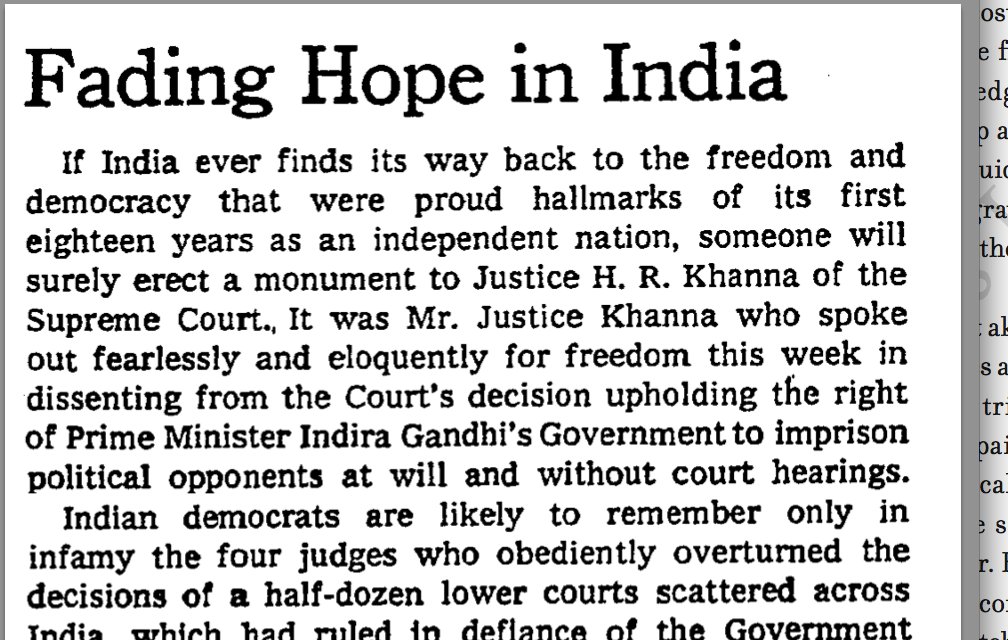
(3) Instead it was overseas intelligentsia (from the Left) who gave the anti-Emergency movement early moral support. But Sangh leaders like Makarand Desai also lobbied @nytimes & other Western papers to editorialise on the silencing of dissent & capture of the judiciary in India.
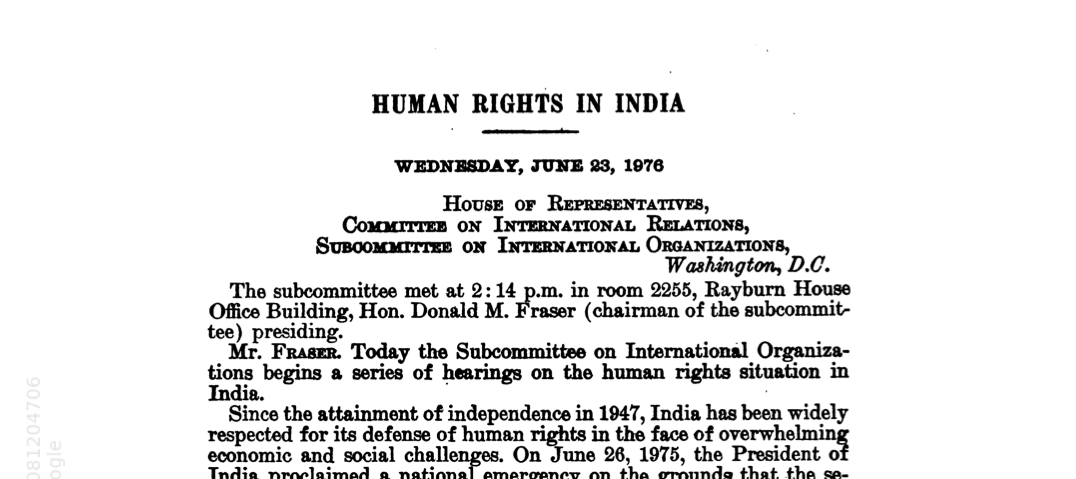
(4) Following this, the US Congressional Committee on International Relations held hearings about human rights in India. Witnesses included Ram Jethmalani; Jagjit Singh Chohan, of the Int'l Council of Sikhs; and Leila Kabir Fernandes, married to union leader George Fernandes.
(5) Questions were also asked in the UK House of Commons – just as they were last year, in the US Congress, in the House of Commons, and in the European Parliament, in support of the anti-CAA Citizenship movement. https://t.co/SeH55OrVll
(6) It was this international pressure on Indira Gandhi that helped to bring the Emergency to an end in 1977. MG Chitkara, an RSS ideologue, said that overseas activism ‘proved to be one of the decisive factors in upsetting the calculations of the dictatorial regime here’.
(7) Predictably, the Indira government's response was to accuse Western media of ‘foreign interference’ and to call their coverage ‘slanderous and malicious’.
Its language – of ‘anti-India propaganda’, ‘external enemies’ – was exactly the same we're hearing today.
(8) Even when the Emergency ended, the linkages with overseas Indians did not. The BJP's popularity in the older generation of Indian expats, the 'Howdy Modi' crowd, is an artifact of foreign states providing safe harbour for dissent & protest when it was not safe in India.
(9) Today, younger generations of Indian expats and diaspora uphold a strong, non-sectarian, progressive South Asian identity – led by role models who represent all that too.
The anti-CAA movement, and now #FarmersProtests, are naturally finding support and safety there.
(10) Don't expect this to end just because @MEAIndia is upset about it. As a young Indian in the US wrote to me, after the Citizenship protests: 'New regimes of control in India will require new forms of resistance in spaces where it remains possible'.

More from India

Dumb£dk@r wasn't like Pe£riyar?

He was an Anti-Hindu m0r0n just like Periy@r.


Yes it's true that he criticised K2@s but that doesn't make him any useful for Hindus.

His writings will remind you a lot of JNU Urban Naxals like Kanhaiya.

"Ancient Hindus had no sexual morals, brother cohabited with sister, son with mother, father with daughter... Men freely shared women & none had exclusive right over her... Prostitution flourished in the worst form...bestiality prevailed, done even by Rishis."
Riddles in Hinduism


This is what Shri Ram said in Kishkindha-Kanda of Valmiki Ramayana regarding such immoral relationships.

But how could Neela Katt@ppa not realize this?

Because he severely lacking analytical capabilities of Hindu texts.


"Hindu Gods were miserable cowards who had to hide behind their wives to save themselves from Asuras. How could these cowards give power to Shakti? Did the Brahmins invent the practice of worshipping of Goddesses to put a new commodity in the market?"

Riddles in Hinduism.

You May Also Like