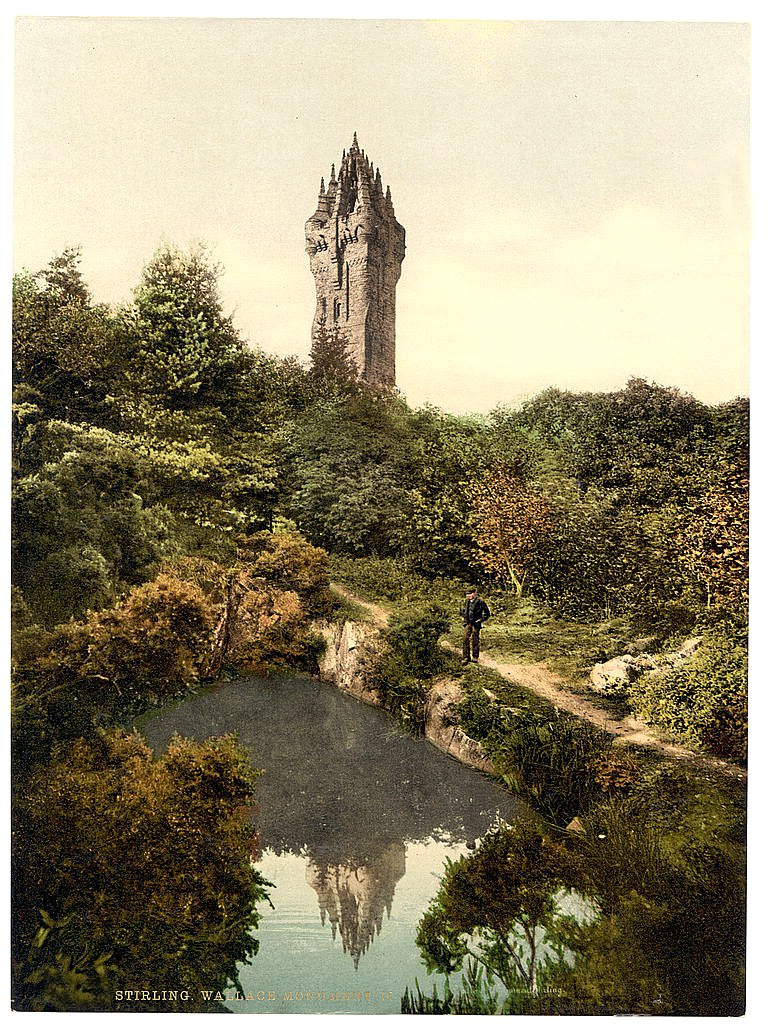
The Wallace Monument was erected in the memory of William Wallace (c. 1270-1305), one of the most important Scottish historical figures. Wallace rose to prominence in 1297 when he defeated an English army at the battle of Stirling Bridge. Although it celebrated a fierce
Glasgow Herald, June 25, 1861.
Mr Sheriff GLASSFORD said—
Sir Archibald Alison, ladies and fellow-countrymen, I have the honour to propose that we avail
I look upon this monument but as a reflex of the spirit of the age. I see our Volunteers there, upon the hill side, and in the valleys beneath, glittering in rank and file; is it wonderful that they should rejoice to behold on this fair eminence that which
More from History

This is THEFT!
Indians had Algebra BEFORE Mμslim prophet & religion was even born.
Here is Bakhshali Manuscript dating back to 3rd century CE. It is an Algebraic treatise. Have you anything like this from the Arabian desert? No, you simply plagiarized Algebra from Indians! https://t.co/cWXRNYMgDt

The Bakhshali manuscript, which has been carbon dated to 3rd century CE, is an ancient Hindu treatise on Arithmetic and Algebra.
The Algebraic problems deal with simultaneous equations, quadratic equations, arithmetic
geometric progressions & quadratic indeterminate equations.

Bakhshali isn't earliest Indian Algebraic treatise. Early Algebra is found in Shulba Sutras dating back to at least 800 BC. Traditional Algebra reached its pinnacle in the works of Aryabhata & Bhaskara.
What makes Bakhshali special is it offers mathematical proof to its theories

It is surprising to see that even after the ancient Indian algebraic treatise has been carbon dated to 3rd century CE by Oxford, they persist with "oh we invented Algebra. It is Halal".
A brief examination of the origins of "Halal Algebra" follows
https://t.co/eFIZ98FDrI

The earliest work of "Arabic Algebra" is the "Al-Kitāb Al-Jabr wal-muqābala" by Al Khwarizmi. The term "Algebra" comes from this book ("Al Jabr").
Before writing his treatise, Al Khwarizmi visited India. His book is a plagiarism from Indian Mathematics and an obvious one at that
Indians had Algebra BEFORE Mμslim prophet & religion was even born.
Here is Bakhshali Manuscript dating back to 3rd century CE. It is an Algebraic treatise. Have you anything like this from the Arabian desert? No, you simply plagiarized Algebra from Indians! https://t.co/cWXRNYMgDt
Muslims gave the world Algebra, so here's a "halal" way to say Merry Christmas to our Christian friends :)#MerryChristmas2020 pic.twitter.com/aLXEw2K2I1
— Qasim Rashid, Esq. (@QasimRashid) December 25, 2020
The Bakhshali manuscript, which has been carbon dated to 3rd century CE, is an ancient Hindu treatise on Arithmetic and Algebra.
The Algebraic problems deal with simultaneous equations, quadratic equations, arithmetic
geometric progressions & quadratic indeterminate equations.
Bakhshali isn't earliest Indian Algebraic treatise. Early Algebra is found in Shulba Sutras dating back to at least 800 BC. Traditional Algebra reached its pinnacle in the works of Aryabhata & Bhaskara.
What makes Bakhshali special is it offers mathematical proof to its theories
It is surprising to see that even after the ancient Indian algebraic treatise has been carbon dated to 3rd century CE by Oxford, they persist with "oh we invented Algebra. It is Halal".
A brief examination of the origins of "Halal Algebra" follows
https://t.co/eFIZ98FDrI
The earliest work of "Arabic Algebra" is the "Al-Kitāb Al-Jabr wal-muqābala" by Al Khwarizmi. The term "Algebra" comes from this book ("Al Jabr").
Before writing his treatise, Al Khwarizmi visited India. His book is a plagiarism from Indian Mathematics and an obvious one at that