This is a limited point about availability of efficacy data for vaccines under development in the context of the approval for CovidShield and Covaxin in India.
There have been many so-called experts on the idiotbox opining about apparent availability of P III data which 1/n
Here is one set of efficacy data post the interim analysis of a mRNA vaccine.
Source: https://t.co/BAPnP3PxEb
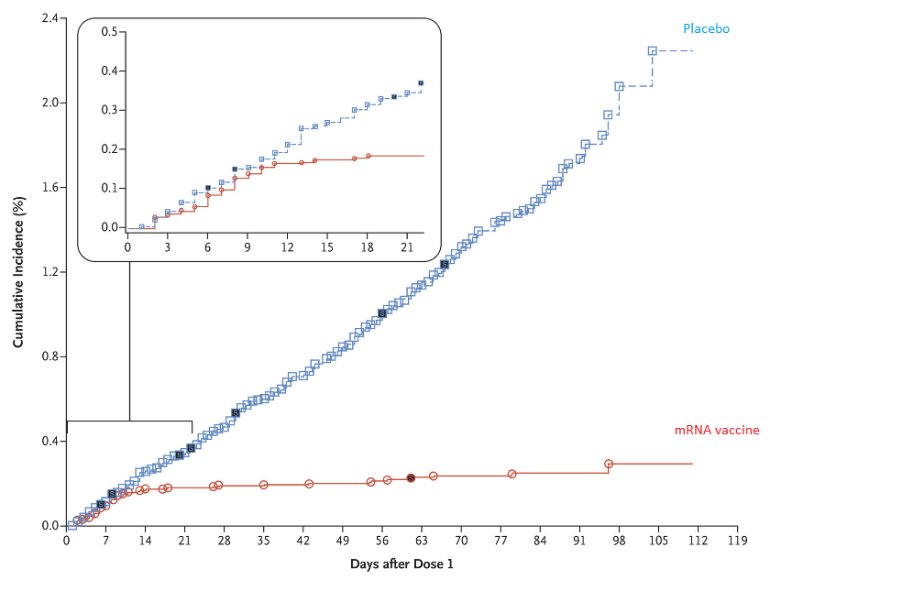
How does the SEC, or the sponsor of these studies, or the experts who are offering their opinion liberally on the idiotbox know what the efficacy is
A. Do they know if the blind was broken for the bridging study and the Phase III study?
B. If so, can they produce data like the one above showing how many subjects who were infected were
And if they cannot answer this question, then ask the following question:
C. In the absence of efficacy data, how does one claim that the vaccine candidate is effective?
D. Do they agree that therapeutic candidates ought to be approved
More from Health
this simple, counter narrative fact keeps cropping up all over the world.
hospital and ICU utilization has been and remains low this year.
it's terribly curious that so few of these monitoring tools provide historical baselines.
getting them is like pulling teeth.
we might think of this as an oversight until you see stuff like this:
this woman was arrested for filming and sharing the fact that their are empty hospitals in the UK.
that's full blown soviet. what possible honest purpose does that
this is the action of a police state and a propaganda ministry, not a well intentioned government and a public heath agency.
"we cannot let people see the truth for fear they might base their actions on real facts" is not much of a mantra for just governance.
90% full ICU sounds scary until you realize that 90-100% full is normal in flu season.
staffed ICU beds are expensive to leave empty. it's like flying with 15% of the plane empty. hospitals don't do that.
and all US hospitals are mandated to be able to flex to 120% ICU.
the US is currently at historically low ICU utilization for this time of year.
61% is "you're all going to go out of business" territory as is 66% full hospital use.
can you blame them for mining CARES act money? they'll die without it.
hospital and ICU utilization has been and remains low this year.
it's terribly curious that so few of these monitoring tools provide historical baselines.
getting them is like pulling teeth.
It took a Freedom of Information request but @Covid19DataUK acquired 2017-2019 averages for England hospitalizations.
— Yinon Weiss (@yinonw) December 31, 2020
2020 had 18% fewer hospitalizations than prior years.
All around the world, using hospital data without context of prior years is just a fear generating lie. pic.twitter.com/DJDpqhIQuw
we might think of this as an oversight until you see stuff like this:
this woman was arrested for filming and sharing the fact that their are empty hospitals in the UK.
that's full blown soviet. what possible honest purpose does that
this is the action of a police state and a propaganda ministry, not a well intentioned government and a public heath agency.
"we cannot let people see the truth for fear they might base their actions on real facts" is not much of a mantra for just governance.
90% full ICU sounds scary until you realize that 90-100% full is normal in flu season.
staffed ICU beds are expensive to leave empty. it's like flying with 15% of the plane empty. hospitals don't do that.
and all US hospitals are mandated to be able to flex to 120% ICU.
the US is currently at historically low ICU utilization for this time of year.
61% is "you're all going to go out of business" territory as is 66% full hospital use.
can you blame them for mining CARES act money? they'll die without it.
I applaud the #EUCancerPlan *BUT* caution: putting #meat 🥩 (a nourishing, evolutionary food) in the same box as 🚬 to solve a contemporary health challenge, would be basing policy on assumptions rather than robust data.
#FollowTheScience yes, but not just part of it!
THREAD👇
1/ Granted, some studies have pointed to ASSOCIATIONS of HIGH intake of red & processed meats with (slightly!) increased colorectal cancer incidence. Also, @WHO/IARC is often mentioned in support (usually hyperbolically so).
But, let’s have a closer look at all this! 🔍
2/ First, meat being “associated” with cancer is very different from stating that meat CAUSES cancer.
Unwarranted use of causal language is widespread in nutritional sciences, posing a systemic problem & undermining credibility.
3/ That’s because observational data are CONFOUNDED (even after statistical adjustment).
Healthy user bias is a major problem. Healthy middle classes are TOLD to eat less red meat (due to historical rather than rational reasons, cf link). So, they
4/ What’s captured here is sociology, not physiology.
Health-focused Westerners eat less red meat, whereas those who don’t adhere to dietary advice tend to have unhealthier lifestyles.
That tells us very little about meat AS SUCH being responsible for disease.
#FollowTheScience yes, but not just part of it!
THREAD👇
\U0001f534LIVE \U0001f4c5Today \u23f012:00 CET
— EU_HEALTH - #EUCancerPlan (@EU_Health) February 3, 2021
We are presenting today the #EUCancerPlan as part of a strong \U0001f1ea\U0001f1fa#HealthUnion
Follow the presentation live here: https://t.co/Cr8ATvzNkg#WorldCancerDay pic.twitter.com/zdByuklWV6
1/ Granted, some studies have pointed to ASSOCIATIONS of HIGH intake of red & processed meats with (slightly!) increased colorectal cancer incidence. Also, @WHO/IARC is often mentioned in support (usually hyperbolically so).
But, let’s have a closer look at all this! 🔍
2/ First, meat being “associated” with cancer is very different from stating that meat CAUSES cancer.
Unwarranted use of causal language is widespread in nutritional sciences, posing a systemic problem & undermining credibility.
3/ That’s because observational data are CONFOUNDED (even after statistical adjustment).
Healthy user bias is a major problem. Healthy middle classes are TOLD to eat less red meat (due to historical rather than rational reasons, cf link). So, they
4/ What’s captured here is sociology, not physiology.
Health-focused Westerners eat less red meat, whereas those who don’t adhere to dietary advice tend to have unhealthier lifestyles.
That tells us very little about meat AS SUCH being responsible for disease.