1/ Welcome to another edition of West’s Well-Being Wednesday! As a reminder, I’ll briefly highlight papers, topics, questions, etc. related to healthcare professional #wellbeing, with a new entry each week. #wellbeingwednesday #burnout #MedTwitter

2/ This week we’ll touch on the association of racial bias and burnout, prompted by @FutureDocs thread last week reflecting on #DrSusanMoore and so many other victims of systematic disparities and racism.
https://t.co/t61vVYAoUP
3/ As a biostatistician, I think it’s interesting that in statistics “bias” is defined as a systematic error or deviation from the truth. This is worth reflecting upon as we debate whether racism and other biases are inherent in our systems – by definition, bias is systematic!
4/ Led by @dyrbye, we published on racial bias and burnout last year. Collaborators included @RRHDr @Ivuoma @bcunningMDPHD @van_ryn
Association of Racial Bias With Burnout Among Resident Physicians https://t.co/cm8JrLyzLO via @JAMANetworkOpen part of @JAMANetwork
5/ This report is part of the multisite longitudinal CHANGES study with @van_ryn as PI. I’m hopeful that this amazing all-star team might have additional clarifying comments: @dyrbye @RRHDr @Ivuoma @bcunningMDPHD
6/ We asked if symptoms of burnout might be associated with resident physicians’ implicit and explicit biases toward (against) black people. Of note, I am not capitalizing “black” here simply to align with the published text.
7/ Why might this association exist and why might it matter? Well, we know burnout is far too prevalent among health care professionals (https://t.co/FKqQATkeV8) and that negative emotional states are associated with racial biases.
8/ The CHANGES study sampled first-year medical students in 2010-2011 from 49 US medical schools, with follow-up in 2014, 2016 (as PGY-2 residents), and 2017 (as PGY-3 residents). In the current study, we focused on data from nonblack physicians.
9/ Variables included burnout, depressive symptoms, a 0-100 feeling thermometer (FT) for explicit racial bias, and a -2 to +2 IAT for implicit racial bias. We looked at cross-sectional associations at PGY-2 and longitudinal patterns from PGY-2 to PGY-3.
10/ Key mean cross-sectional results:

FT score toward black people: 77.9
FT score toward white people: 81.1
IAT 0.4, favoring white people
11/ Increased burnout was a/w increased explicit bias against black people. Magnitude similar to the black-white overall difference, so pretty substantial.
12/ Increased depersonalization and overall burnout, but not emotional exhaustion, was associated with increased implicit bias against black people. Again, effect sizes were similar to the black-white overall difference, so their magnitude is …
13/ In the longitudinal analyses, biases improved from PGY-2 to PGY-3. Residents who recovered from burnout (burnout as PGY-2, not as PGY-3) had the greatest gain in mean FT score (reduction in explicit bias), nearly 5 points!
14/ We don’t know if these relationships are causal, or what factors may drive the observed changes. However, these data may suggest that efforts to reduce burnout might also help the fight against health care inequalities.
15/ Now, @FutureDocs co-authored a very nice editorial adding further insights on this work and its implications.

Breaking the Cycle of Burnout and Bias in Resident Physicians https://t.co/gRBMFWR8XF via @JAMANetworkOpen part of @JAMANetwork
16/ Some key points:

1⃣Unconscious and conscious biases are common, and we need to acknowledge them if we are to improve.
2⃣Burnout does not allow anyone to be their “best self”, and bias concerns appear to be no exception. Burnout may not cause bias, but rather unmask biases.
17/ 👇👇👇

3⃣“Intersectionality and the compounding nature of bias” across marginalized groups requires further attention.
4⃣Careful intervention studies are needed to learn what approaches best mitigate bias and its impacts.
18/ For many 2020 has been the year of #COVID19. We must not lose sight of a deeper truth – 2020 has laid bare deep systematic social injustices #blacklivesmatter. These were huge problems before COVID, but COVID has driven the wedge deeper and widened the gaps.
19/ We cannot truly address the impact of #COVID19 unless we demand efforts to advance social justice across all of society. As physicians, our commitment to public health requires that we be drivers of this change.
20/ Wishing you all an #MVP 2021 filled with Meaning, Values, and Purpose. Come back next week for more! /fin

More from Health

Public Health Scholarships

This may help for those considering MS/PhD in Public Health

1. The Erasmus Mundus Joint Master Degree in Public Health in Disasters
https://t.co/1Z5qpstsSu

2. Afya Bora Global Health

3. Carl Duisberg Scholarships

https://t.co/HnNXdbWBxy

4. Commonwealth Scholarships for Developing Countries

https://t.co/3fWGf5b2OH

5. Fellowships in Public Health & Tropical

6. Fellowships to Promote Mental Health Journalism

https://t.co/MVV9PFsBJ1

7. 2021-22 Jeroen Ensink Memorial Fund

8. Paul S. Lietman Global Travel Grant for Residents & Fellows

https://t.co/qK76R495QT

9. Global Health Internships and Funding

https://t.co/FD9Gh2wXvO

10. Kofi Annan Global Health Leadership

11. MA in European Public Health

https://t.co/5x0Vr7b1j8

12. MSc in Public Health Scholarships - Maastricht University,
1/
Remember woman who tuk multiple @SriSriTattva products 4 range of problems frm diabetes 2 gas 2 liver disease & developed liver failure, listed for liver transplant?
Here is original thread:
https://t.co/PXxI1Slyv2
23 samples, Analysis results
#MedTwitter #livertwitter


2/
Before I go into results, I must say this was overwhelming. There was SO MUCH the lab identified, impossible to put everything here. So I made a summary. At the end of this thread, I have linked a full analysis described in Excel format. Some results were VERY concerning

3/
How did we analyse?
Here R links 2 methods
They R high end, done under strict protocols
Frm Ministry of Forest, Environment, Climate / NABL approvd Lab
ICP-OES https://t.co/O1CLhqVQAu
GC MSMS https://t.co/zRJoXyWQIr
FTIR https://t.co/goAembQ08p
Here is list V analysed 👇


4/
Sample names written on top (each column).
First 5 samples: C what we identified in #Ayurveda #medicines
Antibiotics
Steroids (anabolic/synthetic)
#NARCOTICS - LSD, Morphine
Blood thinners (possible reason Y bleeding tests were off the roof in the patient)
Heavy metals!


5/
Next 5 samples (total 10 now)
Mercury is clear winner. Almost all samples
See controlled substances - Butyrolactones https://t.co/CPz0FwPEOm, methylamine https://t.co/OZnXY7U9UQ
Alcohols, industrial solvents
Rare metals - cobalt, lithium
Again lots of blood thinners
#Ayush
Now you know I love to sh-t in Harvard. But I also like accuracy. So I decided to go look at Harvard’s catalog to see its lack of military history that this article describes (they only teach history of pets it claims) and what I found shocked me! Shocked me! A thread: 1/


First off, Harvard students literally have multiple sections of military history that they can take listed. (It appears these ones are taught at MIT, so they might have to walk down the street for these) but... 2/


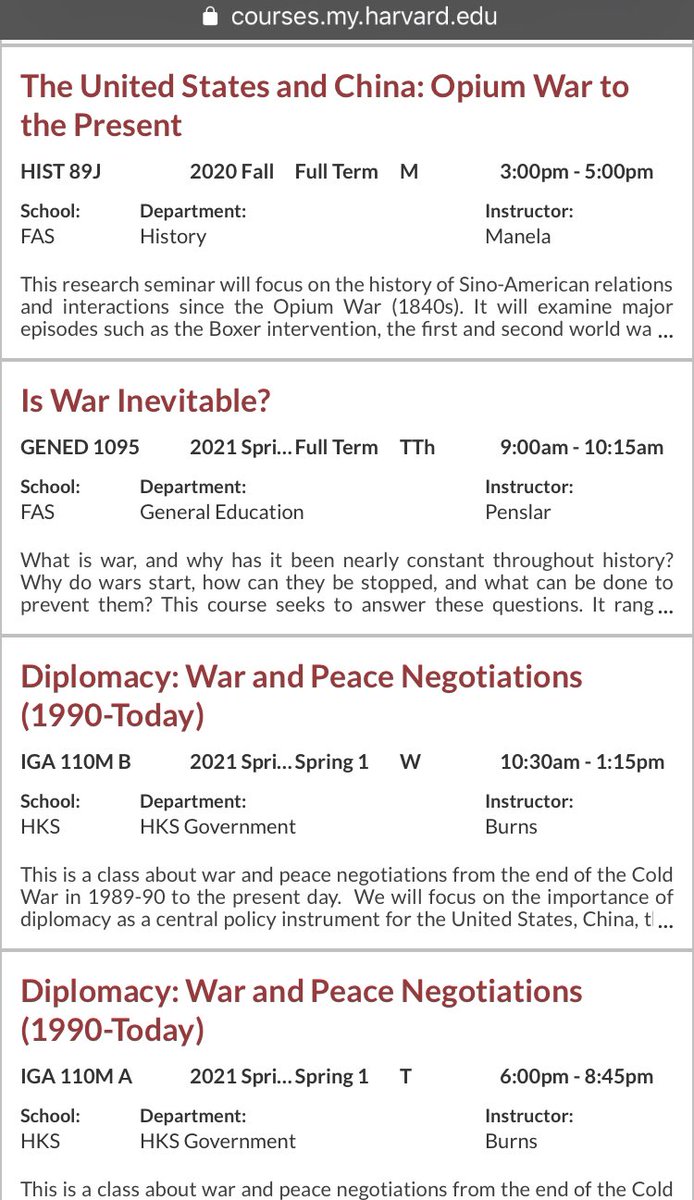
Say they want to stay on campus...they can only take numerous classes on war and diplomacy...3/


They have an entire class on Yalta. That’s right. An entire class on Yalta. 4/


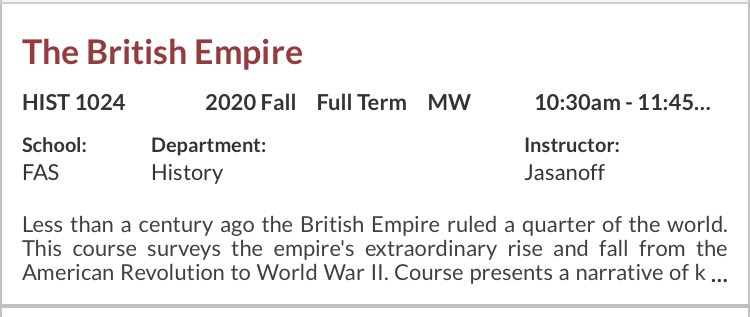
But wait! There is more! They can take the British Empire, The Fall of the Roman Empire for those wanting traditional topics... 5/

You May Also Like

The YouTube algorithm that I helped build in 2011 still recommends the flat earth theory by the *hundreds of millions*. This investigation by @RawStory shows some of the real-life consequences of this badly designed AI.


This spring at SxSW, @SusanWojcicki promised "Wikipedia snippets" on debated videos. But they didn't put them on flat earth videos, and instead @YouTube is promoting merchandising such as "NASA lies - Never Trust a Snake". 2/


A few example of flat earth videos that were promoted by YouTube #today:
https://t.co/TumQiX2tlj 3/

https://t.co/uAORIJ5BYX 4/

https://t.co/yOGZ0pLfHG 5/