
https://t.co/ES5e93BGyT
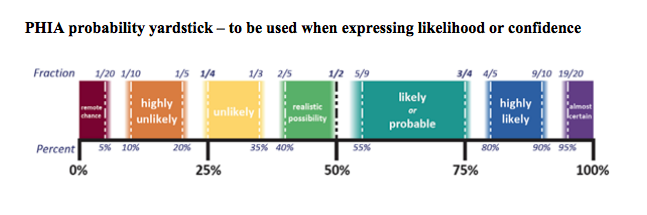
1, Government messaging has become progressively hyperbolic and confusing. Balance and perspective is in short supply. As a result, the information we receive often feels alarming and frightening.

https://t.co/ES5e93BGyT
Did yesterday's UK briefing clearly communicate information accurately and clearly?
Was the information presented openly?
https://t.co/aA2fCRuKwj
Full report here. https://t.co/0WrqG5OiWl
https://t.co/XulQF2aMSX
https://t.co/dLgpSaw02k
https://t.co/bZnVHxy3BU
End
More from Government






Parents in cities, please pay attention to the reopening details from the Whitehouse.
Biden says "small classes". What we need to understand is how they plant to accomplish this.
Through "childcare programs in schools". We see this all over states w/ closed schools.
We need to grasp that the AFT, NEA, & local unions are systematically working to decouple education from childcare.
Their vision is your child sitting on a device all day, watched by a childcare worker, being "taught" from a Teacher working from
This isn't a paranoid conspiracy theory - it is already happening in the majority of districts across the US where schools are closed.
"Learning Hubs" open, supervised by childcare workers, sometimes in the same "unsafe" school
There is NO OTHER WAY to get "small classes" without Hybrid + wraparound childcare. Your child will spend 2-3 days per WEEK supervised by low wage workers and sitting on a laptop.
Here's
Fairfax,
Biden says "small classes". What we need to understand is how they plant to accomplish this.
Through "childcare programs in schools". We see this all over states w/ closed schools.
Today, our first working day, @JoeBiden signed an Executive Order on safely reopening childcare programs in schools - @DrBiden pic.twitter.com/J4vZk5ZAaS
— AFT (@AFTunion) January 21, 2021
We need to grasp that the AFT, NEA, & local unions are systematically working to decouple education from childcare.
Their vision is your child sitting on a device all day, watched by a childcare worker, being "taught" from a Teacher working from
This isn't a paranoid conspiracy theory - it is already happening in the majority of districts across the US where schools are closed.
"Learning Hubs" open, supervised by childcare workers, sometimes in the same "unsafe" school
There is NO OTHER WAY to get "small classes" without Hybrid + wraparound childcare. Your child will spend 2-3 days per WEEK supervised by low wage workers and sitting on a laptop.
Here's
Fairfax,
You May Also Like


@EricTopol @NBA @StephenKissler @yhgrad B.1.1.7 reveals clearly that SARS-CoV-2 is reverting to its original pre-outbreak condition, i.e. adapted to transgenic hACE2 mice (either Baric's BALB/c ones or others used at WIV labs during chimeric bat coronavirus experiments aimed at developing a pan betacoronavirus vaccine)
@NBA @StephenKissler @yhgrad 1. From Day 1, SARS-COV-2 was very well adapted to humans .....and transgenic hACE2 Mice
@NBA @StephenKissler @yhgrad 2. High Probability of serial passaging in Transgenic Mice expressing hACE2 in genesis of SARS-COV-2
@NBA @StephenKissler @yhgrad B.1.1.7 has an unusually large number of genetic changes, ... found to date in mouse-adapted SARS-CoV2 and is also seen in ferret infections.
https://t.co/9Z4oJmkcKj

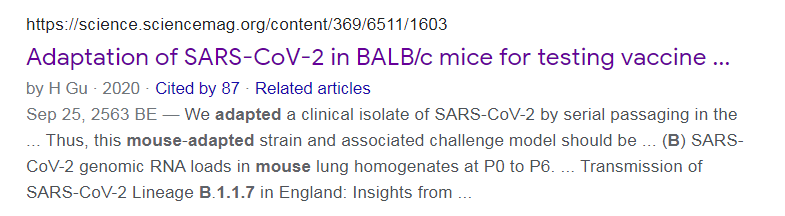
@NBA @StephenKissler @yhgrad We adapted a clinical isolate of SARS-CoV-2 by serial passaging in the ... Thus, this mouse-adapted strain and associated challenge model should be ... (B) SARS-CoV-2 genomic RNA loads in mouse lung homogenates at P0 to P6.
https://t.co/I90OOCJg7o
@NBA @StephenKissler @yhgrad 1. From Day 1, SARS-COV-2 was very well adapted to humans .....and transgenic hACE2 Mice
1. From Day 1, SARS-COV-2 was very well adapted to humans .....and transgenic hACE2 Mice
— Billy Bostickson \U0001f3f4\U0001f441&\U0001f441 \U0001f193 (@BillyBostickson) January 30, 2021
"we generated a mouse model expressing hACE2 by using CRISPR/Cas9 knockin technology. In comparison with wild-type C57BL/6 mice, both young & aged hACE2 mice sustained high viral loads... pic.twitter.com/j94XtSkscj
@NBA @StephenKissler @yhgrad 2. High Probability of serial passaging in Transgenic Mice expressing hACE2 in genesis of SARS-COV-2
1. High Probability of serial passaging in Transgenic Mice expressing hACE2 in genesis of SARS-COV-2!
— Billy Bostickson \U0001f3f4\U0001f441&\U0001f441 \U0001f193 (@BillyBostickson) January 2, 2021
2 papers:
Human\u2013viral molecular mimicryhttps://t.co/irfH0Zgrve
Molecular Mimicryhttps://t.co/yLQoUtfS6s https://t.co/lsCv2iMEQz
@NBA @StephenKissler @yhgrad B.1.1.7 has an unusually large number of genetic changes, ... found to date in mouse-adapted SARS-CoV2 and is also seen in ferret infections.
https://t.co/9Z4oJmkcKj
@NBA @StephenKissler @yhgrad We adapted a clinical isolate of SARS-CoV-2 by serial passaging in the ... Thus, this mouse-adapted strain and associated challenge model should be ... (B) SARS-CoV-2 genomic RNA loads in mouse lung homogenates at P0 to P6.
https://t.co/I90OOCJg7o