Justice Sotomayor opens her dissent in U.S. v. Dustin Higgs by saying the names of every person executed by the federal government over the past year.
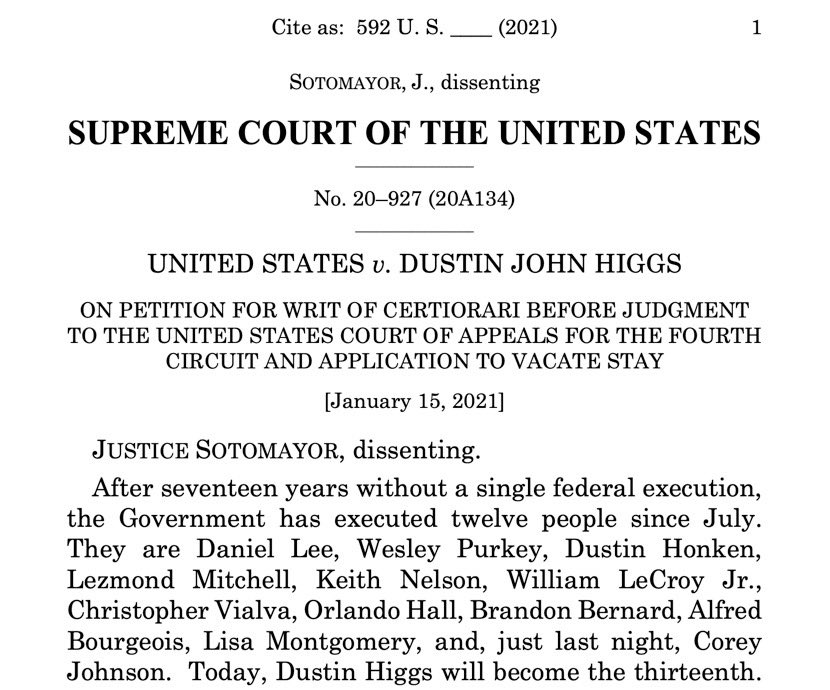
Sotomayor continues by providing historical context. The federal government has executed more people over the past six months than it had in the previous six decades.
Sotomayor details some of the legal disputes that have come up around this spree of federal executions. She goes on to say that, “against this backdrop of legal uncertainty, @TheJusticeDept did not tread carefully.”
Sotomayor explains that it was the government, not death row prisoners, that created the rush to resolve complicated legal questions on artificially compressed deadlines.
Justice Sotomayor: “The government sought emergency relief to proceed before courts had meaningful opportunities to determine if the executions were legal.” The SCOTUS “has consistently rejected inmates’ credible claims for relief.”
Sotomayor adds that the SCOTUS majority ensured that no execution challenges would ever receive meaningful consideration and that most of the Court’s decisions were made behind closed doors with no explanations provided to the public.
Summarizing the above, Sotomayor writes: “This is not justice. After waiting almost two decades to resume federal executions, the Government should have proceeded with some measure of restraint to ensure it did so lawfully. When it did not, [the SCOTUS] should have.”
Sotomayor details how the government has not met the legal standard for emergency relief. She says, in more elegant terms, that the DOJ and SCOTUS majority have short-circuited the legal process to grease the rails for these executions.
Justice Sotomayor: “The Court should not have sanctioned these executions without resolving these critical issues. The stakes were simply too high.”
Sotomayor details several of the complicated legal questions regarding federal executions that have never been resolved. She notes that the government and SCOTUS majority have actively prevented lower courts from answering the questions.
Sotomayor explains that Alfred Bourgeois and Corey Johnson were executed without any court decision on whether they were intellectually disabled. “Their executions may well have been illegal.”
Sotomayor lays bare the fact that the government’s and the SCOTUS majority’s refrain about “last-minute appeals” is not true. She says it’s the government’s fault for creating an “artificial claim of urgency” and forcing rapid-fire adjudication.
Sotomayor details the Court’s failure to consider Corey Johnson’s claim that he was entitled to re-sentencing under the First Step Act. She explains the government’s misconduct in Brandon Bernard’s case and lays out the Court’s legal errors.
Sotomayor ends her legal analysis with the simple truth — We will never know the answers to any of these questions because the Court allowed the government to carry out these executions without full and fair judicial consideration.
Justice Sotomayor: "There can be no 'justice on the fly' in matters of life and death."
Sotomayor continues: "The Court has allowed the United States to execute thirteen people in six months under a statutory scheme and regulatory protocol that have received inadequate scrutiny, without resolving the serious claims the condemned individuals raised."
And Sotomayor concludes: "Those whom the Government executed during this endeavor deserved more from this Court. I respectfully dissent."
Justice Sotomayor’s dissent can be read in its entirety here: https://t.co/xbdXdcs06m

More from Government

You May Also Like

A THREAD ON @SarangSood

Decoded his way of analysis/logics for everyone to easily understand.

Have covered:
1. Analysis of volatility, how to foresee/signs.
2. Workbook
3. When to sell options
4. Diff category of days
5. How movement of option prices tell us what will happen

1. Keeps following volatility super closely.

Makes 7-8 different strategies to give him a sense of what's going on.

Whichever gives highest profit he trades in.


2. Theta falls when market moves.
Falls where market is headed towards not on our original position.


3. If you're an options seller then sell only when volatility is dropping, there is a high probability of you making the right trade and getting profit as a result

He believes in a market operator, if market mover sells volatility Sarang Sir joins him.


4. Theta decay vs Fall in vega

Sell when Vega is falling rather than for theta decay. You won't be trapped and higher probability of making profit.
1/ Here’s a list of conversational frameworks I’ve picked up that have been helpful.

Please add your own.

2/ The Magic Question: "What would need to be true for you


3/ On evaluating where someone’s head is at regarding a topic they are being wishy-washy about or delaying.

“Gun to the head—what would you decide now?”

“Fast forward 6 months after your sabbatical--how would you decide: what criteria is most important to you?”

4/ Other Q’s re: decisions:

“Putting aside a list of pros/cons, what’s the *one* reason you’re doing this?” “Why is that the most important reason?”

“What’s end-game here?”

“What does success look like in a world where you pick that path?”

5/ When listening, after empathizing, and wanting to help them make their own decisions without imposing your world view:

“What would the best version of yourself do”?