
It is a FACT that GOI accepts that there are faults worthy of amendments. This leads is to an entire new discussion that govt still isn’t willing to believe that there are implementation faults & not just faults in the clauses.
So, if the government has accepted that the bills had these flaws where do those people stand who were defending them as perfect?
— smg (@sialmirzagoraya) December 9, 2020
Also farm unions have never shifted their goal post from total revocation of the bills.
1. Scrap the laws.
2. Form panel with experts from both sides.
3. Draft new ordinances.
4. Make laws.
More from Government



They shouldn't be.
The pattern is:
GOP in power - GOP dictates policy
Dems in power - GOP dictates policy
The Dems shouldn't legislate toward the GOP.
The GOP doesn't represent its constituents.
The GOP can push it's agenda on its own time.
If Dems push an agenda that actually helps people, it'll also actually help the GOP constituency.
The GOP won't. So give them nothing.
The Dems should ignore the GOP just like the GOP ignores the Dems.
Make them pay for every moment of obstruction.
Just a hard press on legislation that is unassailable and shine a light on the GOP.
Constant. Relentless. Unyielding.
Shut them out and shut them down.
The GOP is not a legitimate political party. It is an anti-democratic, fascist criminal syndicate with no interest whatsoever in governance.
Nobody should give them the slightest bit of credit or legitimacy ever again.
Not a fucking ounce.
Nobody should engage them in legitimate debate in Congress.
They should be pariahs and treated as unserious occupants of Congress.
Because these people were totally ok with their colleagues being killed in furtherance of the destruction of the insitution.
The pattern is:
GOP in power - GOP dictates policy
Dems in power - GOP dictates policy
Soooooooo what\u2019s the problem. The statement I responded to read as it they haven\u2019t been trying to work together.. but they have so..?
— Othello (@BurberryKid11) February 2, 2021
The Dems shouldn't legislate toward the GOP.
The GOP doesn't represent its constituents.
The GOP can push it's agenda on its own time.
If Dems push an agenda that actually helps people, it'll also actually help the GOP constituency.
The GOP won't. So give them nothing.
The Dems should ignore the GOP just like the GOP ignores the Dems.
Make them pay for every moment of obstruction.
Just a hard press on legislation that is unassailable and shine a light on the GOP.
Constant. Relentless. Unyielding.
Shut them out and shut them down.
The GOP is not a legitimate political party. It is an anti-democratic, fascist criminal syndicate with no interest whatsoever in governance.
Nobody should give them the slightest bit of credit or legitimacy ever again.
Not a fucking ounce.
Nobody should engage them in legitimate debate in Congress.
They should be pariahs and treated as unserious occupants of Congress.
Because these people were totally ok with their colleagues being killed in furtherance of the destruction of the insitution.

You May Also Like






The first area to focus on is diversity. This has become a dogma in the tech world, and despite the fact that tech is one of the most meritocratic industries in the world, there are constant efforts to promote diversity at the expense of fairness, merit and competency. Examples:
USC's Interactive Media & Games Division cancels all-star panel that included top-tier game developers who were invited to share their experiences with students. Why? Because there were no women on the
ElectronConf is a conf which chooses presenters based on blind auditions; the identity, gender, and race of the speaker is not known to the selection team. The results of that merit-based approach was an all-male panel. So they cancelled the conference.
Apple's head of diversity (a black woman) got in trouble for promoting a vision of diversity that is at odds with contemporary progressive dogma. (She left the company shortly after this
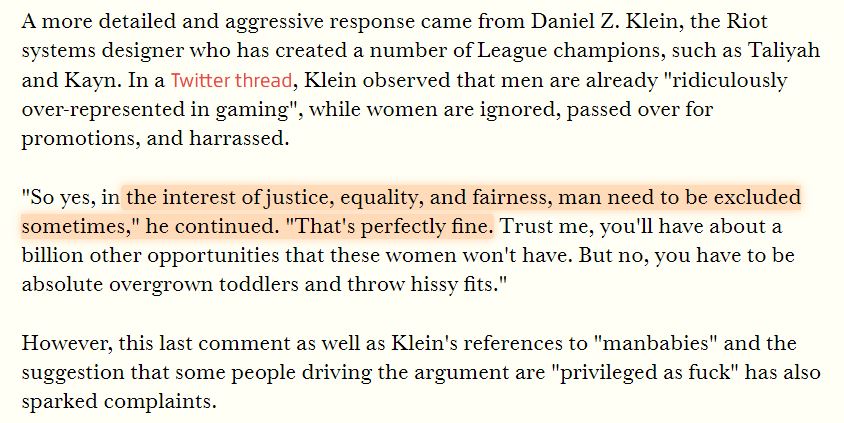
Also in the name of diversity, there is unabashed discrimination against men (especially white men) in tech, in both hiring policies and in other arenas. One such example is this, a developer workshop that specifically excluded men: https://t.co/N0SkH4hR35
USC's Interactive Media & Games Division cancels all-star panel that included top-tier game developers who were invited to share their experiences with students. Why? Because there were no women on the
ElectronConf is a conf which chooses presenters based on blind auditions; the identity, gender, and race of the speaker is not known to the selection team. The results of that merit-based approach was an all-male panel. So they cancelled the conference.
Apple's head of diversity (a black woman) got in trouble for promoting a vision of diversity that is at odds with contemporary progressive dogma. (She left the company shortly after this
Also in the name of diversity, there is unabashed discrimination against men (especially white men) in tech, in both hiring policies and in other arenas. One such example is this, a developer workshop that specifically excluded men: https://t.co/N0SkH4hR35