X : Thoughts on private companies being on the boards of ICS (integrated care systems).
Me : Conflict of interest question? Supplier determining needs?
X : Yes
Me : It's ok, as long as
a) you have effective spend control
b) those private companies are JVs which Gov owns 51% of.

X : What if they are not 51% owned JVs?
Me : Ah, that's a bad idea. You really want your boards to have your interests at heart.
X : What about experience, partnership?
Me : Those are advisors and you take it with a pinch of salt and as much as possible use critical friends.
Suppliers will always tell you that they want to be your partners, to build a relationship, to be your friends, to find the win/win in much the same way a second hand car salesperson wants to be your buddy ... but their interests are not yours and never can be.
X : Critical friends?
Me : Occassionaly you can find critical friends. People that we willing to tell you the truth as they see it regardless of the consequences. They are not very common and it normally requires a deep sense of duty that exceeds any loyalty to others.
X : Can the relationship be symbiotic?
Me : Rarely but that depends. If the organisation has a core overiding principle of focusing on the customer need and I don't mean lip service to this but absolutely embedded into its very core then yes i.e. places like Amazon, Alibaba etc.
But most organisations, even those that talk about "focus on customer need" won't sacrifice their own self and their own well being in order to pursue that customer need. They will tend to fall back on self interest in hard times and become parasitic.
"Symbiosis" and win/win are very easy when the times are good, however the real measure of any commercial relationship is when the times are hard.
X : Why spend control?
Me : You always need an independent mechanism of challenge (outside the department and contract but within Government) to provide challenge through expertise and to spread situational awareness across many contracts. An intelligence function.
X : Why?
Me : People make mistakes, they can trapped by context, they don't understand the wider landscape, it's a point of learning ... so many reasons. Also, sometimes you get the revolving door between public / private that you want to counter.
X : Intelligence function?
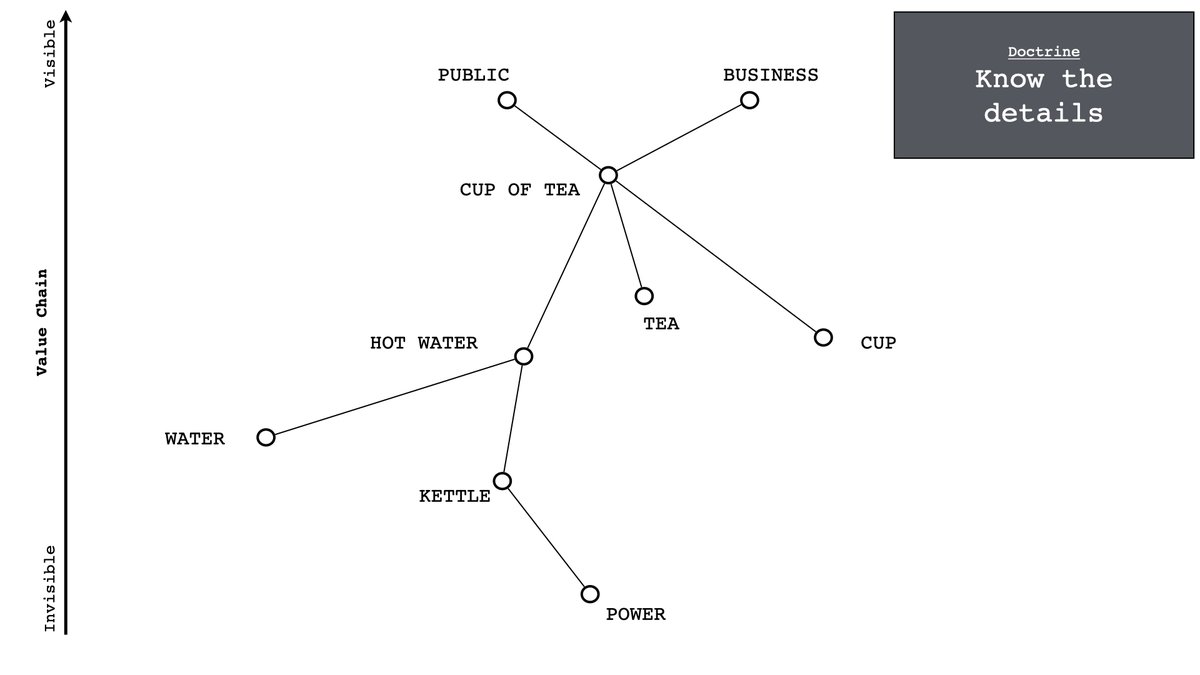
Me : Yes. An effective spend control function including pre and post mortem challenge should also build up your understanding of the landscape, the supply chains, the interconnectedness of components. That would have been useful in brexit, in covid and in a host of other spaces.

More from Simon Wardley

"Fifty-nine percent of those polled said they believed China will become more powerful than the U.S. within 10 years" - https://t.co/3vN4I1TjwP ... I hate to break it to you but it already is in many areas.

When I published this work (originally from 2015) -
https://t.co/GYOItA3StZ - I did tend to get a lot of pushback from US folk when presenting it.

Six years later, less so.


I expect China to start to tackle inequality this year. It's the Achilles heel of the West. We have no response, nor Governments with the required skill, strategy or practice to respond.

We will ultimately face a more advanced, more wealthy and more equal society ...

... as that example of what "is possible" / "good looks like" shift to the East, we will face a painful shift as we question our own values including our kind of democracy. But in reality, the problem is not with our values but our shockingly poor standards of leadership.

X : Is this because of Trump?
Me : No, this has been going on since the 1990s. There has been no effective counterplay to the long game that Deng Xiaoping started. Just hubris, arrogance and exceptionalism with annual Economist articles on "How China will fall".

More from Government

You May Also Like

Recently, the @CNIL issued a decision regarding the GDPR compliance of an unknown French adtech company named "Vectaury". It may seem like small fry, but the decision has potential wide-ranging impacts for Google, the IAB framework, and today's adtech. It's thread time! 👇

It's all in French, but if you're up for it you can read:
• Their blog post (lacks the most interesting details):
https://t.co/PHkDcOT1hy
• Their high-level legal decision: https://t.co/hwpiEvjodt
• The full notification: https://t.co/QQB7rfynha

I've read it so you needn't!

Vectaury was collecting geolocation data in order to create profiles (eg. people who often go to this or that type of shop) so as to power ad targeting. They operate through embedded SDKs and ad bidding, making them invisible to users.

The @CNIL notes that profiling based off of geolocation presents particular risks since it reveals people's movements and habits. As risky, the processing requires consent — this will be the heart of their assessment.

Interesting point: they justify the decision in part because of how many people COULD be targeted in this way (rather than how many have — though they note that too). Because it's on a phone, and many have phones, it is considered large-scale processing no matter what.