
https://t.co/2FAOUT8FdO
Early this week I ranted about a @nytimes editorial misrepresenting the scientific literature around video game uses and effects.
It's one thing for an editorial piece to mishandle scientific information, but it is another when an “educational” organization does it.
A thread.
https://t.co/2FAOUT8FdO
For a primer on the history of the moral panic see here: https://t.co/mj6aedCQBJ
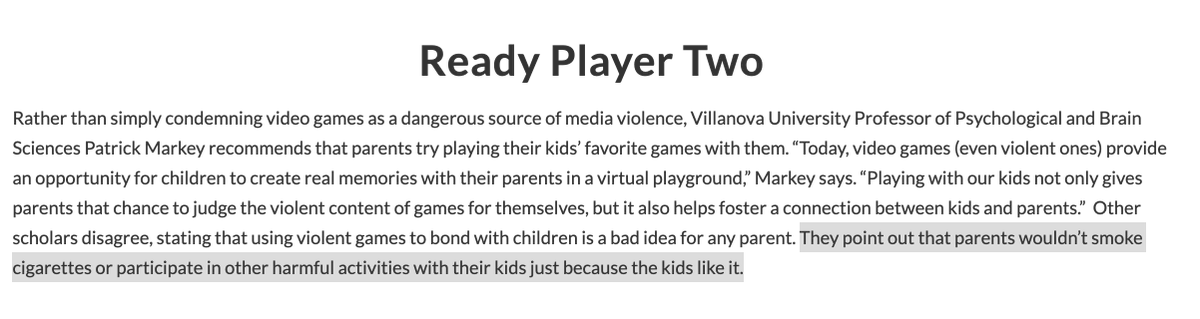
See: https://t.co/IzvAQn1ASo
For an overview on the current state of the research, see here: https://t.co/zbV2r8klrK
Exhibit A: https://t.co/GuU2yrBS1B
The points I raise here alone are notable. This one-sided, exaggerated information does an INCREDIBLE disservice to parents and caretakers everywhere.
For this seminar they chose Dr. Brad Bushman who has dedicated his career to studying violent video game effects. Notably, several of his publications have been redacted due to falsified data.

SPOILER: Because they don't push the moral panic agenda
https://t.co/3BVSZDreWU
This kind of “educational” content is reprehensible. It is why the moral panic around games remains today and parents remain fearful despite the wealth of contrary research.
https://t.co/L4gPRFYXje
https://t.co/4eY8PfWU8K
More from Gaming




You May Also Like









I just finished Eric Adler's The Battle of the Classics, and wanted to say something about Joel Christiansen's review linked below. I am not sure what motivates the review (I speculate a bit below), but it gives a very misleading impression of the book. 1/x
The meat of the criticism is that the history Adler gives is insufficiently critical. Adler describes a few figures who had a great influence on how the modern US university was formed. It's certainly critical: it focuses on the social Darwinism of these figures. 2/x
Other insinuations and suggestions in the review seem wildly off the mark, distorted, or inappropriate-- for example, that the book is clickbaity (it is scholarly) or conservative (hardly) or connected to the events at the Capitol (give me a break). 3/x
The core question: in what sense is classics inherently racist? Classics is old. On Adler's account, it begins in ancient Rome and is revived in the Renaissance. Slavery (Christiansen's primary concern) is also very old. Let's say classics is an education for slaveowners. 4/x
It's worth remembering that literacy itself is elite throughout most of this history. Literacy is, then, also the education of slaveowners. We can honor oral and musical traditions without denying that literacy is, generally, good. 5/x
As someone\u2019s who\u2019s read the book, this review strikes me as tremendously unfair. It mostly faults Adler for not writing the book the reviewer wishes he had! https://t.co/pqpt5Ziivj
— Teresa M. Bejan (@tmbejan) January 12, 2021
The meat of the criticism is that the history Adler gives is insufficiently critical. Adler describes a few figures who had a great influence on how the modern US university was formed. It's certainly critical: it focuses on the social Darwinism of these figures. 2/x
Other insinuations and suggestions in the review seem wildly off the mark, distorted, or inappropriate-- for example, that the book is clickbaity (it is scholarly) or conservative (hardly) or connected to the events at the Capitol (give me a break). 3/x
The core question: in what sense is classics inherently racist? Classics is old. On Adler's account, it begins in ancient Rome and is revived in the Renaissance. Slavery (Christiansen's primary concern) is also very old. Let's say classics is an education for slaveowners. 4/x
It's worth remembering that literacy itself is elite throughout most of this history. Literacy is, then, also the education of slaveowners. We can honor oral and musical traditions without denying that literacy is, generally, good. 5/x


