1/31 Lots of media coverage, rightly, on huge NHS pressure. What’s cause of, and how widespread, is pressure? How is NHS responding? How serious is this & what’s impact on patients & staff? What’s likely to happen over next few weeks? Long new explainer thread below in two parts.
2/31 WHAT'S CAUSE OF, AND HOW WIDESPREAD IS, CURRENT NHS PRESSURE? Remember overall context. Winter always busiest time of NHS year & NHS capacity always at its most stretched. Last five winters show that, despite increases in capacity, NHS at / over its capacity limit...
3/31 ...Whilst overall staff levels improved in 2020, NHS also entered year with 100k vacancies. Covid makes all this much worse. NHS balancing four sets of patients – winter patients; covid patients; planned care cases, incl. delays from first phase; and those needing vaccine.
4/31 Covid cases rising extremely rapidly, driven by new variant. In England yesterday there were 22,700 covid patients in hospital vs 500 at start of Sept and 19k at top of 1st peak. Just since Xmas Day NHS has had 5,000 more covid inpatients, equivalent to filling 10 hospitals.
5/31 Impossible in a thread to capture full range of regional variation. But, at top level, London/SE/E of England trusts under substantial pressure. Northern trusts seen improvements since Oct but worried covid levels not dropped sufficiently to cope with any third surge.
6/31 On capacity, NHS has inescapably fewer beds in use than this time last year because of the need for tight infection control to protect patients and staff. For example, six bed bays have to become four beds, and some wards cannot be used for non covid patients at all.
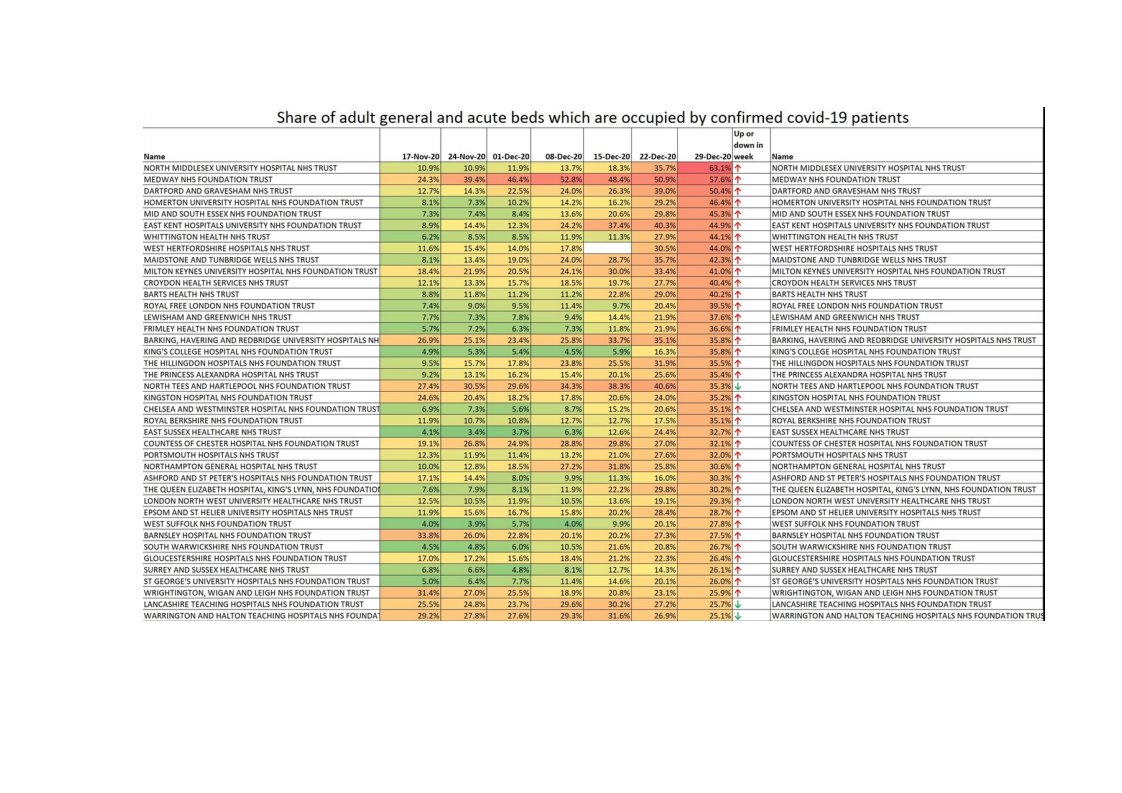
7/31 As attached chart from @HSJnews shows, over 40 hospitals now have more than 25% of their general and acute beds occupied by covid patients. So, fewer beds & many more occupied by covid patients. Many hospitals London/SE also report they're now v short of critical care beds.
8/31 CEOs equally, if not more, worried about staffing. Areas with high covid load suffering from double whammy of high numbers of covid patients and high levels of staff absence because of covid community infection prevalence and important self isolating rules...
9/31 ...Some in highest areas of covid infection now reporting two to three times normal levels of staff absence. It's not just absolute numbers of staff absence but also absence rates in particular categories of staff. EG London/SE trusts need more critical care specialists.
10/31 WHAT ARE NHS TRUSTS DOING TO RESPOND? Important to understand that all trusts have detailed, well worked, escalation plans in place to meet extra demand. Hospitals used summer to make physical adaptations & upgrade infrastructure to create maximum possible surge capacity.
11/31 Trusts will therefore start by trying to utilise every last ounce of capacity available and create more temporary capacity, at pace, if needed. EG Many in London/SE now creating extra surge critical care capacity for covid patients in real time, complex though this is.
12/31 At same time, trusts are seeking to maximise numbers of patients being safely discharged into community beds and being looked after at home. This is creating significant pressure on community services – a good illustration of pressure all NHS is under, not just hospitals.
13/31 Once a hospital trust has used up all its own capacity it will seek help from its neighbours. This is working well. In larger areas where every hospital is under pressure, small numbers of patients will be moved across regions, where it makes clinical sense to do so…
14/31 ...EG hospitals in SW closer to London/SE already helping out colleagues. Midlands doing same for East of England. Patient transfers over large distances rarer but can help where clinically appropriate. But need to avoid adding pressure to overstretched ambulance services!
15/31 NHS now using Nightingales/readying them for use. Exeter/Manchester in use and London now being readied for use if required. NHS trusts can only undertake all this mutual aid because we have a National Health Service and because we have prepared so carefully for it.
16/31 HOW SERIOUS IS PRESSURE AND WHAT’S IMPACT ON PATIENTS & STAFF? Important to be precise with words. Not right to use "cataclysm”, “collapse” or “overwhelm” as they imply NHS will stop providing care. The NHS task is to keep providing care, whatever the pressure.
17/31 But, where the NHS is currently under extreme pressure, we are seeing some or all of the following in a more prolonged and widespread way than is normal, even at times of very significant winter pressure. Delays in accessing care for non critical patients....
18/31 …Rebooking of planned procedures, ambulance handover delays (v worrying for ambulance trusts), high levels of bed occupancy in some wards, staff stretched to cover growing demand, and pressure on staff/patient ratios. None of this is good for staff or patients.
19/31 It's important to openly acknowledge that these pressures are happening and their potential impact on quality of care/outcomes. Not least so they can be distinguished from "collapse, cataclysm & overwhelm". Which, thanks to amazing work of frontline staff, isn’t happening.
20/31 NHS staff doing what they always do – providing best possible care to all who need it, prioritised by clinical need. EG Currently 20,000 more non-covid/emergency patients in hospital compared to April first peak. Double number of urgent & cancer operations being performed.
21/31 CEOs are very worried, though, about the impact of this much pressure on already tired and exhausted staff who are now being asked to delay leave, work extra shifts and transfer to new roles e.g. help in critical care. See here, for example:
https://t.co/N2xPmllxY6
22/31 CEOs continue to marvel at, and be incredibly grateful for, staff commitment, dedication and professionalism in what many acknowledge are the most difficult circumstances they have seen in their careers. Strong view that this is much more difficult than the first phase.
23/31 WHAT HAPPENS NEXT? ..... This thread continues in a new thread.......

More from For later read

Humans inherently like the act of solidarity. We are social beings. We like to huddle up and be together.
They used this against us.
They convinced us that it was an act of solidarity to flatten the curve, to wear a mask for others, to take the vaccines for others,


and to reach #covidzero for others. They convinced us that this was for the greater good of society.
In reality, this couldn't be further away from the truth. They have divided us and broken the core structure of our society. They have dehumanized us with their masks.

They set us against each other into clans on opposite sides of a spectrum. They have turned us into aggressive beings fighting for our survival. Some of us fear harm from the virus, others fear harm from the vaccine, and yet others fear harm from the attack on our civilization.

We are all on a flight or fight mode. We are all operating under the influence of fear. We must collect ourselves and reflect on what has happened over the last year.
How is this for the greater good of society?

They used a tactical warfare strategy against us.
'Divide and conquer'.
We fell for it.
Now we must become aware of it and fight back.
We must reunite. We must find true solidarity to save our world. To free ourselves. To regain our autonomy.

You May Also Like

"I lied about my basic beliefs in order to keep a prestigious job. Now that it will be zero-cost to me, I have a few things to say."


We know that elite institutions like the one Flier was in (partial) charge of rely on irrelevant status markers like private school education, whiteness, legacy, and ability to charm an old white guy at an interview.

Harvard's discriminatory policies are becoming increasingly well known, across the political spectrum (see, e.g., the recent lawsuit on discrimination against East Asian applications.)

It's refreshing to hear a senior administrator admits to personally opposing policies that attempt to remedy these basic flaws. These are flaws that harm his institution's ability to do cutting-edge research and to serve the public.

Harvard is being eclipsed by institutions that have different ideas about how to run a 21st Century institution. Stanford, for one; the UC system; the "public Ivys".