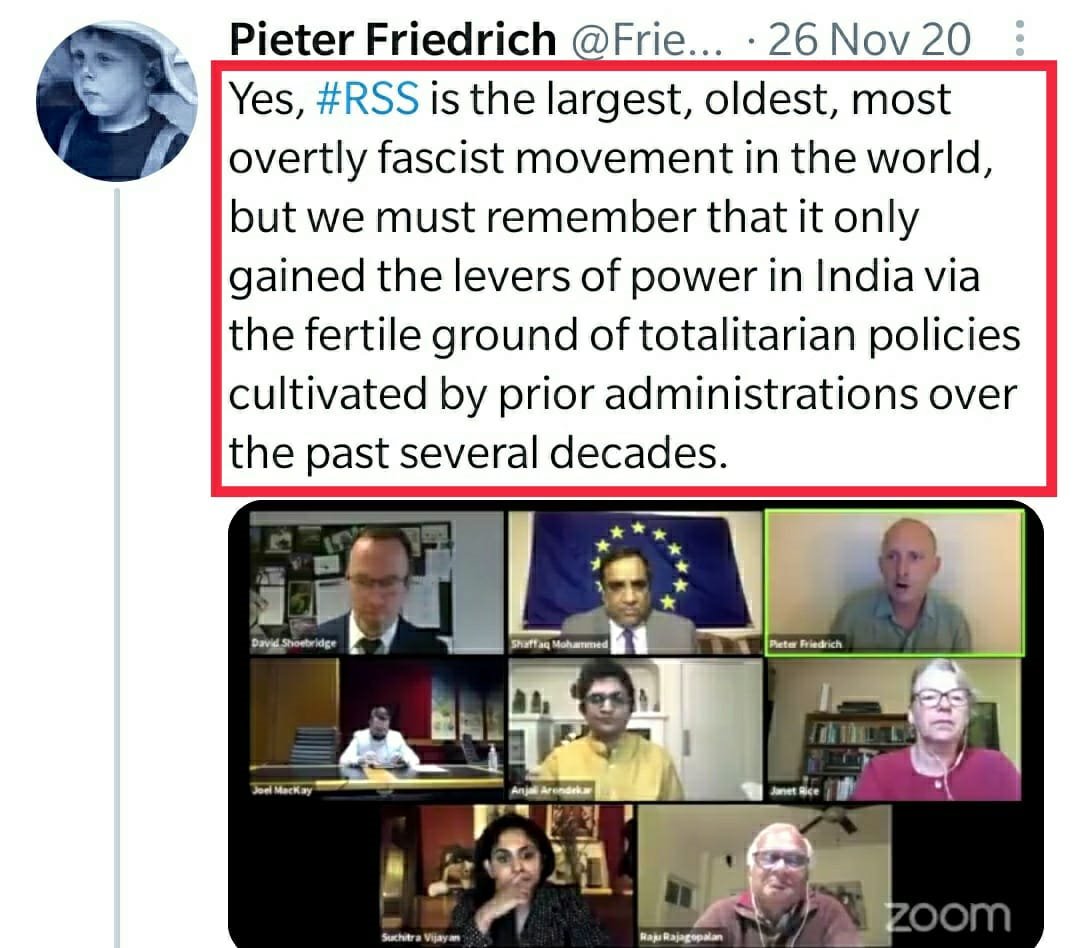
We need to stop imagining the Jan 6 fascists are purely "brainwashed," misguided, etc. Neither are they guided by white supremacy *only*.
More from For later read
1. The death of Silicon Valley, a thread
How did Silicon Valley die? It was killed by the internet. I will explain.
Yesterday, my friend IRL asked me "Where are good old days when techies were
2. In the "good old days" Silicon Valley was about understanding technology. Silicon, to be precise. These were people who had to understand quantum mechanics, who had to build the near-miraculous devices that we now take for granted, and they had to work
3. Now, I love libertarians, and I share much of their political philosophy. But you have to be socially naive to believe that it has a chance in a real society. In those days, Silicon Valley was not a real society. It was populated by people who understood quantum mechanics
4. Then came the microcomputer revolution. It was created by people who understood how to build computers. One borderline case was Steve Jobs. People claimed that Jobs was surrounded by a "reality distortion field" - that's how good he was at understanding people, not things
5. Still, the heroes of Silicon Valley were the engineers. The people who knew how to build things. Steve Jobs, for all his understanding of people, also had quite a good understanding of technology. He had a libertarian vibe, and so did Silicon Valley
How did Silicon Valley die? It was killed by the internet. I will explain.
Yesterday, my friend IRL asked me "Where are good old days when techies were
Where are good old days when techies were libertarians.
— Cranky (@rushingdima) January 9, 2021
2. In the "good old days" Silicon Valley was about understanding technology. Silicon, to be precise. These were people who had to understand quantum mechanics, who had to build the near-miraculous devices that we now take for granted, and they had to work
3. Now, I love libertarians, and I share much of their political philosophy. But you have to be socially naive to believe that it has a chance in a real society. In those days, Silicon Valley was not a real society. It was populated by people who understood quantum mechanics
4. Then came the microcomputer revolution. It was created by people who understood how to build computers. One borderline case was Steve Jobs. People claimed that Jobs was surrounded by a "reality distortion field" - that's how good he was at understanding people, not things
5. Still, the heroes of Silicon Valley were the engineers. The people who knew how to build things. Steve Jobs, for all his understanding of people, also had quite a good understanding of technology. He had a libertarian vibe, and so did Silicon Valley
Wow, Morgan McSweeney again, Rachel Riley, SFFN, Center for Countering Digital Hate, Imran Ahmed, JLM, BoD, Angela Eagle, Tracy-Ann Oberman, Lisa Nandy, Steve Reed, Jon Cruddas, Trevor Chinn, Martin Taylor, Lord Ian Austin and Mark Lewis. #LabourLeaks #StarmerOut 24 tweet🧵
Morgan McSweeney, Keir Starmer’s chief of staff, launched the organisation that now runs SFFN.
The CEO Imran Ahmed worked closely with a number of Labour figures involved in the campaign to remove Jeremy as leader.
Rachel Riley is listed as patron. https://t.co/nGY5QrwBD0
SFFN claims that it has been “a project of the Center For Countering Digital Hate” since 4 May 2020. The relationship between the two organisations, however, appears to date back far longer. And crucially, CCDH is linked to a number of figures on the Labour right. #LabourLeaks
Center for Countering Digital Hate registered at Companies House on 19 Oct 2018, the organisation’s only director was Morgan McSweeney – Labour leader Keir Starmer’s chief of staff. McSweeney was also the campaign manager for Liz Kendall’s leadership bid. #LabourLeaks #StarmerOut
Sir Keir - along with his chief of staff, Morgan McSweeney - held his first meeting with the Jewish Labour Movement (JLM). Deliberately used the “anti-Semitism” crisis as a pretext to vilify and then expel a leading pro-Corbyn activist in Brighton and Hove
Morgan McSweeney, Keir Starmer’s chief of staff, launched the organisation that now runs SFFN.
The CEO Imran Ahmed worked closely with a number of Labour figures involved in the campaign to remove Jeremy as leader.
Rachel Riley is listed as patron. https://t.co/nGY5QrwBD0
SFFN claims that it has been “a project of the Center For Countering Digital Hate” since 4 May 2020. The relationship between the two organisations, however, appears to date back far longer. And crucially, CCDH is linked to a number of figures on the Labour right. #LabourLeaks
Center for Countering Digital Hate registered at Companies House on 19 Oct 2018, the organisation’s only director was Morgan McSweeney – Labour leader Keir Starmer’s chief of staff. McSweeney was also the campaign manager for Liz Kendall’s leadership bid. #LabourLeaks #StarmerOut
Sir Keir - along with his chief of staff, Morgan McSweeney - held his first meeting with the Jewish Labour Movement (JLM). Deliberately used the “anti-Semitism” crisis as a pretext to vilify and then expel a leading pro-Corbyn activist in Brighton and Hove
You May Also Like
1/OK, data mystery time.
This New York Times feature shows China with a Gini Index of less than 30, which would make it more equal than Canada, France, or the Netherlands. https://t.co/g3Sv6DZTDE
That's weird. Income inequality in China is legendary.
Let's check this number.
2/The New York Times cites the World Bank's recent report, "Fair Progress? Economic Mobility across Generations Around the World".
The report is available here:
3/The World Bank report has a graph in which it appears to show the same value for China's Gini - under 0.3.
The graph cites the World Development Indicators as its source for the income inequality data.
4/The World Development Indicators are available at the World Bank's website.
Here's the Gini index: https://t.co/MvylQzpX6A
It looks as if the latest estimate for China's Gini is 42.2.
That estimate is from 2012.
5/A Gini of 42.2 would put China in the same neighborhood as the U.S., whose Gini was estimated at 41 in 2013.
I can't find the <30 number anywhere. The only other estimate in the tables for China is from 2008, when it was estimated at 42.8.
This New York Times feature shows China with a Gini Index of less than 30, which would make it more equal than Canada, France, or the Netherlands. https://t.co/g3Sv6DZTDE
That's weird. Income inequality in China is legendary.
Let's check this number.
2/The New York Times cites the World Bank's recent report, "Fair Progress? Economic Mobility across Generations Around the World".
The report is available here:
3/The World Bank report has a graph in which it appears to show the same value for China's Gini - under 0.3.
The graph cites the World Development Indicators as its source for the income inequality data.
4/The World Development Indicators are available at the World Bank's website.
Here's the Gini index: https://t.co/MvylQzpX6A
It looks as if the latest estimate for China's Gini is 42.2.
That estimate is from 2012.
5/A Gini of 42.2 would put China in the same neighborhood as the U.S., whose Gini was estimated at 41 in 2013.
I can't find the <30 number anywhere. The only other estimate in the tables for China is from 2008, when it was estimated at 42.8.
The UN just voted to condemn Israel 9 times, and the rest of the world 0.
View the resolutions and voting results here:
The resolution titled "The occupied Syrian Golan," which condemns Israel for "repressive measures" against Syrian citizens in the Golan Heights, was adopted by a vote of 151 - 2 - 14.
Israel and the U.S. voted 'No' https://t.co/HoO7oz0dwr
The resolution titled "Israeli practices affecting the human rights of the Palestinian people..." was adopted by a vote of 153 - 6 - 9.
Australia, Canada, Israel, Marshall Islands, Micronesia, and the U.S. voted 'No' https://t.co/1Ntpi7Vqab
The resolution titled "Israeli settlements in the Occupied Palestinian Territory, including East Jerusalem, and the occupied Syrian Golan" was adopted by a vote of 153 – 5 – 10.
Canada, Israel, Marshall Islands, Micronesia, and the U.S. voted 'No'
https://t.co/REumYgyRuF
The resolution titled "Applicability of the Geneva Convention... to the
Occupied Palestinian Territory..." was adopted by a vote of 154 - 5 - 8.
Canada, Israel, Marshall Islands, Micronesia, and the U.S. voted 'No'
https://t.co/xDAeS9K1kW
View the resolutions and voting results here:
The resolution titled "The occupied Syrian Golan," which condemns Israel for "repressive measures" against Syrian citizens in the Golan Heights, was adopted by a vote of 151 - 2 - 14.
Israel and the U.S. voted 'No' https://t.co/HoO7oz0dwr
The resolution titled "Israeli practices affecting the human rights of the Palestinian people..." was adopted by a vote of 153 - 6 - 9.
Australia, Canada, Israel, Marshall Islands, Micronesia, and the U.S. voted 'No' https://t.co/1Ntpi7Vqab
The resolution titled "Israeli settlements in the Occupied Palestinian Territory, including East Jerusalem, and the occupied Syrian Golan" was adopted by a vote of 153 – 5 – 10.
Canada, Israel, Marshall Islands, Micronesia, and the U.S. voted 'No'
https://t.co/REumYgyRuF
The resolution titled "Applicability of the Geneva Convention... to the
Occupied Palestinian Territory..." was adopted by a vote of 154 - 5 - 8.
Canada, Israel, Marshall Islands, Micronesia, and the U.S. voted 'No'
https://t.co/xDAeS9K1kW
1/“What would need to be true for you to….X”
Why is this the most powerful question you can ask when attempting to reach an agreement with another human being or organization?
A thread, co-written by @deanmbrody:
2/ First, “X” could be lots of things. Examples: What would need to be true for you to
- “Feel it's in our best interest for me to be CMO"
- “Feel that we’re in a good place as a company”
- “Feel that we’re on the same page”
- “Feel that we both got what we wanted from this deal
3/ Normally, we aren’t that direct. Example from startup/VC land:
Founders leave VC meetings thinking that every VC will invest, but they rarely do.
Worse over, the founders don’t know what they need to do in order to be fundable.
4/ So why should you ask the magic Q?
To get clarity.
You want to know where you stand, and what it takes to get what you want in a way that also gets them what they want.
It also holds them (mentally) accountable once the thing they need becomes true.
5/ Staying in the context of soliciting investors, the question is “what would need to be true for you to want to invest (or partner with us on this journey, etc)?”
Multiple responses to this question are likely to deliver a positive result.
Why is this the most powerful question you can ask when attempting to reach an agreement with another human being or organization?
A thread, co-written by @deanmbrody:
Next level tactic when closing a sale, candidate, or investment:
— Erik Torenberg (@eriktorenberg) February 27, 2018
Ask: \u201cWhat needs to be true for you to be all in?\u201d
You'll usually get an explicit answer that you might not get otherwise. It also holds them accountable once the thing they need becomes true.
2/ First, “X” could be lots of things. Examples: What would need to be true for you to
- “Feel it's in our best interest for me to be CMO"
- “Feel that we’re in a good place as a company”
- “Feel that we’re on the same page”
- “Feel that we both got what we wanted from this deal
3/ Normally, we aren’t that direct. Example from startup/VC land:
Founders leave VC meetings thinking that every VC will invest, but they rarely do.
Worse over, the founders don’t know what they need to do in order to be fundable.
4/ So why should you ask the magic Q?
To get clarity.
You want to know where you stand, and what it takes to get what you want in a way that also gets them what they want.
It also holds them (mentally) accountable once the thing they need becomes true.
5/ Staying in the context of soliciting investors, the question is “what would need to be true for you to want to invest (or partner with us on this journey, etc)?”
Multiple responses to this question are likely to deliver a positive result.