
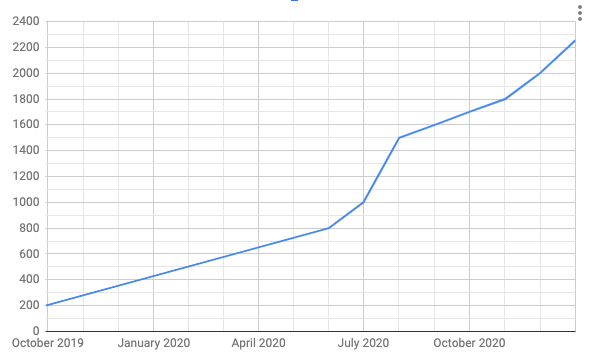
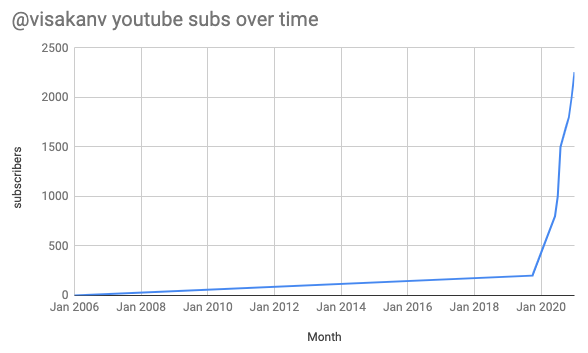
motivating myself by reminding myself that I created my youtube account in 2005 so I can extend the graph all the way back and make it look really exciting
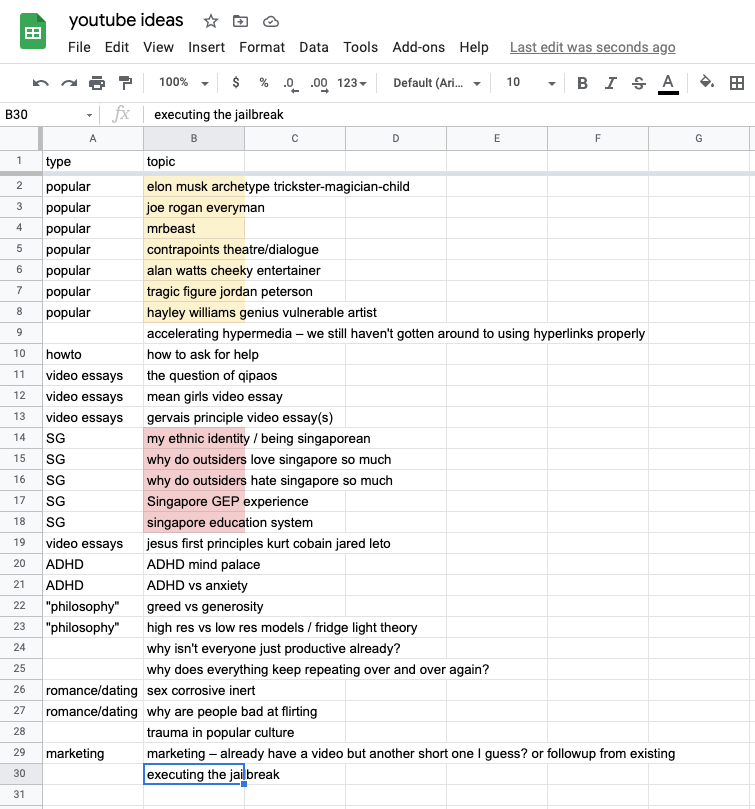
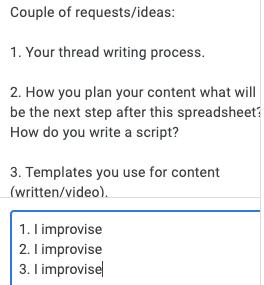
ok just sent that email I been procrastinating on pic.twitter.com/ytTAFPKwti
— visa is decluttering old drafts (@visakanv) January 30, 2021
https://t.co/svGsmVhzzq
Plans are worthless, planning is priceless. Spend a day making elaborate plans and then disregard them completely to make whatever you think is most compelling. Repeat monthly or quarterly
— visa is decluttering old drafts (@visakanv) November 30, 2020

More from visa is decluttering old drafts


Several conversations with several friends - and also the story of my entire life - is getting me to crystalize some thoughts
The most valuable thing I know is how to make friends
The most powerful + valuable thing I can do is teach it to other people
The most important person you have to be friends with is yourself
Possibly the most important thing in a friendship- including one with yourself, or your spouse, or your child - is attention. Deep, focused, undivided, non-judgemental attention.
To really see + hear the other person, in a world where people constantly feel unseen & unheard
So: the most important thing about the most important thing in life is attention,
and in schools, IMO, we often screw up how we teach it.
If you use threats and coercion to force kids to “pay” attention...
...you set people up for dysfunctional relationships their whole life
becoming friends with yourself:
The most valuable thing I know is how to make friends
The most powerful + valuable thing I can do is teach it to other people
The most important person you have to be friends with is yourself
Possibly the most important thing in a friendship- including one with yourself, or your spouse, or your child - is attention. Deep, focused, undivided, non-judgemental attention.
To really see + hear the other person, in a world where people constantly feel unseen & unheard
So: the most important thing about the most important thing in life is attention,
and in schools, IMO, we often screw up how we teach it.
If you use threats and coercion to force kids to “pay” attention...
...you set people up for dysfunctional relationships their whole life
becoming friends with yourself:
Much of self-improvement, personal development, introspection, etc can quite simply be reframed as the art of socialising with yourself. Listen to yourself, pay close attention to yourself, don\u2019t interrupt yourself, be kind and supportive to yourself, be constructive in criticism
— Visa\u2019s Vexing Vacillations (@visakanv) March 27, 2019
There is an art to replying and commenting, and probably like 60-70% of people I’ve seen on the internet fail at it. The important thing is not to speak your mind, but to “support” the OP. You can support them by disagreeing well & you can “mis-support” them by agreeing stupidly
Every “utterance” (status, tweet, whatever) is a bit of an invitation, a bit of a proposal. “Let’s play this game”. When strangers read the proposal accurately, and support the game, a shared understanding develops. You can make friends this way.
Some people deliberately choose to ignore, misread, disregard or denounce other people’s bids. Others are outright clueless and don’t know how to play, and sometimes cluelessness leads to worse bungling than deliberate malice (JJ’s razor)
I was a lot more belligerent and disagreeable when I was younger, in part because I simplistically thought playing other people’s games was a sheep-like way to live. Why should I support other people’s dumb games? Why not mock them instead? It’s easy, and intoxicating
I learned that you rarely build anything worthwhile that way. The “best” case scenario: you win over other disagreeable people. A few years of this & it becomes the world you live in – surrounded by other belligerent assholes who don’t know or care how to play nice. A cursed life
Every “utterance” (status, tweet, whatever) is a bit of an invitation, a bit of a proposal. “Let’s play this game”. When strangers read the proposal accurately, and support the game, a shared understanding develops. You can make friends this way.
Some people deliberately choose to ignore, misread, disregard or denounce other people’s bids. Others are outright clueless and don’t know how to play, and sometimes cluelessness leads to worse bungling than deliberate malice (JJ’s razor)
"The intentionality of an agent with behavior sufficiently indistinguishable from malice, is irrelevant." (JJ's razor > Hanlon's \U0001f609.) @cr1901
— JJ \u300cc\u03b9t\u03b9\u01b6\u03b5\u0273\u0192\u03b9v\u03b5\u300d \U0001f3f4\u200d\u2620\ufe0f (@CTZN5) June 6, 2016
I was a lot more belligerent and disagreeable when I was younger, in part because I simplistically thought playing other people’s games was a sheep-like way to live. Why should I support other people’s dumb games? Why not mock them instead? It’s easy, and intoxicating
I learned that you rarely build anything worthwhile that way. The “best” case scenario: you win over other disagreeable people. A few years of this & it becomes the world you live in – surrounded by other belligerent assholes who don’t know or care how to play nice. A cursed life

More from For later read


Nice to discover Judea Pearl ask a fundamental question. What's an 'inductive bias'?
I crucial step on the road towards AGI is a richer vocabulary for reasoning about inductive biases.
explores the apparent impedance mismatch between inductive biases and causal reasoning. But isn't the logical thinking required for good causal reasoning also not an inductive bias?
An inductive bias is what C.S. Peirce would call a habit. It is a habit of reasoning. Logical thinking is like a Platonic solid of the many kinds of heuristics that are discovered.
The kind of black and white logic that is found in digital computers is critical to the emergence of today's information economy. This of course is not the same logic that drives the general intelligence that lives in the same economy.
Help! What precisely is "inductive bias"? Some ML researchers are in the opinion that the machine learning category of \u2018inductive biases\u2019 can allow us to build a causal understanding of the world. My Ladder of Causation says: "This is mathematically impossible". Who is right? 1/
— Judea Pearl (@yudapearl) February 14, 2021
I crucial step on the road towards AGI is a richer vocabulary for reasoning about inductive biases.
explores the apparent impedance mismatch between inductive biases and causal reasoning. But isn't the logical thinking required for good causal reasoning also not an inductive bias?
An inductive bias is what C.S. Peirce would call a habit. It is a habit of reasoning. Logical thinking is like a Platonic solid of the many kinds of heuristics that are discovered.
The kind of black and white logic that is found in digital computers is critical to the emergence of today's information economy. This of course is not the same logic that drives the general intelligence that lives in the same economy.

This response to my tweet is a common objection to targeted advertising.
@KevinCoates correct me if I'm wrong, but basic point seems to be that banning targeted ads will lower platform profits, but will mostly be beneficial for consumers.
Some counterpoints 👇
1) This assumes that consumers prefer contextual ads to targeted ones.
This does not seem self-evident to me
Research also finds that firms choose between ad. targeting vs. obtrusiveness 👇
If true, the right question is not whether consumers prefer contextual ads to targeted ones. But whether they prefer *more* contextual ads vs *fewer* targeted
2) True, many inframarginal platforms might simply shift to contextual ads.
But some might already be almost indifferent between direct & indirect monetization.
Hard to imagine that *none* of them will respond to reduced ad revenue with actual fees.
3) Policy debate seems to be moving from:
"Consumers are insufficiently informed to decide how they share their data."
To
"No one in their right mind would agree to highly targeted ads (e.g., those that mix data from multiple sources)."
IMO the latter statement is incorrect.
@KevinCoates correct me if I'm wrong, but basic point seems to be that banning targeted ads will lower platform profits, but will mostly be beneficial for consumers.
Some counterpoints 👇
That targeted ads allow for "free" products for consumers is a common talking point and we're going to see more of it in the coming months.: https://t.co/Xty3My3f0u (1/14)
— Kevin Coates (@KevinCoates) February 16, 2021
1) This assumes that consumers prefer contextual ads to targeted ones.
This does not seem self-evident to me
Great post by @Sherman1890 got me thinking about the future of targeted ads.
— Dirk Auer (@AuerDirk) February 12, 2021
More and more tools (privacy labels, ad blockers, GDPR) enable consumers to opt-out from targeted ads - can limit the data platforms receive or block ads altogether.
The end of targeted ads? \U0001f9f5\U0001f447 https://t.co/MA6A3BrUWq
Research also finds that firms choose between ad. targeting vs. obtrusiveness 👇
If true, the right question is not whether consumers prefer contextual ads to targeted ones. But whether they prefer *more* contextual ads vs *fewer* targeted
2) True, many inframarginal platforms might simply shift to contextual ads.
But some might already be almost indifferent between direct & indirect monetization.
Hard to imagine that *none* of them will respond to reduced ad revenue with actual fees.
3) Policy debate seems to be moving from:
"Consumers are insufficiently informed to decide how they share their data."
To
"No one in their right mind would agree to highly targeted ads (e.g., those that mix data from multiple sources)."
IMO the latter statement is incorrect.
You May Also Like







This is NONSENSE. The people who take photos with their books on instagram are known to be voracious readers who graciously take time to review books and recommend them to their followers. Part of their medium is to take elaborate, beautiful photos of books. Die mad, Guardian.
THEY DO READ THEM, YOU JUDGY, RACOON-PICKED TRASH BIN

If you come for Bookstagram, i will fight you.
In appreciation, here are some of my favourite bookstagrams of my books: (photos by lit_nerd37, mybookacademy, bookswrotemystory, and scorpio_books)

Beautifully read: why bookselfies are all over Instagram https://t.co/pBQA3JY0xm
— Guardian Books (@GuardianBooks) October 30, 2018
THEY DO READ THEM, YOU JUDGY, RACOON-PICKED TRASH BIN
If you come for Bookstagram, i will fight you.
In appreciation, here are some of my favourite bookstagrams of my books: (photos by lit_nerd37, mybookacademy, bookswrotemystory, and scorpio_books)


