
They discuss the subjectivity of water temperature - 18deg is cool when weather is hot, warm when weather is cold. No escape from your own subjectivity
The courage to be disliked, Ichiro Kishimi and Fumitake Koga. Heard good things, let’s dig in

They discuss the subjectivity of water temperature - 18deg is cool when weather is hot, warm when weather is cold. No escape from your own subjectivity
Y: people cannot change. I am suffering because of my inability to change
Narrator: why is Y like this, so determined to refute P? Feelings of inferiority, self-pity, self-consciousness
P: why are you so adamant about this
Y: I have an incel friend
P: why do you think he can’t go out?
Y: background?
P: so cause and effect? determinism?
Y: ya
P: if determinism were true, wouldn’t everyone be incel
🤔
P: aye
Y: so there’s no explanation why my friend can’t go out?
P: your friend is insecure so he can’t go out. Flip it: he doesn’t want to go out, so he’s creating the anxiety.
Y: ridiculous. You’re saying he’s pretending to be sick
P: no
Y: what’s the diff
P: when you’re sick, it doesn’t matter why you’re sick
Y: are you denying the existence of trauma??
P: yup. we are not determined by our experiences, but by the meaning we give them
P: he wants the attention
Y: so you’re saying my friend is... happy?
P: nah. He’s achieving his goal
Y: wtf
P: let’s not talk about your friend. What about you?
P: you got angry so that you could shout.
Y: wtf
P: if you had a knife on you, would you have stabbed him?
Y: of course not
P: you wanted to shout.
Y: jfc you fucking distrustful nihilist
Y: u deny human emotion
P: no. Everyone has emotions. But emotions can be controlled. It’s determinism that’s nihilistic. So u the nihilist, lol
Y: I don’t want to be but the past is so powerful
P: because you want it to be
Y: god fucking damnit
P: do you want to be?
Y: I think I’d be happy if I were
P: so you are currently unhappy. Because you hate yourself?
Y: yeah duh
P: don’t feel bad, few people like themselves
Y: do you?
P: eh, I accept myself
Y: ...
Y: fuk u
P: it’s because you think unhappiness is good for you
Y: why the everloving fuck would I do that
P: I don’t know. Debate me to find out
Y: wtf. fine
Y: ?? Ok but suppose it’s true. So what now? I can choose it all over?
P: yup. But you make the decision not to
Y: ??
P: you describe yourself as unhappy. You say you want to change. So why not change?
Y: HOW
Y: so what do I do
P: make a decision to stop your current lifestyle. No more “if only”
Y: wow, big mood
P: not criticising u. All that matters is what you do now
Y: now now?
P: the only now there is. The past doesn’t exist
Y: this is some heavy shit. Brb next week
P: lol k see u
Y: so she fabricated that fear of blushing as an excuse for her own inability to confess her feelings. Or as a kind of insurance for when he rejected her
P: yea. I told her “it’s easy to cure your fear. But I won’t help you”
Y: 🤔
Y: sigh I hate you but you’re probably right
P: life is pain
(Visa: true)
Y: that’s a lie! Academic sophistry! What about individual agony?
P: we cannot do without interpersonal relationships. But so-called internal worry does not exist. The shadows of other people are everpresent
P: are you familiar with the term “feeling of inferiority?”
Y: yeah, duh. me_irl
P: what are those feelings, specifically?
P: All of these are value judgements of yourself. You feel worth less
Y: I know that feels
Y: ur short
P: 155cm. When I was your age, this bothered me. I imagined a more enjoyable life was waiting for me 10-20cm higher. I told a friend this. He dismissed it as a bunch of nonsense
Y: wow rude
(true)
P: so it made me realize that being smol was desirable. It transformed my values. I let go of my feeling of inferiority
All problems are interpersonal problems.
you can use feelings of inferiority as motivation to act. be watchful for when you use it as an excuse to give up
there’s also a superiority complex - eg bragging. confidence doesn’t boast
P: just keep moving forward without competing or comparing yourself to others
Y: how?
P: don’t compare to others, compare to your ideal self. We’re all different. And we’re all equal
P: as human beings, yes. With sincerity
Y: so you’re like free from worldly shit
P: more or less. I’m an outsider philosopher with no connection to worldly competition
Y: doesn’t competition push you to be better
P: lol sure
In truth the world doesn’t notice you much at all
Y: what a happy person you are! You are a sunflower bathed in sunlight. I am a gourd grown in the dim shade
P: lmao this shit again?? We went over this
P: I feel indignation re: social problems. But it’s a rational indignation, not a sudden burst of emotion. Personal anger cools. Righteous indignation persists. Anger as an expression of apersonal grudge is a tool for making others submit to you
P: I would contemplate their hidden goal. When you feel genuinely angry due to another person’s words or behaviour, consider that they are challenging you to a power struggle.
Y: ??
Y: why?
P: to prove his power. By winning.
Y: ??
Y: I wouldn’t put up with this
P: what is the other person’s goal? Does he simply want to discuss politics? No. He finds you unbearable and wants to provoke you, make you submit
P: say you defeat him with words. He will withdraw. And then plot revenge, and retaliate.
Y: how
P: child oppressed by parent will turn to delinquency, self-harm. Revenge! Almost impossible to resolve. So avoid needless power struggles
P: no. Disengage. Do not react
Y: that’s tough
P: understand that anger is a form of communication. You don’t need to use it. We can communicate without it. When you understand this experientially, the anger emotion stops appearing
P: it’s not that you mustn’t get angry - but that you do not need to use your anger to communicate. Short-tempered people are typically incompetent communicators
All problems are interpersonal problems
Y: why would I do that
P: to avoid an interpersonal relationship with A
Y: ???
P: happens a lot in marriages
Y: how could you know if I’m lying?
P: I don’t. All I know is that you chose your lifestyle, no one else
Y: argh
P: y not
Y: seems like I lack courage. WTB courage pls
P: let’s discuss freedom. What is freedom?
Y: idk. Dostoyevsky said “money is coined freedom”
P: let’s suppose u r rich but still unhappy
Y: fml
Y: relationships
P: how do relationships rob you of freedom
Y: demands, obligations. My parents wanted X
P: how did you feel when you did X for your parents?
Y: resentful. Also some relief; that they’ll finally recognise me
Y: how
P: recognition is nice but unnecessary. Why do you need it?
Y: eliminate inferiority
P: this is the influence of reward-and-punishment education/conditioning
Y: wat
Y: wtf? Wanting recognition is a normal desire
P: u been brainwashed son. We are not living to satisfy other’s expectations
Y: ?? but
P: if you modify your life to get the recognition and live up to people’s expectations, do you think you will be happy?
Y: ...
P: suppose you have a child who has a hard time studying. ❌ attention in class, ❌ do his homework. What do you do?
Y: everything I can. Tutors. Discipline. That’s how I was raised actually- no dinner till homework
P: did u learn to enjoy studying?
P: in Adlerian psych we ask, “whose task is this?” Whether the child studies or plays, it’s his task, not the parent’s. A parent commanding his child to study is intruding on another person’s tasks
Y: then what is to be done?
P: do not intrude
Y: isn’t it the parents duty to get the child to study? They’re the guardian. No child WANTS to study
P: parents say “it’s for your own good”. Kids know this is BS
P: pay attention. Adlerian psych doesn’t recommend non-interference, which is the attitude of ignorance. You tell the child that it is his task, and let him know you are ready to assist when he needs. But don’t intrude
P: forcing change while ignoring the person’s goals and intentions will only lead to an intense reaction
Y: so the counsellor does not change the client’s life?
P: you are the only one who can change yourself
P: first I think, this is the child’s task. I would tell him that I am ready to assist him whenever he is in need
Y: you can be so detached with your own child??
P: children do not become what their parents want them to become
Y: that’s tough...
P: if you are stressed, learn the boundary of “from here on, this is not my task”. Taking on other people’s tasks turns ones life into something heavy with hardship
Y: are you saying it doesn’t matter how sad I make my parents feel??
P: yup
Y: wild
Y: what what other people think of me - even my family - that is their task, not mine?
P: yep. Why do you even care? Why assume that other people’s tasks are yours?
Y: sth feels wrong
Y: I work for one
P: he dislikes you, unreasonably. But there’s no reason for you to get cosy with him
Y: how do I get any work done then
P: “I can’t work because of my boss” is another life-lie. What you should do is face your tasks honestly
Y: 🤔
P: u know Alexander the Great? He cut the Gordian knot
Y: I’m not Alexander the Great. How can I build good relationships by cutting...?
P: why?
Y: your separation of tasks is a form of disengagement from the world
P: do you want someone to intervene? Decide your path?
Y: maybe I do!! I don’t have so much clarity about what I want out of life, clear-cut dreams and objectives!
P: this is a very unfree way to live. You say desire from recognition, but really you’re afraid of being disliked
Y: nobody wants to be disliked
P: but how do you escape this? Can you swear loyalty to everybody?
Y: so I should be egocentric?
P: separating tasks is not egocentric. Meddling and intervening in other people’s lives is egocentric
P: people who choose unfree ways to live, when seeing free people, criticise them as hedonistic. This is a lie to help one accept his own unfree life. Truly free people do not make such comments; they cheer on the will to be free
P: to live like a stone tumbling downhill is to be a slave to one’s desires and impulses (including the desire for recognition, and the fear of being disliked). Real freedom is akin to pushing up one’s tumbling self from below
Y: ?
Y: ?
P: freedom is being disliked by other people.
P: it’s proof that you’re exercising your freedom and living in accordance with your own principles.
Y: but...
P: it’s certainly stressful to be disliked. But trying to escape it is a very unfree way of living, and also impossible. The cost of freedom is being disliked.
P: No. I am not saying to engage in wrongdoing. The point is that people will dislike you anyway. What I’m saying is, don’t be *afraid* of being disliked.
P: do not be self-righteous. Do not be defiant. Simply separate tasks.
Y: then... how?
Y: does that really fix things?
P: of course
Y: Reeaaalllyyyy?
P: yes. Remember, separation of tasks. It no longer mattered to me how my father responded
Y: so were you able to repair your relationship?
P: yes, I think so.
P: you misunderstand. Separation is not about keeping people away - it’s a way of thinking to unravel the complex entanglement
Y: what is, then?
P: let’s talk about “community feeling”
Y: ?
Y: uhuh
P: when you think of community, what comes to mind?
Y: household, school, workplace...
P: Adler extends it to the entire universe.
Y: the family
P: smaller: it’s you and I. When there are two people, society emerges in their presence, as does community
Y: and?
Y: selfish tyrant. irresponsible egotist
P: & also people who can’t separate tasks, are obsessed with recognition
Y: y?
P: they look to others, but the focus is on them
P: while the I is life’s protagonist, it is never more than a member of the community. If you’re not careful, you’ll start assuming people exist to serve you and care about your problems. when those expectations go unfulfilled, you feel insulted, resentful
P: let’s talk parent/child or senior/junior relationships. Is it more effective to raise by praise, or by rebuke?
Y: praise. Animal training has demonstrated this. Positive reinforcement
P: Adler says do neither
P: imagine if I responded to one of your questions with “good job, Y!” How would you feel?
Y: condescended to
P: exactly. Praise is partially the passing of judgement by a person of ability on a person of no ability. so praising your child reinforces hierarchy
Y: 🤔
Y: “thank you”
P: gratitude, delight - encouragement that’s based on horizontal relationships, without judgement
Y: is there really such a big difference between “thanks” and “good job”??
More from Visakan Veerasamy
There is an art to replying and commenting, and probably like 60-70% of people I’ve seen on the internet fail at it. The important thing is not to speak your mind, but to “support” the OP. You can support them by disagreeing well & you can “mis-support” them by agreeing stupidly
Every “utterance” (status, tweet, whatever) is a bit of an invitation, a bit of a proposal. “Let’s play this game”. When strangers read the proposal accurately, and support the game, a shared understanding develops. You can make friends this way.
Some people deliberately choose to ignore, misread, disregard or denounce other people’s bids. Others are outright clueless and don’t know how to play, and sometimes cluelessness leads to worse bungling than deliberate malice (JJ’s razor)
I was a lot more belligerent and disagreeable when I was younger, in part because I simplistically thought playing other people’s games was a sheep-like way to live. Why should I support other people’s dumb games? Why not mock them instead? It’s easy, and intoxicating
I learned that you rarely build anything worthwhile that way. The “best” case scenario: you win over other disagreeable people. A few years of this & it becomes the world you live in – surrounded by other belligerent assholes who don’t know or care how to play nice. A cursed life
Every “utterance” (status, tweet, whatever) is a bit of an invitation, a bit of a proposal. “Let’s play this game”. When strangers read the proposal accurately, and support the game, a shared understanding develops. You can make friends this way.
Some people deliberately choose to ignore, misread, disregard or denounce other people’s bids. Others are outright clueless and don’t know how to play, and sometimes cluelessness leads to worse bungling than deliberate malice (JJ’s razor)
"The intentionality of an agent with behavior sufficiently indistinguishable from malice, is irrelevant." (JJ's razor > Hanlon's \U0001f609.) @cr1901
— JJ \u300cc\u03b9t\u03b9\u01b6\u03b5\u0273\u0192\u03b9v\u03b5\u300d \U0001f3f4\u200d\u2620\ufe0f (@CTZN5) June 6, 2016
I was a lot more belligerent and disagreeable when I was younger, in part because I simplistically thought playing other people’s games was a sheep-like way to live. Why should I support other people’s dumb games? Why not mock them instead? It’s easy, and intoxicating
I learned that you rarely build anything worthwhile that way. The “best” case scenario: you win over other disagreeable people. A few years of this & it becomes the world you live in – surrounded by other belligerent assholes who don’t know or care how to play nice. A cursed life
Several conversations with several friends - and also the story of my entire life - is getting me to crystalize some thoughts
The most valuable thing I know is how to make friends
The most powerful + valuable thing I can do is teach it to other people
The most important person you have to be friends with is yourself
Possibly the most important thing in a friendship- including one with yourself, or your spouse, or your child - is attention. Deep, focused, undivided, non-judgemental attention.
To really see + hear the other person, in a world where people constantly feel unseen & unheard

So: the most important thing about the most important thing in life is attention,
and in schools, IMO, we often screw up how we teach it.
If you use threats and coercion to force kids to “pay” attention...
...you set people up for dysfunctional relationships their whole life

becoming friends with yourself:
The most valuable thing I know is how to make friends
The most powerful + valuable thing I can do is teach it to other people
The most important person you have to be friends with is yourself
Possibly the most important thing in a friendship- including one with yourself, or your spouse, or your child - is attention. Deep, focused, undivided, non-judgemental attention.
To really see + hear the other person, in a world where people constantly feel unseen & unheard
So: the most important thing about the most important thing in life is attention,
and in schools, IMO, we often screw up how we teach it.
If you use threats and coercion to force kids to “pay” attention...
...you set people up for dysfunctional relationships their whole life
becoming friends with yourself:
Much of self-improvement, personal development, introspection, etc can quite simply be reframed as the art of socialising with yourself. Listen to yourself, pay close attention to yourself, don\u2019t interrupt yourself, be kind and supportive to yourself, be constructive in criticism
— Visa\u2019s Vexing Vacillations (@visakanv) March 27, 2019
motivating myself by reminding myself that I created my youtube account in 2005 so I can extend the graph all the way back and make it look really exciting
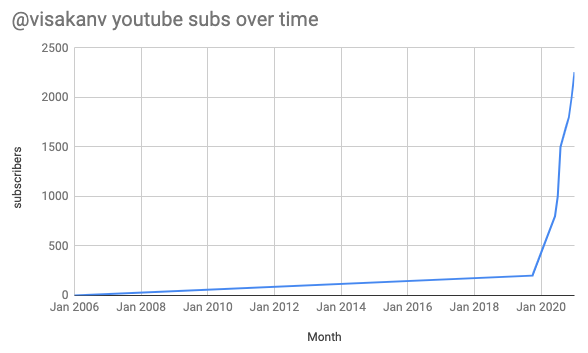
the less exciting but more useful graph

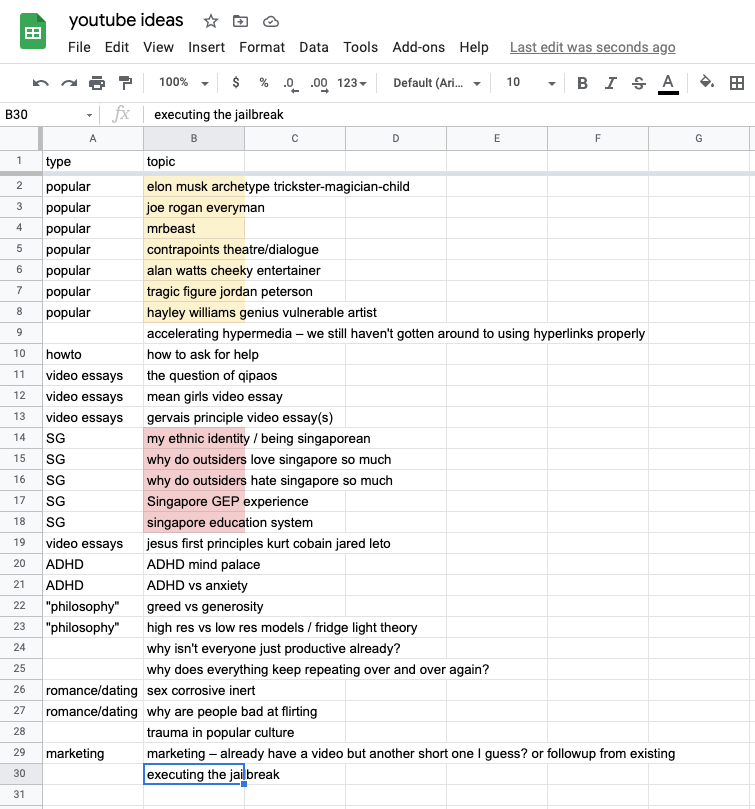
now I am going to make a plan for my next 200 youtube videos and then ignore them entirely. but first I have to reply to an email...
well that was quite a detour. now, to google sheets...
gettin' started
feel free to comment
https://t.co/DUpcQwA8kC
the less exciting but more useful graph
now I am going to make a plan for my next 200 youtube videos and then ignore them entirely. but first I have to reply to an email...
well that was quite a detour. now, to google sheets...
ok just sent that email I been procrastinating on pic.twitter.com/ytTAFPKwti
— visa is decluttering old drafts (@visakanv) January 30, 2021
gettin' started
feel free to comment
https://t.co/DUpcQwA8kC


More from All








You May Also Like

Krugman is, of course, right about this. BUT, note that universities can do a lot to revitalize declining and rural regions.
See this thing that @lymanstoneky wrote:
And see this thing that I wrote:
And see this book that @JamesFallows wrote:
And see this other thing that I wrote:
One thing I've been noticing about responses to today's column is that many people still don't get how strong the forces behind regional divergence are, and how hard to reverse 1/ https://t.co/Ft2aH1NcQt
— Paul Krugman (@paulkrugman) November 20, 2018
See this thing that @lymanstoneky wrote:
And see this thing that I wrote:
And see this book that @JamesFallows wrote:
And see this other thing that I wrote:



1/“What would need to be true for you to….X”
Why is this the most powerful question you can ask when attempting to reach an agreement with another human being or organization?
A thread, co-written by @deanmbrody:
2/ First, “X” could be lots of things. Examples: What would need to be true for you to
- “Feel it's in our best interest for me to be CMO"
- “Feel that we’re in a good place as a company”
- “Feel that we’re on the same page”
- “Feel that we both got what we wanted from this deal
3/ Normally, we aren’t that direct. Example from startup/VC land:
Founders leave VC meetings thinking that every VC will invest, but they rarely do.
Worse over, the founders don’t know what they need to do in order to be fundable.
4/ So why should you ask the magic Q?
To get clarity.
You want to know where you stand, and what it takes to get what you want in a way that also gets them what they want.
It also holds them (mentally) accountable once the thing they need becomes true.
5/ Staying in the context of soliciting investors, the question is “what would need to be true for you to want to invest (or partner with us on this journey, etc)?”
Multiple responses to this question are likely to deliver a positive result.
Why is this the most powerful question you can ask when attempting to reach an agreement with another human being or organization?
A thread, co-written by @deanmbrody:
Next level tactic when closing a sale, candidate, or investment:
— Erik Torenberg (@eriktorenberg) February 27, 2018
Ask: \u201cWhat needs to be true for you to be all in?\u201d
You'll usually get an explicit answer that you might not get otherwise. It also holds them accountable once the thing they need becomes true.
2/ First, “X” could be lots of things. Examples: What would need to be true for you to
- “Feel it's in our best interest for me to be CMO"
- “Feel that we’re in a good place as a company”
- “Feel that we’re on the same page”
- “Feel that we both got what we wanted from this deal
3/ Normally, we aren’t that direct. Example from startup/VC land:
Founders leave VC meetings thinking that every VC will invest, but they rarely do.
Worse over, the founders don’t know what they need to do in order to be fundable.
4/ So why should you ask the magic Q?
To get clarity.
You want to know where you stand, and what it takes to get what you want in a way that also gets them what they want.
It also holds them (mentally) accountable once the thing they need becomes true.
5/ Staying in the context of soliciting investors, the question is “what would need to be true for you to want to invest (or partner with us on this journey, etc)?”
Multiple responses to this question are likely to deliver a positive result.

Great article from @AsheSchow. I lived thru the 'Satanic Panic' of the 1980's/early 1990's asking myself "Has eveyrbody lost their GODDAMN MINDS?!"
The 3 big things that made the 1980's/early 1990's surreal for me.
1) Satanic Panic - satanism in the day cares ahhhh!
2) "Repressed memory" syndrome
3) Facilitated Communication [FC]
All 3 led to massive abuse.
"Therapists" -and I use the term to describe these quacks loosely - would hypnotize people & convince they they were 'reliving' past memories of Mom & Dad killing babies in Satanic rituals in the basement while they were growing up.
Other 'therapists' would badger kids until they invented stories about watching alligators eat babies dropped into a lake from a hot air balloon. Kids would deny anything happened for hours until the therapist 'broke through' and 'found' the 'truth'.
FC was a movement that started with the claim severely handicapped individuals were able to 'type' legible sentences & communicate if a 'helper' guided their hands over a keyboard.
For three years I have wanted to write an article on moral panics. I have collected anecdotes and similarities between today\u2019s moral panic and those of the past - particularly the Satanic Panic of the 80s.
— Ashe Schow (@AsheSchow) September 29, 2018
This is my finished product: https://t.co/otcM1uuUDk
The 3 big things that made the 1980's/early 1990's surreal for me.
1) Satanic Panic - satanism in the day cares ahhhh!
2) "Repressed memory" syndrome
3) Facilitated Communication [FC]
All 3 led to massive abuse.
"Therapists" -and I use the term to describe these quacks loosely - would hypnotize people & convince they they were 'reliving' past memories of Mom & Dad killing babies in Satanic rituals in the basement while they were growing up.
Other 'therapists' would badger kids until they invented stories about watching alligators eat babies dropped into a lake from a hot air balloon. Kids would deny anything happened for hours until the therapist 'broke through' and 'found' the 'truth'.
FC was a movement that started with the claim severely handicapped individuals were able to 'type' legible sentences & communicate if a 'helper' guided their hands over a keyboard.
