🧵: The 10 Metrics for SaaS Startups (an Operator's Guide)

Focusing on the wrong things can kill your startup.

Based on founding and scaling @edenworkplace, here are the metrics that matter most:

Metric 1: ARR (Annualized Recurring Revenue)

You will need to know this number each day, so you'll focus on Contracted ARR in your CRM tool (as opposed to accounting ARR).

Big ARR milestones are $100K (Signal), $1 million (PMF), $10 million (Growth), $100 million (IPO Scale)
Metric 2: ARR Growth

Once you get past the Signal stage, your ARR growth is the primary determinant of future success (and valuation).

Strong annual growth rate from Signal to PMF is 4x+ and from PMF to Growth is 2.5x+.

@edenofficemagic grew 11x between Signal and PMF stages.
Metric 3: ACV (Average Customer Value)

ACV often starts low for a SaaS company (as your product is not featureful enough for large enterprises) and grows as the company moves upmarket.

ACV is calculated by taking total revenue and dividing it by your number of customer logos.
Metric 4: ACV Growth

Most SaaS companies will make ACV growth a focus.

It is fair to increase revenue per customer as you add more value to users in new features, integrations, and products.

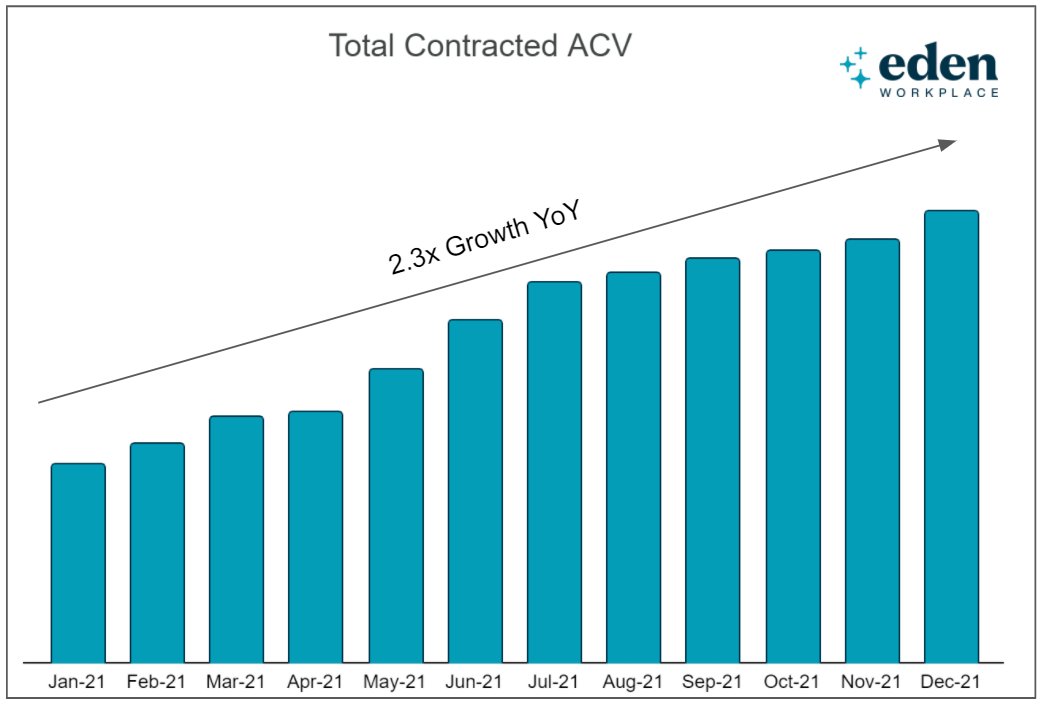
@edenofficemagic grew ACV 2.3x last year, mostly through cross-selling new products.
Metric 5: NDR (Net Dollar Retention)

NDR tracks what happens to $1.00 of avg customer revenue 12 months after acquiring the customer.

You want positive NDR, as that means customer expansion more than offsets reduction and churn.

Below are @edenworkplace's cohorts (132% NDR).
Metric 6: Gross Revenue Churn Rate

A high churn rate always catches up to you, typically in the Growth stage.

"Good" depends on ACV here. Very SMB can be > 30% annual gross churn. Enterprise is typically < 10%.
Metric 7: Gross Margin

Generally, a good SaaS company is well north of 60%, and ideally closer to 80%.

Be conservative: include CSM and support costs in COGS, not just product costs such as AWS. Your VCs will be conservative, so you are better off not deluding yourselves.
Metric 8: CAC Payback Months (on Gross Profit)

CAC is calculated by taking sales and marketing cost and dividing it by the number of new logos acquired.

Then divide CAC by avg gross profit contribution of new logos to determine payback.

6-18 months payback is often the goal.
Metric 9: Months Cash Runway

Cash is like oxygen. When you have it, you don't think about it. When you don't, it is all you think about.

You calculate runway by taking cash balance and dividing it by monthly burn.

Typically, startups aim for 24+ months at raise and 6+ always.
Metric 10: Pipeline

Pipeline is calculated as the sum of outstanding sales contracts (not closed won or lost).

To some extent, your pipeline is your destiny.

If you have enough, you will hit your goals. If you don't, you'll miss them.

Watch it closely.
These are the 10 metrics that matter most for running a SaaS company.

If you keep an eye on them, you'll at least know when you need to course correct.

Follow me @joedubeytldr for more concise lessons on startup building, investing, and decision making.

Onwards + upwards!

More from Finance

1/ My Mission: To Spread Financial Wellness (thread)

Here’s what "financial wellness" means to me

ā¬‡ļøā¬‡ļøā¬‡ļøā¬‡ļøā¬‡ļøā¬‡ļøā¬‡ļøā¬‡ļøā¬‡ļøā¬‡ļø

2/ Mindset

Humans are programmed to think short-term

Evolutionary, thinking short-term makes sense. It helps with survival.

Financial wellness is all about training yourself to develop a long-term mindset

Not easy -- it takes practice


3/ Mindset

If you join the right tribes, you can’t help but improve

My favs:
@AffordAnything
@ChooseFiFI
FinTwit
@MicroCapClub
@themotleyfoolFool
@visualizevalue

Twitter / Podcasts / Blogs / YouTube -- when used correctly -- are amazing


4/ Mindset

Educate yourself - constantly!

Especially about:

1⃣Money
2⃣Relationships
3⃣Health

These 3 categories have an outsized influence on all areas of your life

Books


5/ Career

In the beginning, focus on growing your income

Do more than what is expected

Become a lynchpin

Find a career that you ENJOY (<- important!) that also has high-income potential

Start a side hustle (<- important!)

Build your talent
1/ I'm thrilled to announce the launch of my new website, a one-stop shop for all the content I'm creating.

There you'll find links to all my podcasts, the TTMYGH newsletter, and other exciting future projects.

2/ In 2020, I reignited my passion for interviewing brilliant people by launching The Grant Williams Podcast in various forms, including The End Game, The Super Terrific Happy Hour, and The Narrative Game.


3/ Starting February 1, I'm taking the bold step of moving these podcasts completely behind a paywall.

For the very affordable price of only $10 a month, listeners can gain access to the Copper Tier of
https://t.co/fxUfH8maI4, which includes all current & future podcasts.


4/ Why am I doing this? First and foremost, I aspire to create VALUABLE content. By definition, if something is priced at $0, it isn’t valuable. The time, effort and creativity that goes into these episodes is substantial. To keep doing them properly, they can no longer be free.

5/ I also strongly believe content creators should be able to make a living creating content. If everything is free, that’s not possible. I never seriously considered accepting outside sponsors – complete integrity is too critical to me.
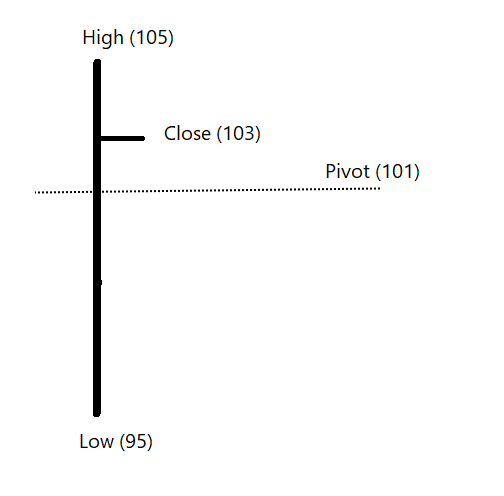
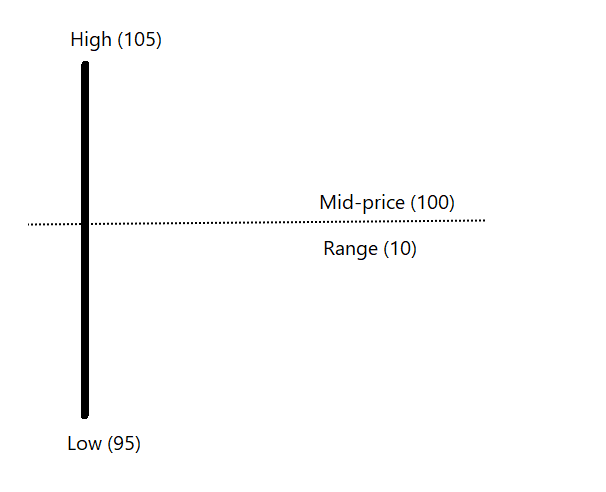
Ok here is the explanation. Grab a cup of coffee and read on. If you have not read/noticed this, you will see intraday options movement in a new light.


Say we have two options, one 50 delta ATM options and another 30 delta OTM option. Normally for a 100 point move, the ATM option will move 50 points and the OTM option will move 30 points. But in a high volatile environment, the OTM option will also move nearly 50 points

To understand why this happens, first understand why an ATM option is 50 delta. An ATM option has the probability of 50% of expiring as ITM. The price just has to close a rupee above the strike for the CE to be ITM and vice versa for PEs

Now think of a highly volatile day like today. If someone is asked where the BNF will close for the day or expiry, no one can answer. BNF can close freakin anywhere, That makes every option of an equal probability of being ITM. So all options have a 50% probability of being ITM

Hence, when a huge volatile move starts, all OTM options behave like ATM options. This phenomenon was first observed in the Black Monday crash of 1987 at Wall Street, which also gave rise to the volatility skew/smirk

You May Also Like

A THREAD ON @SarangSood

Decoded his way of analysis/logics for everyone to easily understand.

Have covered:
1. Analysis of volatility, how to foresee/signs.
2. Workbook
3. When to sell options
4. Diff category of days
5. How movement of option prices tell us what will happen

1. Keeps following volatility super closely.

Makes 7-8 different strategies to give him a sense of what's going on.

Whichever gives highest profit he trades in.


2. Theta falls when market moves.
Falls where market is headed towards not on our original position.


3. If you're an options seller then sell only when volatility is dropping, there is a high probability of you making the right trade and getting profit as a result

He believes in a market operator, if market mover sells volatility Sarang Sir joins him.


4. Theta decay vs Fall in vega

Sell when Vega is falling rather than for theta decay. You won't be trapped and higher probability of making profit.
The UN just voted to condemn Israel 9 times, and the rest of the world 0.

View the resolutions and voting results here:

The resolution titled "The occupied Syrian Golan," which condemns Israel for "repressive measures" against Syrian citizens in the Golan Heights, was adopted by a vote of 151 - 2 - 14.

Israel and the U.S. voted 'No'
https://t.co/HoO7oz0dwr


The resolution titled "Israeli practices affecting the human rights of the Palestinian people..." was adopted by a vote of 153 - 6 - 9.

Australia, Canada, Israel, Marshall Islands, Micronesia, and the U.S. voted 'No' https://t.co/1Ntpi7Vqab


The resolution titled "Israeli settlements in the Occupied Palestinian Territory, including East Jerusalem, and the occupied Syrian Golan" was adopted by a vote of 153 – 5 – 10.

Canada, Israel, Marshall Islands, Micronesia, and the U.S. voted 'No'
https://t.co/REumYgyRuF


The resolution titled "Applicability of the Geneva Convention... to the
Occupied Palestinian Territory..." was adopted by a vote of 154 - 5 - 8.

Canada, Israel, Marshall Islands, Micronesia, and the U.S. voted 'No'
https://t.co/xDAeS9K1kW