1/ Thread: $GOOG 4Q'20 Update

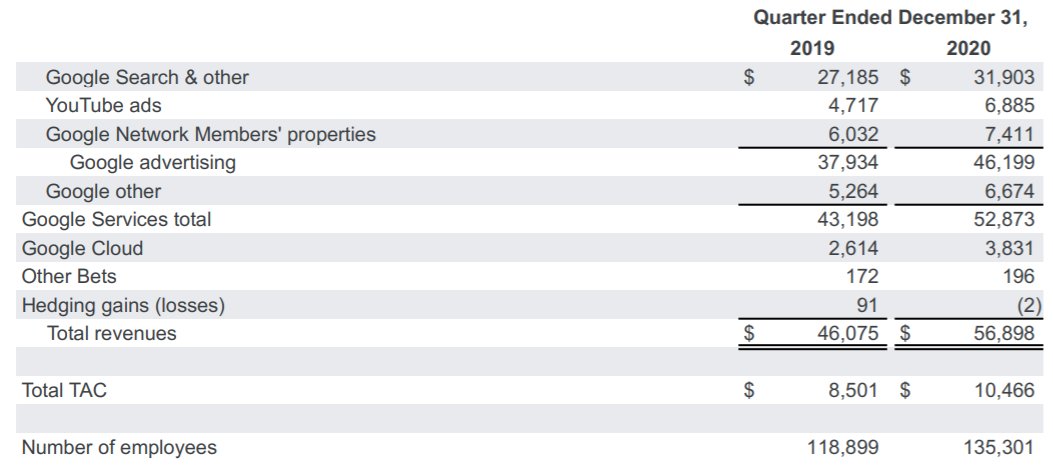
For the first time, GOOG segmented its cloud revenues/income separately, and overall revenue was >20% in 4Q which led to +7% after-hours reaction yesterday.

Here are my notes from earnings/press release.

2/ In the last quarter, here is the segment-wise growth:

Search +17.4%
YouTube ads +46.0%
Google Network Members +22.9%
Cloud +46.6%

Cloud more than doubled in the last two years.
Other bets losses $4.5 Bn in 2020 (vs $4.8 Bn in 2019)
3/ Operating margin in Q4 ~28%
FCF margin in Q4 ~30%

One of the big takeaways was the core business was even MORE profitable than most investors thought since cloud had -42.9% operating margin.

$GOOG's search business is a good comp for Fed in terms of "printing" money. JK.
4/ "you can track takeout and delivery orders when you book or order from Google Maps"

"More than 0.5 million channels livestreamed on YouTube for the first time in 2020"

"videos in our new Shorts player are receiving 3.5 billion daily views."
5/ Google Pay app is now used by >150 mn people in 30 countries.

Cloud backlog $30 Bn now (from $19 Bn in Q3)

# of Deals >$250 Mn became >3x

Waymo is providing hundreds of fully AV rides per week

Retail searches >3x YoY

Cloud operating losses flat YoY
6/ No direct answer to the question of long-term cloud margins; mostly just focusing on investing given the large TAM. Scale benefits will come later.
7/ Direct Response, nonexistent 3 years ago, has been a smashing success.

There's a reason Masterclass was flooding YouTube. It simply works.

"We now reach more 18- to 49-year-olds than all linear TV networks combined."
8/ Advertising on YouTube TV is still "very very early"

"we heard from customers, they have a very strong interest in advertising and streaming environments."
End/ Thanks to @theTIKR for the transcript. Feel free to join by clicking this (no affiliation): https://t.co/WT5xp30GUT

I also publish one deep dive every month on a publicly listed company.

Subscribe here: https://t.co/DK8JPKS0Ua

More from Finance

I'm lucky to attain financial freedom before 30.

I credit Fintwit for my learnings.

Here's 10 key concepts every investor must know:

1. $$ needed to retire
2. Researching a business
3. Reading annual reports
4. Reading earnings calls
5. Criteria of a multi bagger

(Read on...)

6. Holding a multi bagger
7. Economic moats
8. When to buy a stock
9. Earnings vs cashflow
10. Traits of quality companies

Here's my 10 favourite threads on these concepts:

1. How much $$ do you need to retire

Before you start, you must know the end game.

To meet your retirement goals...

How much $$ do you need in your portfolio?

10-K Diver does a good job explaining what's a safe withdrawl rate.

Hint: It's NOT


2. Research a business

Your investment returns are a lagging indicator.

Instead, your research skills are the leading predictor of your results.

Conclusion?

To be a good investor, you must be a great business researcher.

Start with


3. Reading annual reports

This is the bread and butter of a good business analyst.

You cannot just listen to opinions from others.

You must learn to deep dive a business and make your own judgments.

Start with the 10k.

Ming Zhao explains it
** MEGA THREAD ON Cryptocurrencies/Blockchain**

I wanted to know the best resources to learn about cryptocurrencies and blockchain for someone with zero knowledge. I asked Twitter, and Twitter answered.

This thread is a compilation of the best resources I was recommended. 👇👇

Let's start with ** BOOKS **

The first thing you should do before you pick up any book:

Learn about Bitcoin & Ethereum by reading the respective whitepapers.

- [Bitcoin white paper](https://t.co/cErOaFn6QL) by Satoshi Nakamoto

- [Ethereum White paper] (
https://t.co/0g5kYCGJGq) by Vitalik Buterin

Even if you are not tech savvy, you can get a good grasp about how blockchain functions from these papers.

1) *The Basics of Bitcoins and Blockchains: An Introduction to Cryptocurrencies and the Technology that Powers Them* by Antony Lewis

This book covers topics such as the history of Bitcoin, the Bitcoin blockchain, and Bitcoin buying, selling, and mining.

It also answers how payments are made and how transactions are kept secure.

Other cryptocurrencies and cryptocurrency pricing are examined, answering how one puts a value on cryptocurrencies and digital tokens.

You May Also Like

1/ Some initial thoughts on personal moats:

Like company moats, your personal moat should be a competitive advantage that is not only durable—it should also compound over time.

Characteristics of a personal moat below:


2/ Like a company moat, you want to build career capital while you sleep.

As Andrew Chen noted:


3/ You don’t want to build a competitive advantage that is fleeting or that will get commoditized

Things that might get commoditized over time (some longer than


4/ Before the arrival of recorded music, what used to be scarce was the actual music itself — required an in-person artist.

After recorded music, the music itself became abundant and what became scarce was curation, distribution, and self space.

5/ Similarly, in careers, what used to be (more) scarce were things like ideas, money, and exclusive relationships.

In the internet economy, what has become scarce are things like specific knowledge, rare & valuable skills, and great reputations.