Sweden's elderly in 2020 recorded one of the lowest mortality rates in history.

Overall mortality rates in Sweden by age were excellent in 2020 and better than the 2015-2018 average mortality rates for nearly all age groups.

A deep dive into why 👇👇👇

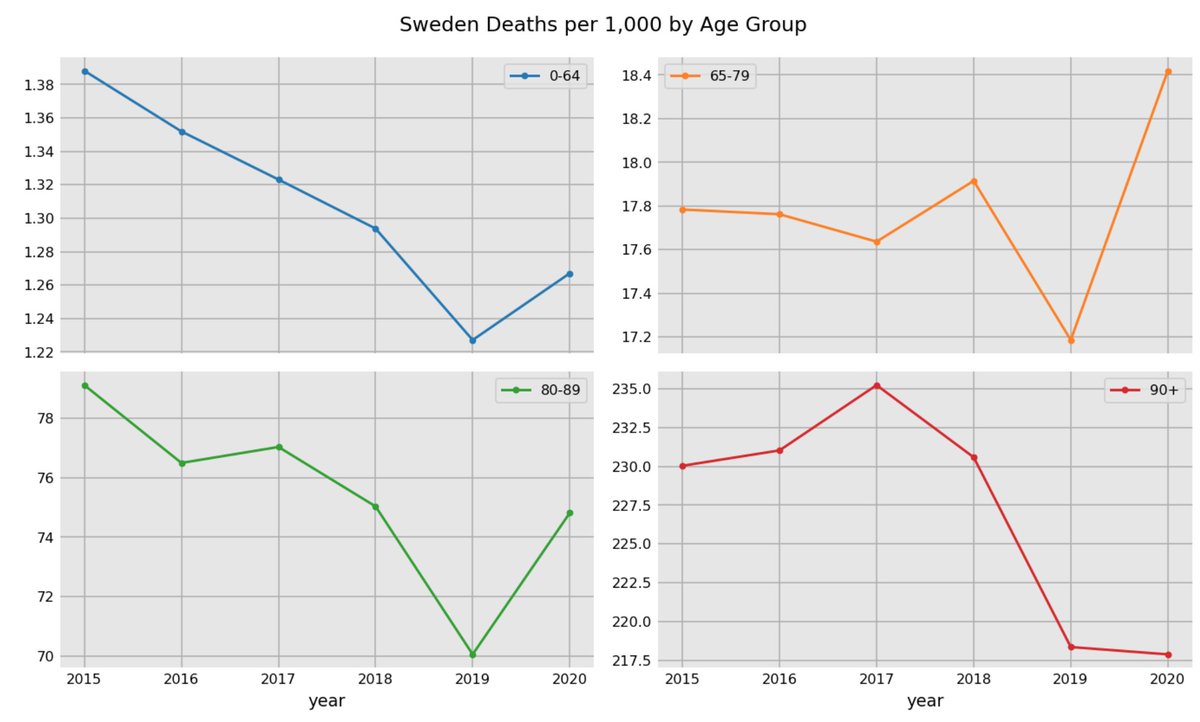
Overall death numbers are meaningless without stratifying by age. Below, we have mortality rates from 2015-2020 by age groups 0-64, 65-79, 80-89, and 90+. The 65-79 group fared worst with ~3% inc. over 2015-18 average.

Amazingly, the 90+ group had lower mortality in 2020.
All age groups can be plotted on the same graph, but must be standardized since the range of values is so large (1 for 0-64 vs 200 for 90+)

Here, mortality rates are shown relative to 2018.
The most interesting observation (imo) is the significant drop in mortality rate in 2019 in all age groups.

Around 60% of all deaths in Sweden come from the 80+ age group. When mortality rates dropped 5% in 2019, this left a much larger than normal 80+ pop alive in 2020.
This lead to a swelling of the 80+ population in 2020 by 6.6%. This was by far the biggest percentage increase in one age group over the 5 year period of data

Pop. Deaths
2018 - 522k 54k
2019 - 536k 52k
2020 - 572k 59k
Looking at the extremes, the 100+ population increased by nearly 50%, from 2200 to 3100. The probability of death for a random 100 year old is 35%. So, this very small subset of the population (.03%) will be responsible for ~1.2% of all deaths in Sweden.
With this huge increase in 80+ population and a slight decline in the 0-64 population, Sweden was primed for a large increase in total deaths in 2020.

Total Deaths
2018 - 92185
2019 - 88766
2020 - 97811 (slight downward adjustment for leap year)
In conclusion, Sweden's total deaths increased by 10%, but their mortality rate by age was very similar to the 2015-2018 average. A substantial drop in mortality rates in 2019, left a much larger elderly population alive in 2020.
All data sources are from Sweden's official statistics page - https://t.co/mcvpPWfcdK

I used the June 2020 population estimate by age group for the analysis.
I've issued a correction to this. 2020 population numbers were slightly inflated, bringing mortality rates down to around the average of 2011-2020 and not lower than 2015-2018 average.

https://t.co/veHH4luKkF

More from Finance

Ok here is the explanation. Grab a cup of coffee and read on. If you have not read/noticed this, you will see intraday options movement in a new light.


Say we have two options, one 50 delta ATM options and another 30 delta OTM option. Normally for a 100 point move, the ATM option will move 50 points and the OTM option will move 30 points. But in a high volatile environment, the OTM option will also move nearly 50 points

To understand why this happens, first understand why an ATM option is 50 delta. An ATM option has the probability of 50% of expiring as ITM. The price just has to close a rupee above the strike for the CE to be ITM and vice versa for PEs

Now think of a highly volatile day like today. If someone is asked where the BNF will close for the day or expiry, no one can answer. BNF can close freakin anywhere, That makes every option of an equal probability of being ITM. So all options have a 50% probability of being ITM

Hence, when a huge volatile move starts, all OTM options behave like ATM options. This phenomenon was first observed in the Black Monday crash of 1987 at Wall Street, which also gave rise to the volatility skew/smirk
** MEGA THREAD ON Cryptocurrencies/Blockchain**

I wanted to know the best resources to learn about cryptocurrencies and blockchain for someone with zero knowledge. I asked Twitter, and Twitter answered.

This thread is a compilation of the best resources I was recommended. 👇👇

Let's start with ** BOOKS **

The first thing you should do before you pick up any book:

Learn about Bitcoin & Ethereum by reading the respective whitepapers.

- [Bitcoin white paper](https://t.co/cErOaFn6QL) by Satoshi Nakamoto

- [Ethereum White paper] (
https://t.co/0g5kYCGJGq) by Vitalik Buterin

Even if you are not tech savvy, you can get a good grasp about how blockchain functions from these papers.

1) *The Basics of Bitcoins and Blockchains: An Introduction to Cryptocurrencies and the Technology that Powers Them* by Antony Lewis

This book covers topics such as the history of Bitcoin, the Bitcoin blockchain, and Bitcoin buying, selling, and mining.

It also answers how payments are made and how transactions are kept secure.

Other cryptocurrencies and cryptocurrency pricing are examined, answering how one puts a value on cryptocurrencies and digital tokens.

You May Also Like