Emergency: A dark chapter in the history of India.

(The Terrible Story Of An Actress Snehalatha Reddy Who Was Tortured Till Death).

On the night of 25th June 1975, the then Prime Minister Indira Gandhi declared the Emergency,

on the orders of Indira Gandhi, with the signing of President Fakhruddin Ali Ahmed, the Emergency was imposed on the country and suspended the fundamental rights of all citizens, which shook the nation's democratic foundations.

This emergency ended on 21 March 1977.
In 19 months, lakhs were imprisoned and tortured unnecessarily.

Thousands of column inches have been dedicated to articulating the horrors of Emergency, and the lessons it holds for future generations.
Among those who stood tallest at the time, but paid the ultimate price for her principled dissent, was writer, activist, producer and actress Snehalatha Reddy (1932– 20 January 1977)

She was known for her works in Kannada cinema,Kannada theatre and Telugu cinema, Telugu theatre
Married to poet, mathematician and director Pattabhi Rama Reddy, the couple were devoted socialists, dedicated to the cause of renowned activist and freedom fighter Dr Rammanohar Lohia.

Considering their affiliation to Lohia’s principles,both Sneha and Pattabhi spoke out against
the tyrannical Indira Gandhi regime and the proclamation of Emergency.

George Fernandes was then a young trade union leader and was at the forefront of the underground movement.

Actress Snehalatha Reddy whose fault was nothing. But it cost her dearly to befriend a politician
The actress was subjected to immense atrocities only because she was a friend of George Fernandes, whom the police were trying to nab during the Emergency.

Picked up by the police on May 2, 1976, she was booked under the draconian MISA (Maintenance of Internal Security Act).
She was arrested along with Fernandes in the Baroda Dynamite case, even though the final charge sheet did not contain her name. She was guilty by mere association.

At a time when all fundamental rights were suspended, She was held without trial for eight months in
Bangalore Central Jail, enduring regular torture and was subjected to inhumane conditions. Despite having chronic asthma she received irregular treatment and on two occasions even went into an asthmatic coma.

The atrocities against Snehalatha Reddy have been
mentioned in Kuldeep Nayyar’s Book “Emergency Retold”.

It is written in the book that when the actress was jailed,she was in a cell in which only one person could live. In that cell there was a hole in d corner at the place of the urinal and at the other end there was a wrought
iron door. She spent many nights sleeping on the floor during her imprisonment. For the entire 8 months, Snehlata was tortured endlessly in a fake case.

Atal Bihari Vajpayee and Lal Krishna Advani, who were lodged in a cell next to them in jail, later told that during their
imprisonment they could hear a woman screaming. It was later revealed that she was Kannada actress Snehalatha.

Despite the horrors of prison, never did Snehalatha let her spirit waver. She fought for prisoner rights, seeking an end to the horrible beatings women
inmates would suffer and improving the quality of food.

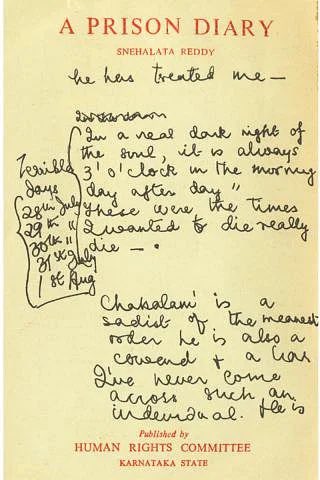
While in jail, Snehalatha Reddy had maintained a diary which was published by the Karnataka Human Rights Committee in 1977 in a compilation titled A Prison Diary.

Snehalatha writes:

“As soon as a woman comes in,
she is stripped naked in front of everyone else. When a human being is sentenced, he or she is punished enough. Must the human body be degraded and humiliated as well? Who is responsible for these perverse methods?”

(Source: The Concerned For Working Children, Nandana Reddy)
Her frail health worsened due to solitary confinement. She was eventually released on parole on January 15, 1977. Sadly, five days later (20 January 1977) she passed away as a result of chronic asthma and a debilitating lung infection. Not receiving regular medical treatment
for her condition, along with enduring all the physical hardships,had wrecked her health. She paid the ultimate price for her dissent—Death.
Source- https://t.co/dJqORzjAEe

More from Vशुद्धि

क्या आप जानते हैं हिंदी वर्णमाला का प्रत्येक अक्षर तार्किक है और सटीक गणना के साथ क्रमिक रूप से रखा गया है। इस तरह का वैज्ञानिक दृष्टिकोण अन्य विदेशी भाषाओं की वर्णमाला में शामिल नहीं है।

भारतीय भाषाओं की वर्णमाला विज्ञान से भरी हुई हैं।

#हिन्दीदिवसकीहार्दिकशुभकामनाएं


क ख ग घ ड़ – पांच के इस समूह को “कण्ठव्य” कंठवय कहा जाता है क्योंकि इस का उच्चारण करते समय कंठ से ध्वनि निकलती है।

च छ ज झ ञ – इन पाँचों को “तालव्य” तालु कहा जाता है क्योंकि इसका उच्चारण करते समय जीभ ऊपर तालू को छूती है

बोल के देखें


ट ठ ड ढ ण  – इन पांचों को “मूर्धन्य” मुर्धन्य कहा जाता है क्योंकि इसका उच्चारण करते समय जीभ मुर्धन्य (ऊपर उठी हुई) महसूस करेगी।

त थ द ध न – पांच के इस समूह को दन्तवय कहा जाता है क्योंकि यह उच्चारण करते समय जीभ दांतों को छूती है।

🙏🏻 स्वयं करके देखें


प फ ब भ म – पांच के इस समूह को कहा जाता है ओष्ठव्य क्योंकि दोनों होठ इस उच्चारण के लिए मिलते हैं।

दुनिया की किसी भी अन्य भाषा में ऐसा #वैज्ञानिक दृष्टिकोण नहीं है! निःसंदेह, हमें अपनी ऐसी भारतीय भाषा पर गर्व होना चहिए!

पाणिनि के व्याकरण में  महेश्वर सूत्र है  जो कि संख्या में 14 है ,कहा जाता है कि ये स्वर महादेव के डमरू से निकले हुए ध्वनि है जिसके आधार पर व्याकरण की रचना की गई और भाषा का विकास
ऋषि, मुनि, महर्षि, साधु और संत में क्या अंतर होता है?

भारत में प्राचीन काल से ही ऋषि-मुनियों का विशेष महत्व रहा है।आज से सैकड़ों साल पहले 'ऋषि', 'मुनि', 'महर्षि' और 'ब्रह्मर्षि' समाज के पथ प्रदर्शक माने जाते थे. तब यही लोग अपने ज्ञान और तप के बल पर समाज कल्याण का कार्य किया


करते थे और लोगों को समस्याओं से मुक्ति दिलाते थे। आज के समय में हमें कई तीर्थ स्थलों, मंदिरों, जंगलों और पहाड़ों में साधु-संत देखने को मिल जाते हैं. लेकिन वे ऋषि-मुनियों की तरह इतने ज्ञानी नहीं होते.

आइए जानते हैं ऋषि, मुनि, महर्षि, साधु और संत में क्या अंतर है

ऋषि :~

ऋषि शब्द की व्युत्पत्ति 'ऋष' है जिसका अर्थ 'देखना' या 'दर्शन शक्ति' होता है।

ऋषि अर्थात "दृष्टा" भारतीय परंपरा में श्रुति ग्रंथों को दर्शन करने (यानि यथावत समझ पाने) वाले जनों को कहा जाता है। वे व्यक्ति विशिष्ट जिन्होंने अपनी विलक्षण एकाग्रता के बल पर गहन ध्यान में


विलक्षण शब्दों के दर्शन किये उनके गूढ़ अर्थों को जाना व मानव अथवा प्राणी मात्र के कल्याण के लिये ध्यान में देखे गए शब्दों को लिखकर प्रकट किया। इसीलिये कहा गया -

“ऋषयो मन्त्र द्रष्टारः न तु कर्तारः।”

अर्थात् ऋषि तो मंत्र के देखनेवाले हैं नकि बनानेवाले

अर्थात् बनानेवाला तो केवल एक परमात्मा ही है

मुनि :~

मुनि वह है जो मनन करे, भगवद्गीता में कहा है कि जिनका चित्त दु:ख से उद्विग्न नहीं होता, जो सुख की इच्छा नहीं करते और जो राग, भय और क्रोध से रहित हैं, ऐसे निश्चल बुद्धिवाले मुनि कहे जाते हैं। वैदिक ऋषि जंगल के कंदमूल खाकर जीवन

You May Also Like

Recently, the @CNIL issued a decision regarding the GDPR compliance of an unknown French adtech company named "Vectaury". It may seem like small fry, but the decision has potential wide-ranging impacts for Google, the IAB framework, and today's adtech. It's thread time! 👇

It's all in French, but if you're up for it you can read:
• Their blog post (lacks the most interesting details):
https://t.co/PHkDcOT1hy
• Their high-level legal decision: https://t.co/hwpiEvjodt
• The full notification: https://t.co/QQB7rfynha

I've read it so you needn't!

Vectaury was collecting geolocation data in order to create profiles (eg. people who often go to this or that type of shop) so as to power ad targeting. They operate through embedded SDKs and ad bidding, making them invisible to users.

The @CNIL notes that profiling based off of geolocation presents particular risks since it reveals people's movements and habits. As risky, the processing requires consent — this will be the heart of their assessment.

Interesting point: they justify the decision in part because of how many people COULD be targeted in this way (rather than how many have — though they note that too). Because it's on a phone, and many have phones, it is considered large-scale processing no matter what.
My top 10 tweets of the year

A thread 👇

https://t.co/xj4js6shhy


https://t.co/b81zoW6u1d


https://t.co/1147it02zs


https://t.co/A7XCU5fC2m